AI RFP Software for Project Teams: 2026 Guide
Discover how AI RFP software can cut proposal drafting time by 60%. Explore benefits and find the right tool for your project team in 2026.

AI RFP software is defined as a category of generative AI tools that automate the creation, drafting, and scoring of request-for-proposal documents. These platforms pull from organizational knowledge bases, past winning proposals, and compliance requirements to produce accurate draft responses in hours rather than days. Generative AI drafting reduces proposal writing time by 40–60% in documented case studies. That productivity gain alone explains why mid-to-large project teams are replacing manual workflows with AI-powered RFP automation tools at a rapid pace. The industry term for this category is "AI-assisted proposal automation," and understanding how it differs from legacy tools is the first step toward choosing the right platform.
What is AI RFP software and how does it work?
AI RFP software operates on a fundamentally different architecture than traditional document editors or template libraries. The core engine is generative AI, trained on your organization's historical proposals, compliance documents, and product data. When a new RFP arrives, the system reads the entire document at once and begins mapping each question to relevant content from your knowledge base.
The most significant shift in modern platforms is the rise of AI-agent architecture. Unlike older tools that process one question at a time, AI agents handle the full RFP simultaneously. They map questions to evaluation criteria, generate draft responses, and flag compliance gaps before a human reviewer ever opens the document. That compression of the review cycle moves response timelines from days to hours.
Key features found across leading rfp automation software platforms include:
- Generative AI drafting: Pulls from past wins and internal knowledge bases to produce first-draft responses automatically.
- Compliance gap identification: Flags sections where your draft fails to address mandatory requirements or regulatory language.
- AI proposal scoring: Evaluates each response against evaluation criteria and flags unsupported claims before submission.
- Knowledge base integration: Connects to content management systems, CRMs, and collaboration platforms to keep proposal content current.
- Collaboration workflows: Allows subject matter experts to review, edit, and approve sections in real time without email chains.
Integration depth matters as much as AI quality. The best rfp ai tools connect directly to platforms like SharePoint, Salesforce, and Slack, so proposal teams work inside tools they already use. Disconnected systems create version control problems that erase the time savings AI drafting provides.
Pro Tip: Test any AI drafting tool on a real RFP section from your industry before committing. Generic demos use clean, simple content. Your actual RFPs contain technical jargon, regulatory language, and multi-part questions that expose the real quality gap between platforms.
What types of AI RFP platforms exist?
Three distinct platform categories serve different organizational profiles. Choosing the wrong tier is the biggest buyer mistake in this market. Each category targets a specific combination of team maturity, data quality, and compliance demand.
| Platform tier | Best fit | Key strength | Key limitation |
|---|---|---|---|
| AI-native challengers | Agile teams, clean data | Fast onboarding, high draft quality | Limited legacy integrations |
| Established leaders | Mid-to-large B2B teams | Deep integrations, proven workflows | Slower to adopt new AI features |
| Legacy enterprise tools | Regulated industries | Complex workflow support | AI is retrofitted, not native |
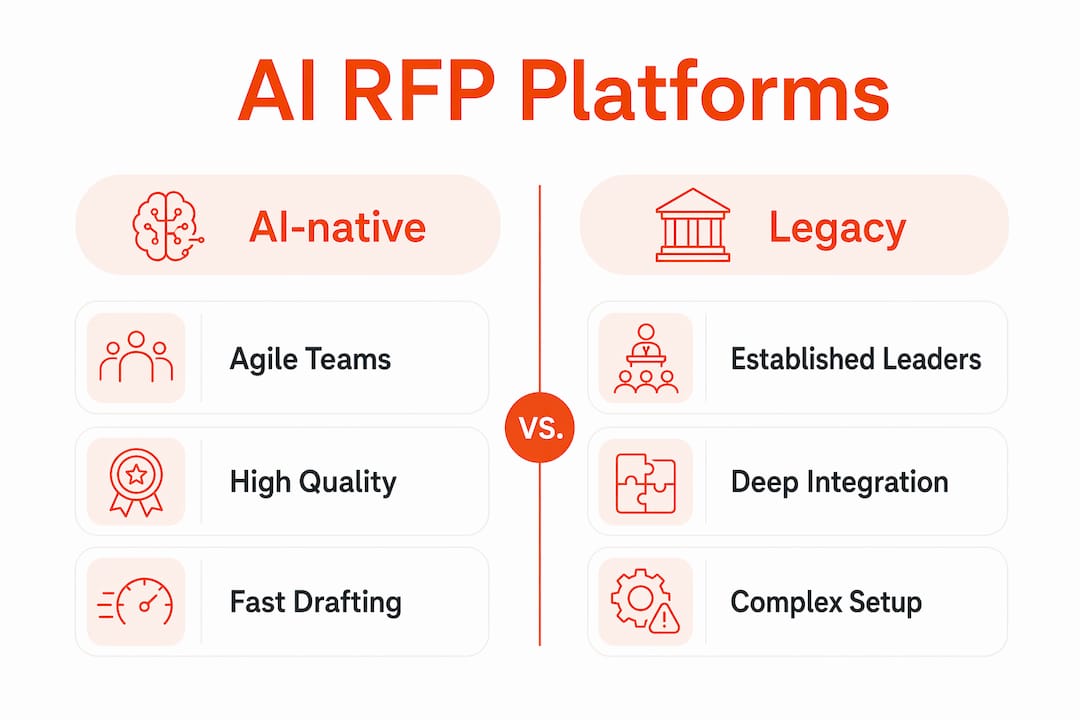
AI-native platforms build around generative AI from inception. They deliver better drafting quality, particularly for technical and regulatory RFP sections, because the AI is not an add-on. Legacy enterprise tools retrofit AI on top of older architectures, which limits how deeply the AI can interact with document structure and compliance logic.
Mid-to-large B2B teams with mature proposal operations benefit most from established leaders because integration depth with ERP and CRM systems reduces manual data entry. Agile teams with clean, well-organized content libraries get faster results from AI-native challengers, where onboarding takes days rather than months.

The regulated environment scenario deserves special attention. Government contractors, healthcare vendors, and financial services firms face strict compliance requirements that generic AI drafting can miss. For these teams, AI proposal scoring features that check responses against regulatory criteria before submission are not optional. They are the primary reason to invest in rfp ai software at all.
Pro Tip: Ignore feature lists built around buzzwords. Ask vendors to show you their compliance gap detection on a real regulatory RFP from your sector. That single test reveals more than any demo script.
How do you implement AI RFP software effectively?
Implementation quality determines whether a team captures the full productivity benefit or ends up with an expensive tool that nobody uses. The process follows a predictable sequence, and skipping steps creates compounding problems later.
- Audit your content library first. AI drafting quality depends entirely on the quality of your historical proposals and knowledge base. Remove outdated content, tag documents by topic and win/loss status, and resolve conflicting information before the AI ingests anything.
- Run a structured pilot. Select one active RFP and run the AI drafting tool in parallel with your normal process. Compare output quality, time spent, and compliance coverage. This gives you real performance data before full deployment.
- Train the team on review, not drafting. The human role shifts from writing first drafts to reviewing and refining AI output. That shift requires training on how to evaluate AI-generated content critically, not just accept it.
- Set up integration connections early. Connect the platform to your CRM, document management system, and collaboration tools in week one. Waiting until after launch creates adoption friction that is hard to reverse.
- Establish a continuous improvement loop. Feed win/loss data back into the knowledge base regularly. AI-native platforms auto-extract and structure knowledge from new documents within minutes to hours, but they need accurate outcome data to improve draft quality over time.
The most common implementation failure is skipping the content audit. Teams that load disorganized, outdated, or contradictory documents into an AI platform get disorganized, outdated, and contradictory drafts. The AI amplifies what it finds. Garbage in, garbage out applies here more than anywhere else in enterprise software.
Measuring ROI requires tracking three metrics from day one: average response time per RFP, proposal team hours per submission, and win rate by proposal type. Without baseline data, teams cannot demonstrate the value of their investment to leadership.
What trends are shaping AI for RFPs in 2026?
The rfp automation tools market is moving fast. Several developments are changing what teams can realistically expect from AI-assisted proposal automation this year.
- AI-agent architecture is now the standard. The shift from question-by-question processing to full-document simultaneous analysis has compressed response cycles from days to hours. Teams that have not yet adopted agent-based platforms are operating at a structural disadvantage.
- Proposal scoring is becoming table stakes. AI proposal scoring that evaluates responses against evaluation criteria and flags compliance risks before submission is now expected in enterprise-grade platforms. It directly improves win rates in regulated procurement.
- Dynamic proposal customization is emerging. Leading platforms now adjust tone, technical depth, and emphasis based on the buyer profile embedded in the RFP. This goes beyond template selection and into real-time content adaptation.
- Multilingual support is expanding. Global procurement teams increasingly require RFP responses in multiple languages. AI-native platforms are adding multilingual drafting that maintains technical accuracy across languages, not just basic translation.
- Sourcing platform integration is growing. AI-driven eAuctions within sourcing software deliver 10–20% cost savings compared to manual RFQ processes. RFP platforms that connect to sourcing and supplier management systems create end-to-end procurement automation.
The common thread across all these trends is that AI is moving from a drafting assistant to a full proposal management engine. Teams that treat it as a spell-checker with extra features will miss the structural efficiency gains that early adopters are already capturing.
Key Takeaways
AI RFP software delivers its greatest value when teams align platform choice with their data quality, team maturity, and compliance requirements.
| Point | Details |
|---|---|
| Generative AI cuts drafting time | AI drafting reduces proposal writing time by 40–60%, shifting team effort from writing to reviewing. |
| Platform tier must match team profile | AI-native challengers suit agile teams; established leaders fit mid-to-large B2B with complex integrations. |
| Content library quality drives output | Auditing and organizing historical proposals before implementation determines AI draft quality. |
| AI proposal scoring improves win rates | Pre-submission compliance checks flag unsupported claims and regulatory gaps before reviewers see the document. |
| Agent architecture compresses timelines | Full-document simultaneous processing moves RFP response cycles from days to hours. |
Why I think most teams pick the wrong AI RFP tool
After watching organizations evaluate and implement proposal automation platforms, the pattern is consistent. Teams get excited about AI features in a demo, skip the hard questions about data readiness, and then wonder why their win rate did not improve after six months.
The real differentiator between platforms is not the AI model. It is how the platform handles your specific content, your compliance requirements, and your team's actual workflow. An AI-native platform with a clean knowledge base will outperform a legacy tool with a bolted-on AI layer every time, even if the legacy tool has a longer feature list.
I have also seen teams underestimate the value of AI-assisted RFP creation for reclaiming proposal team time. When subject matter experts spend 60% of their week writing first drafts, they have no capacity for strategy, client research, or win theme development. AI drafting gives that time back. The teams that use it well do not just respond faster. They respond smarter.
The advice I give consistently: pilot on a real RFP, not a demo scenario. Run the AI tool on a live submission with actual stakes. That test reveals integration gaps, content library weaknesses, and team readiness issues that no vendor presentation will show you.
— Cody
Swarm-stack brings AI and human expertise together for RFPs
Swarm-stack takes a different approach to AI-assisted proposal work. Rather than replacing human judgment with automated drafts, it combines multiple AI specialists and human experts in structured real-time sessions. Teams build detailed RFPs and project plans where every angle gets argued before the final document takes shape.
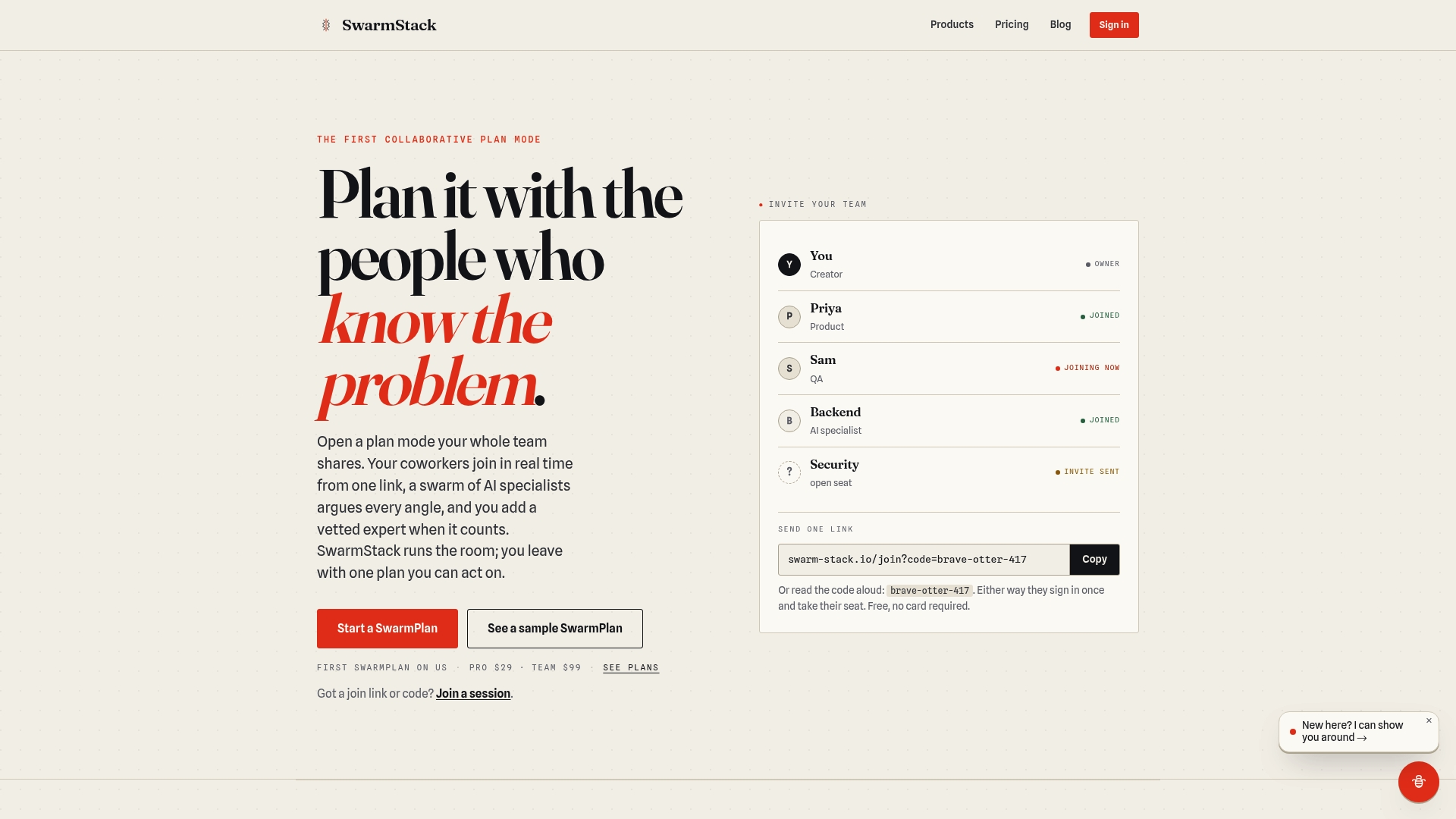
The result is a proposal that reflects genuine organizational thinking, not just pattern-matched content from a knowledge base. Swarm-stack's data privacy architecture keeps sensitive proposal content secure throughout the collaboration process. Teams join via a single link, contribute in real time, and leave with a well-defined deliverable ready to submit. For teams that want AI speed without sacrificing human oversight, Swarm-stack is worth a close look.
FAQ
What is AI RFP software?
AI RFP software is a category of generative AI tools that automate the drafting, scoring, and compliance review of request-for-proposal documents. These platforms use organizational knowledge bases and past proposals to produce accurate draft responses significantly faster than manual methods.
How much time does AI RFP software save?
Generative AI drafting reduces proposal writing time by 40–60% in documented case studies. That time savings shifts proposal teams from writing first drafts to reviewing and refining AI-generated content.
What is AI-agent architecture in RFP tools?
AI-agent architecture processes an entire RFP document simultaneously rather than one question at a time. It maps questions to evaluation criteria, generates responses, and flags compliance gaps before human review, compressing response timelines from days to hours.
How do I choose between AI-native and legacy RFP platforms?
The choice depends on your team's data quality and integration needs. Agile teams with clean data benefit from AI-native challengers, while mid-to-large B2B teams with complex workflows get more value from established leaders with deeper integrations.
Does AI RFP software work for regulated industries?
AI proposal scoring features evaluate responses against regulatory criteria and flag compliance risks before submission. This pre-submission quality check makes AI RFP tools particularly valuable for government contractors, healthcare vendors, and financial services firms.