Pre Qualification Construction: A Project Manager's Guide
Discover the importance of pre qualification construction for project managers. Learn how to evaluate contractors to avoid future risks.

Contractor prequalification is the systematic evaluation of a firm's financial capacity, safety record, technical experience, and regulatory compliance before that firm is allowed to bid on a construction project. Project managers who skip this step routinely inherit problems that were entirely predictable: undercapitalized contractors, lapsed insurance, and safety records that signal future incidents. The construction prequalification process exists to filter those risks out before a contract is signed, not after a delay or injury forces the issue.
What does pre qualification construction actually evaluate?
The City of Calgary's prime contractor list captures the core logic well: contractors must meet minimum standards across commercial, safety, environmental, and technical categories before they can work on municipal projects. That four-part framework maps almost exactly to what rigorous prequalification programs assess everywhere.
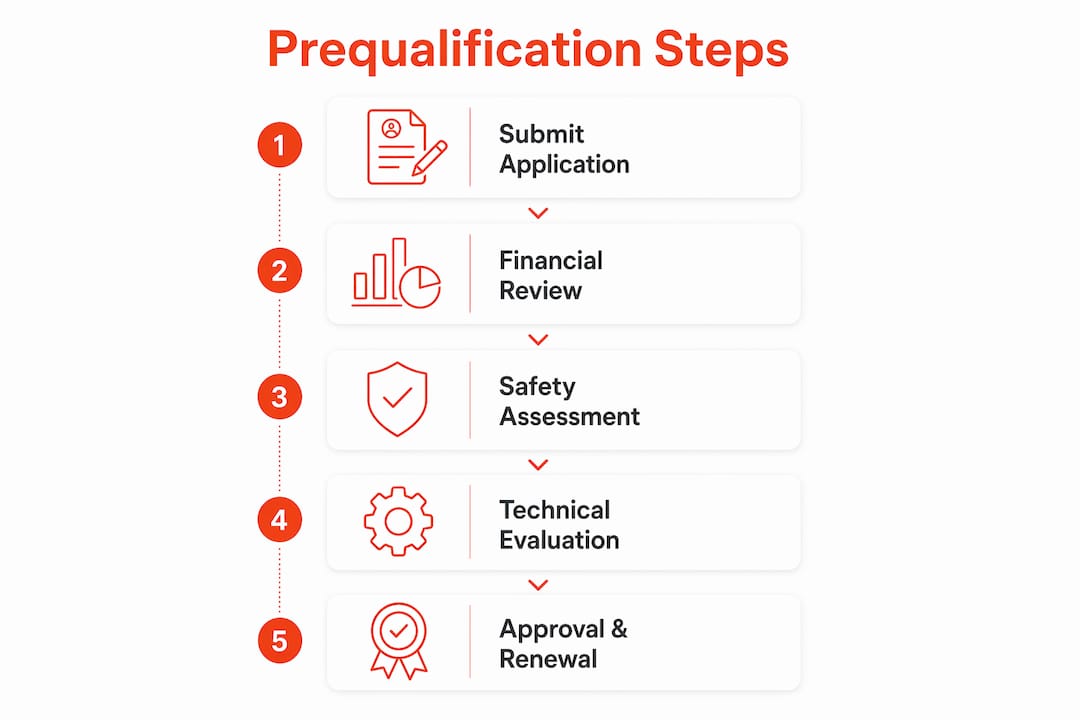
The standard contractor prequalification criteria cover five areas:
- Financial capacity. Audited financial statements, working capital ratios, and bonding capacity tell you whether a contractor can actually fund the work through completion. A firm that runs out of cash at 60% completion is more expensive than a higher bid from a solvent contractor.
- Safety performance. Experience Modification Rate (EMR) scores, OSHA recordable incident rates, and safety program documentation are the primary metrics. An EMR above 1.0 signals above-average claims history and warrants scrutiny.
- Technical experience. Project portfolios, references, and key personnel credentials confirm the contractor has done comparable work. Scope, scale, and complexity all matter here.
- Licensing, insurance, and bonding. These are binary requirements. A contractor without current general liability coverage or the required state license is ineligible, full stop.
- Quality and environmental management systems. ISO 9001 certification or documented quality control plans show that a contractor manages work systematically rather than reactively.
Pro Tip: Request three to five references from projects completed within the last two years, not the last decade. A contractor's current operational capacity matters more than historical peak performance.
How do prequalification requirements differ by jurisdiction and sector?

Construction contractor qualifications are not universal. The standards, categories, and renewal cycles vary significantly by country, state, and project type. Project managers working across geographies need to understand these differences before they design a prequalification program.
| Jurisdiction / System | Key Standard | Renewal Cycle | Notable Feature |
|---|---|---|---|
| U.S. DOT / State Public Works | State-specific prequalification ratings | Annual | Ratings cap maximum bid value |
| United Kingdom (post-April 2023) | Common Assessment Standard (CAS) | Varies by certifier | Replaced PAS 91; covers 13 risk areas |
| Australia (Austroads NPS) | R1–R5 roads, B1–B4 bridges, F0.25–F150 PLUS financial levels | Three-year renewal | Mandatory for projects above $250,000 |
| Private sector (general) | Client-defined | Project-by-project | Fewer mandated categories; more negotiable |
The U.S. DOT model
State DOT prequalification ratings directly control how large a contract a firm can bid on. Annual renewals require updated audited financials, current insurance certificates, and a refreshed safety record. A rating recalculation can shrink a contractor's maximum bid size overnight if their financials weaken. That makes DOT prequalification a continuous financial discipline, not a one-time application.
The UK shift from PAS 91 to CAS
The British Standards Institution withdrew PAS 91 in april 2023. CAS now covers 13 risk areas, expanding well beyond the original five modules to include identity verification, anti-bribery, modern slavery, and equality criteria. SSIP certification still covers core health and safety, but SSIP alone does not satisfy the financial and environmental modules that CAS requires. UK project managers now need to confirm which specific modules a contractor has completed, not just whether they hold any certification.
Australia's Austroads system
The Austroads National Prequalification System uses technical categories (R1 through R5 for roads, B1 through B4 for bridges) combined with financial levels. Assessments are free, and the three-year renewal cycle gives contractors a longer runway than the U.S. annual model. Projects above $250,000 require mandatory certification, which means smaller contractors bidding on mid-size public works must plan their prequalification timeline well in advance.
What are the best practices for running an effective prequalification program?
A well-designed construction project qualification program does not rely on judgment calls. It converts eligibility into a documented, repeatable decision. These steps build that kind of program.
- Standardize your questionnaire. Consistent evidence requests converted into repeatable gates make prequalification defensible. When every contractor answers the same questions and submits the same document types, you can compare them objectively and defend your decisions if challenged.
- Use a two-stage submission process. A technical or eligibility envelope is reviewed first. Only contractors who pass proceed to the pricing stage. This two-envelope model prevents your team from wasting time evaluating bids from firms that were never eligible.
- Track document expiry dates actively. Insurance certificates, bonding, and financial statements all expire. Lapses in documentation can remove a contractor from your eligible list until they requalify. Build calendar alerts or use a compliance tracking system so renewals never catch you off guard mid-project.
- Align your categories with the procurer's system. In Australia's Austroads framework, category mismatches cause delays and eligibility problems. Confirm that the contractor's prequalification category matches the specific work type and financial threshold of your project before you open bidding.
- Use RFP response software to manage submissions. Digital portals reduce manual data entry errors, create audit trails, and allow contractors to update documents without resubmitting entire packages.
Pro Tip: Build a prequalification renewal calendar at the start of every project. Set 60-day and 30-day alerts before any contractor's insurance, bonding, or financial documents expire. A lapsed certificate discovered on the day work is scheduled to start creates real delays.
What benefits does rigorous prequalification deliver to your project?
The importance of prequalification in construction goes beyond compliance. A well-run program produces measurable improvements across the entire project lifecycle.
- Fewer cost overruns. Contractors with proven financial stability and relevant experience are far less likely to run short on cash or underestimate scope. Both failures drive change orders and delays.
- Reduced safety incidents. Screening for EMR rates and documented safety programs filters out contractors with poor track records before they set foot on site.
- Faster procurement. A pre-approved contractor pool means you are not starting from scratch on every project. Repeat prequalification for known contractors is faster and cheaper than full evaluations each time.
- Audit readiness. Documented eligibility decisions protect you in disputes or regulatory reviews. A paper trail showing why each contractor was selected is far more defensible than a verbal explanation.
- A stronger contractor pipeline. Over time, a prequalification program builds a pool of vetted firms you can call on repeatedly, which reduces procurement risk on future projects.
Prequalification does not just protect the current project. It builds institutional knowledge about which contractors perform and which ones create problems, and that knowledge compounds in value with every project you complete.
Why I think most teams treat prequalification as a checkbox
I have watched project managers spend weeks negotiating contract terms and then spend two hours on prequalification. That ratio is backwards. The contract governs what happens when things go wrong. Prequalification determines whether things go wrong in the first place.
The most common mistake I see is treating prequalification as a one-time gate rather than a living compliance program. A contractor who was financially sound at bid time can deteriorate significantly by the time mobilization begins. Annual renewals exist for a reason. The teams that skip interim checks are the ones who discover mid-project that their general contractor's bonding lapsed three months ago.
The shift from PAS 91 to CAS in the UK is a good example of how standards evolve faster than most teams realize. Plenty of project managers I have spoken with still reference PAS 91 as the benchmark, not knowing it was withdrawn in april 2023. Staying current with the standard your jurisdiction actually uses is not optional. It is the difference between a prequalification program that holds up under scrutiny and one that creates liability.
The other underrated factor is category alignment. In the Austroads system, a contractor prequalified at the R3 road category cannot simply bid on an R5 project. Misaligned categories are one of the most common reasons bids get rejected after significant effort from both sides. Catching that mismatch before the tender closes saves everyone time.
Software helps, but it does not replace judgment. The best prequalification programs I have seen combine standardized digital workflows with a human review step for borderline cases. Automation handles the routine document checks. Experienced reviewers handle the exceptions.
— Cody
How Swarm-stack supports your prequalification workflows
Managing prequalification documentation across multiple contractors and renewal cycles is genuinely complex work. Swarm-stack brings AI-driven collaboration and structured workflows to exactly this kind of process, helping teams collect, review, and track contractor submissions without the usual back-and-forth.

With Swarm-stack, your team can run structured prequalification sessions that pull in input from multiple reviewers simultaneously, reducing the time it takes to reach a documented eligibility decision. The platform's real-time collaboration model means your procurement team, legal team, and safety officers can all contribute to a single review without version-control chaos. Visit Swarm-stack to see how AI-augmented workflows can make your contractor selection process faster and more defensible.
Key Takeaways
A rigorous prequalification program is the single most effective way to reduce contractor-related risk before a project begins.
| Point | Details |
|---|---|
| Prequalification screens before bidding | Evaluate financial capacity, safety records, licensing, and experience before contractors enter the bid pool. |
| Standards vary by jurisdiction | U.S. DOT, UK CAS, and Australia's Austroads system each have distinct categories, renewal cycles, and documentation requirements. |
| Treat it as a living program | Document expiry and renewal lapses can remove contractors from eligible lists mid-project; active tracking prevents this. |
| Standardize your process | Repeatable questionnaires and two-stage submissions convert subjective vetting into defensible, documented decisions. |
| Prequalification builds long-term value | A vetted contractor pool reduces procurement effort and risk on every future project, not just the current one. |
Perspective
Why prequalification deserves more than two hours of your time
I have watched project managers spend weeks negotiating contract terms and then spend two hours on prequalification. That ratio is backwards. The contract governs what happens when things go wrong. Prequalification determines whether things go wrong in the first place.
The most common mistake I see is treating prequalification as a one-time gate rather than a living compliance program. A contractor who was financially sound at bid time can deteriorate significantly by the time mobilization begins. Annual renewals exist for a reason. The teams that skip interim checks are the ones who discover mid-project that their general contractor's bonding lapsed three months ago.
The shift from PAS 91 to CAS in the UK is a good example of how standards evolve faster than most teams realize. Plenty of project managers I have spoken with still reference PAS 91 as the benchmark, not knowing it was withdrawn in april 2023. Staying current with the standard your jurisdiction actually uses is not optional. It is the difference between a prequalification program that holds up under scrutiny and one that creates liability.
The other underrated factor is category alignment. In the Austroads system, a contractor prequalified at the R3 road category cannot simply bid on an R5 project. Misaligned categories are one of the most common reasons bids get rejected after significant effort from both sides. Catching that mismatch before the tender closes saves everyone time.
Software helps, but it does not replace judgment. The best prequalification programs I have seen combine standardized digital workflows with a human review step for borderline cases. Automation handles the routine document checks. Experienced reviewers handle the exceptions.
— Cody
FAQ
What is contractor prequalification in construction?
Contractor prequalification is the process of evaluating a firm's financial stability, safety record, technical experience, and regulatory compliance before allowing them to bid on a project. It filters out unqualified firms before procurement resources are spent on their bids.
What documents are typically needed for prequalification?
Standard prequalification documents include audited financial statements, current insurance certificates, bonding documentation, OSHA safety records including EMR rates, relevant project references, and applicable licenses. Public works agencies such as state DOTs also require annual updates to maintain active eligibility.
How does the UK Common Assessment Standard differ from SSIP?
SSIP covers core health and safety assessment and is recognized across member organizations. CAS expands to 13 risk areas including financial standing, environmental management, anti-bribery, and modern slavery, making it a more complete prequalification standard for UK construction procurement.
How often does prequalification need to be renewed?
Renewal cycles vary by system. U.S. DOT prequalification requires annual renewal with updated financials and insurance. Australia's Austroads system uses a three-year renewal cycle. UK CAS renewal timing depends on the certifying body. Private sector programs set their own schedules.
Why does prequalification reduce project risk?
Prequalification removes contractors with weak finances, poor safety records, or missing credentials before work begins. That early screening directly reduces the probability of cost overruns, safety incidents, and mid-project contractor failures that are far more expensive to resolve than the time spent on upfront evaluation.