Argument Mapping: A Practical Guide for Clear Thinking
Unlock clear thinking with argument mapping. Learn to visualize complex arguments, making analysis and decision-making easier.

An argument map is a visual diagram that shows the logical structure of an argument using boxes and arrows. Unlike a mind map, which links ideas by association, an argument map traces inferential relationships: which claims support which conclusions, where objections arise, and what evidence backs each premise. Use one when you need to teach critical thinking, analyze a complex policy debate, build a rationale for an RFP, or align a team on a decision before committing resources.
Core elements you will encounter in every map:
- Contention/conclusion — the central claim the argument is trying to establish
- Premises — the reasons offered in support of the contention
- Co-premises — dependent premises that must jointly work together to support a conclusion
- Sub-conclusions/intermediate conclusions — claims that are both supported by premises and themselves support the main contention
- Objections — counter-claims that challenge a premise or the contention directly
- Rebuttals — responses that answer objections
- Basis/evidence boxes — externally verifiable facts, data, or citations that ground a premise
The University of Saskatchewan's critical thinking tutorial and Federation University's argument map help sheet both place the contention at the top, with reasons and rebuttals branching below, and evidence boxes attached to individual premises.
Key Takeaways
Argument mapping is most effective when you start with the logical skeleton, keep premises as single testable claims, and version the map as the reasoning evolves.
| Point | Details |
|---|---|
| Start with the skeleton | Map the contention and direct premises before adding evidence or objections to avoid over-complication. |
| Keep premises atomic | Each premise should express one testable idea; split any premise that contains two independent claims. |
| Choose tools by context | Paper suits quick solo analysis; collaborative platforms with versioning suit legal, policy, or procurement work. |
| Watch for false precision | A well-drawn map does not validate weak premises — always assess evidence quality separately from map structure. |
| Swarm-stack for teams | Swarm-stack converts mapping sessions into versioned, exportable deliverables with traceable decision logs. |
Table of Contents
- What does an argument map actually contain?
- How to create an argument map step by step
- Argument map examples: simple and complex
- Which tools work best for argument mapping?
- Where argument mapping actually helps
- Limitations and common pitfalls
- Standards and best practices for notation
- Running argument mapping sessions with your team
- Why argument mapping is more useful than it looks
- Swarm-stack makes team argument mapping production-ready
- Sources
What does an argument map actually contain?
The components listed above are not just labels. Each one plays a distinct structural role, and knowing the difference between them is what separates a useful map from a cluttered diagram.
Premises and co-premises. An independent premise supports the conclusion on its own; if you remove it, the conclusion still has other support. A co-premise (also called a linked or dependent premise) only works in combination with at least one other premise. If you remove one co-premise, the inference collapses. Visually, co-premises are typically bracketed or joined by a horizontal bar before the inference arrow drops to the conclusion.
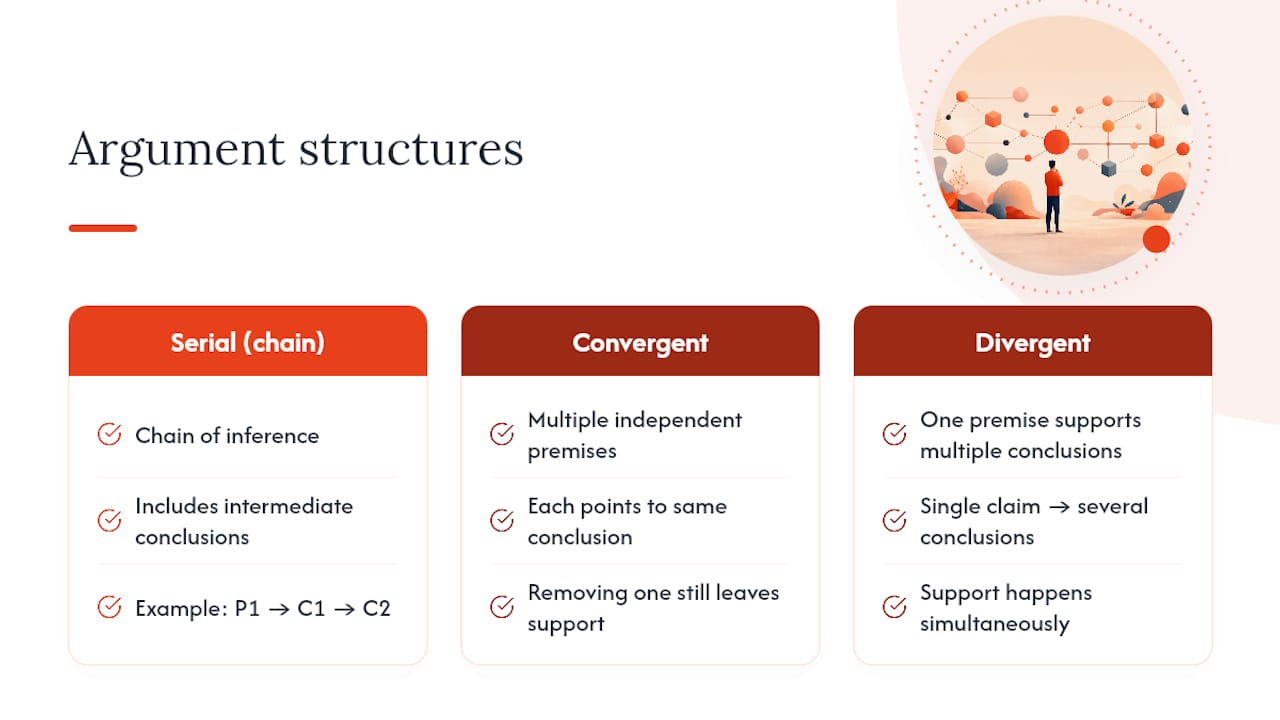
Intermediate conclusions. These are claims that sit in the middle of a chain. They are supported by premises below them and, in turn, support the main contention above. A serial (chain) argument is the simplest version: P1 supports C1, which supports C2. A convergent argument has multiple independent premises each pointing separately to the same conclusion. A divergent argument has one premise supporting multiple conclusions simultaneously.
Objections and rebuttals. Objections typically connect to a premise or to the contention with a dotted or differently colored arrow to signal that they challenge rather than support. A rebuttal then connects to the objection, countering it. This notation convention, recommended in HKU's argument mapping tutorial, keeps the map readable without conflating support and opposition.
Notation options. The most common format is box-and-arrow with the contention at the top. Some traditions use numbered nodes (P1, P2, C1) so that written analysis can cross-reference the diagram. Color coding helps: green or blue for supporting claims, red or orange for objections, gray for evidence boxes. Left-to-right layouts work well on wide screens; top-down layouts print more cleanly.
Pro Tip: Build the logical skeleton first — contention plus its direct premises — before adding evidence boxes or objections. A skeleton that already looks tangled is a signal to split the contention, not to add more nodes.
How to create an argument map step by step
The process below works whether you are mapping a published editorial, a policy brief, or a live team discussion.
- Read the source text once for comprehension. Do not highlight yet. Get the overall shape of the argument in your head.
- Identify the main contention. Ask: what is the author ultimately trying to convince you of? Write it as a single, self-contained declarative sentence and place it at the top of your map.
- List the direct reasons. What does the author give as reasons for that contention? Write each as its own sentence. These are your candidate premises.
- Check for dependency. Do any two premises only make sense together? If yes, mark them as co-premises. If each stands alone, treat them as independent (convergent) supports.
- Look for intermediate conclusions. If a reason is itself argued for, it is a sub-conclusion. Draw it as a node between its supporting premises and the main contention.
- Add objections and rebuttals. Note any counter-arguments the text raises (or that you can identify). Connect them with a distinct arrow style.
- Attach evidence boxes. For each empirical premise, add a basis box with the source citation. This is what makes the map auditable.
- Review granularity. A premise that contains two separate ideas should be split. A premise that is obvious and uncontested can stay implicit, but mark it as an assumption so reviewers know it is there.
Granularity checklist before you finalize:
- Every premise is a single, testable claim
- Co-premises are explicitly bracketed
- Assumptions (hidden premises) are labeled, not silently omitted
- Each evidence box names a source
- The map can be read top-to-bottom without consulting the original text
Pro Tip: When mapping collaboratively, assign one person to challenge every premise with "why should I accept this?" before the session ends. That single question surfaces more hidden assumptions than any checklist.
The HKU tutorial recommends working through short passages first, then progressively longer ones, because the skill of isolating claims from rhetorical filler is itself a learned competency. Argument-mapping software accelerates that learning by removing the drawing overhead, letting you focus on the logic rather than the layout.
Argument map examples: simple and complex
Example A: a simple map
Source text: "Remote work should be a permanent option for office employees.
Map structure:
- Contention: Remote work should be a permanent option for office employees.
- Premise 1 (independent): Productivity does not decline for most remote workers.
- Evidence box: [cite relevant study]
- Premise 2 (independent): Employees report higher job satisfaction when working remotely.
- Evidence box: [cite survey source]
- Premise 1 (independent): Productivity does not decline for most remote workers.
Reading this map takes about ten seconds. The two premises are independent: either one gives partial support to the contention even if the other were false. The evidence boxes signal where a skeptic should look first.
Example B: a complex multi-tier map
Source text: "Cities should ban single-use plastics. Plastic waste harms marine ecosystems because it breaks into microplastics that enter the food chain. This public health risk justifies regulatory intervention. Critics argue bans hurt low-income consumers, but reusable alternatives are now affordable enough to offset that concern."
Map structure:
- Contention: Cities should ban single-use plastics.
- Sub-conclusion (C1): Plastic waste creates a public health risk.
- Premise 1: Plastic breaks into microplastics that enter the food chain.
- Evidence box: [marine biology source]
- Premise 2: Microplastic ingestion poses documented health risks.
- Evidence box: [epidemiology source]
- Premise 1: Plastic breaks into microplastics that enter the food chain.
- Premise 3 (independent): Public health risks justify regulatory intervention.
- Objection: Bans disproportionately burden low-income consumers.
- Rebuttal: Reusable alternatives are now affordable enough to offset that burden.
- Evidence box: [cost comparison source]
- Rebuttal: Reusable alternatives are now affordable enough to offset that burden.
- Sub-conclusion (C1): Plastic waste creates a public health risk.
How to read a map quickly. Start at the contention. Trace each direct premise. For each one, ask: is the inference from premise to conclusion valid? Then check the evidence boxes. The weakest link is usually the premise with no evidence box or the co-premise pair where one member is an unstated assumption.
Quality checklist for any map:
- Contention is unambiguous and falsifiable
- No premise doubles as the conclusion (circular reasoning)
- Objections are represented fairly, not as strawmen
- Every empirical claim has a traceable evidence box
- Intermediate conclusions are genuinely necessary, not decorative
Pro Tip: After drawing a complex map, cover the contention and ask a colleague to read only the premises and guess the conclusion. If they cannot, your premises are not doing enough inferential work.
Which tools work best for argument mapping?
The right tool depends on your context: a solo student, a classroom of twenty, or a cross-functional team working on a procurement decision each has different needs.
Tool categories:
- Paper and whiteboard. Fast to start, zero learning curve, and ideal for a first-pass skeleton. The downside is that revisions are messy and sharing requires a photo.
- Generic diagramming tools (Figma, draw.io, Miro). Flexible and familiar to most teams. They lack argument-specific templates, so you build notation conventions yourself.
- Dedicated argument-mapping software. Tools built specifically for this purpose include structured templates, premise-typing, and sometimes automated feedback. The empirical review at ReasoningLab notes that software adoption accelerated because it removes the drawing overhead and enables scaffolding that paper cannot.
- Collaborative platforms with versioning. For teams that need to turn a map into a traceable deliverable, platforms that support real-time editing, invite links, version history, and export to project tools (GitHub, Jira) are the practical choice.
Criteria to weigh when selecting a tool:
- Ease of use for your least technical team member
- Support for structured notation (objection arrows, co-premise brackets)
- Built-in templates or argument map template libraries
- Real-time collaboration and invite-link access
- Version history and change logs
- Evidence/bibliography support within nodes
- Export formats (PDF, PNG, JSON, or direct project-tool integration)
- Learning curve relative to session frequency
A lightweight tool suits a one-off classroom exercise or a quick pre-meeting analysis. A structured platform with versioning and export makes sense for legal case preparation, policy analysis, or any RFP rationale that needs to be auditable months later.
Where argument mapping actually helps
Argument mapping is used across a wider range of contexts than most people expect.
Typical applications:
- Teaching critical thinking in undergraduate courses, law schools, and professional training programs
- Structured debate preparation for policy teams, debaters, and public affairs professionals
- Policy analysis where competing stakeholder positions need to be laid out before a decision
- Legal case reasoning to map evidence chains, anticipate objections, and identify gaps before trial
- Procurement and RFP rationale — documenting why a vendor was selected or a requirement was included, which is exactly the kind of traceable reasoning that software development RFPs demand
- Collaborative team decision-making where alignment on the reasons for a decision matters as much as the decision itself
The empirical case for mapping in education is meaningful. Research synthesizing argument-mapping instruction outcomes reports convergent evidence that high-intensity argument-mapping instruction substantially contributes to critical thinking skill gains in higher-education settings. The same review calls for more fine-grained causal studies, so the honest framing is: the signal is strong and consistent, not yet fully mechanistically explained.
Practically, teams that map arguments before a decision tend to surface assumptions earlier, catch weak inferences before they become expensive commitments, and produce documentation that holds up to later scrutiny. That last benefit is underappreciated in procurement contexts, where a poorly documented vendor-selection rationale can create legal exposure.
Limitations and common pitfalls
Argument mapping is not the right tool for every situation, and misusing it creates its own problems.
Cognitive and practical limits:
- Over-complexity. A map with fifty nodes is usually a sign that the argument itself needs to be simplified, not that the map needs to be bigger. Maps that are too large become unreadable and defeat the purpose.
- False precision. A well-drawn map can make a weak argument look rigorous. The visual structure signals logical order, but it does not validate the premises themselves.
- Confirmation bias in premise selection. Mappers tend to include premises that support their preferred conclusion and omit inconvenient ones. An external reviewer or a structured objection-hunting step is the corrective.
- Mapping low-relevance noise. Not every sentence in a source text is a premise. Mapping rhetorical filler as if it were a logical claim inflates the map and obscures the real structure.
Situations where mapping may not help:
- Purely creative brainstorming, where associative thinking is the goal and premature structure kills ideas
- Fast-moving decisions where the cost of mapping exceeds the value of the clarity it produces
- Highly intuitive domains where expert judgment resists decomposition into explicit premises
How to mitigate the main pitfalls:
- Start with a small map (one contention, three to five premises) and expand only when the skeleton is solid
- Use version history to prune nodes that add complexity without adding clarity
- Separate the evidence-assessment step from the structure-drawing step so that weak evidence does not get embedded in the map's architecture before it is challenged
- Ask someone outside the project to read the map cold and report what they think the argument is
Standards and best practices for notation
Consistent notation is what makes a map readable to someone who was not in the room when it was drawn.
Recommended conventions:
- Place the contention at the top; reasons and rebuttals below, as recommended by Federation University's argument map help sheet
- Use solid arrows for inferential support (premise to conclusion)
- Use dotted or colored arrows for objections and rebuttals to distinguish challenge from support
- Bracket or join co-premises with a horizontal bar before the arrow drops to the conclusion
- Label intermediate conclusions clearly (e.g., "C1," "Sub-conclusion") so they are not mistaken for final conclusions
- Attach evidence boxes as subordinate nodes to the premises they support, not to the contention directly
Granularity guidelines:
- Split a premise when it contains two independently testable ideas
- Group related premises only when they are genuinely co-dependent (linked)
- Show hidden (implicit) premises explicitly, labeled as "Assumed:" so reviewers can challenge them
- Stop adding nodes when a premise is uncontested common knowledge
Documentation practices for collaborative maps:
- Record source metadata (author, title, URL, date) in every evidence box
- Add version notes when a major structural revision changes the inference chain
- Keep a change log for maps that will be reviewed over multiple sessions
Pro Tip: Create a lightweight template for your most common map type — a classroom critique, a vendor-selection rationale, or a policy brief — so that every session starts from the same structural skeleton and reviews stay comparable across iterations.
Running argument mapping sessions with your team
Mapping works better as a team activity when roles are assigned before the session starts.
Pre-session preparation:
- Distribute the source text or problem statement at least 24 hours in advance
- Ask each participant to write down what they believe the main contention is
- Identify one person as the facilitator, one as the scribe, and one as the evidence reviewer
During the session:
- Open with a contention check: compare each participant's version and agree on a single formulation
- Brainstorm premises without filtering; the scribe captures everything
- The facilitator groups premises into independent vs. co-dependent clusters
- The evidence reviewer flags every empirical claim that lacks a source
- Add objections deliberately: assign one person to argue against the contention for five minutes
- Close by versioning the map and assigning follow-up tasks for unresolved evidence gaps
Post-session:
- Export the map and attach it to the project record
- Log which premises remain contested and who is responsible for resolving them
- Set a review date for the next version
This workflow maps directly onto how Swarm-stack structures collaborative sessions: real-time participation via invite link, structured prompts that surface objections, versioned deliverables, and export to tools like GitHub and Jira. For teams producing RFP responses or procurement rationale, that combination of argument structure and traceable versioning is the difference between a document that holds up to scrutiny and one that does not.
EEAT signals to include in team deliverables:
- Cite the academic or primary sources used in evidence boxes
- Document who participated in the mapping session and in what role
- Note which premises were contested and how they were resolved
- Include the map version number and date in the final deliverable
Pro Tip: Run short, focused mapping sprints on a single contention rather than trying to map an entire policy document in one session. A 45-minute sprint on one claim produces a cleaner, more defensible map than a three-hour session that tries to cover everything.

Why argument mapping is more useful than it looks
Most people who encounter argument mapping for the first time treat it as a note-taking format. That undersells it considerably.
The real value shows up when a map forces you to write every premise as a standalone declarative sentence. That single constraint exposes how much of ordinary argumentation is held together by implication, rhetorical momentum, and shared assumption rather than actual inference. A paragraph that reads as persuasive prose often maps into three premises, one of which is doing almost no work and one of which is an assumption the author never defended.
The forecast for the practice is straightforward: as automated feedback tools improve and argument-mapping software becomes easier to integrate into standard workflows, adoption will grow in legal, policy, and procurement contexts where traceable reasoning is not optional. The current barrier is not the method itself but the shortage of people who can teach it well, which is exactly what better tooling addresses.
One thing you can do today: take a single editorial paragraph from a source you are currently analyzing, map it on paper using the skeleton approach, and then ask a colleague to read only the map and tell you what the argument is. The gap between what they say and what you intended is your revision agenda.
Swarm-stack makes team argument mapping production-ready
Teams that map arguments well still face a second problem: turning that map into a traceable, shareable deliverable without losing the reasoning that produced it.
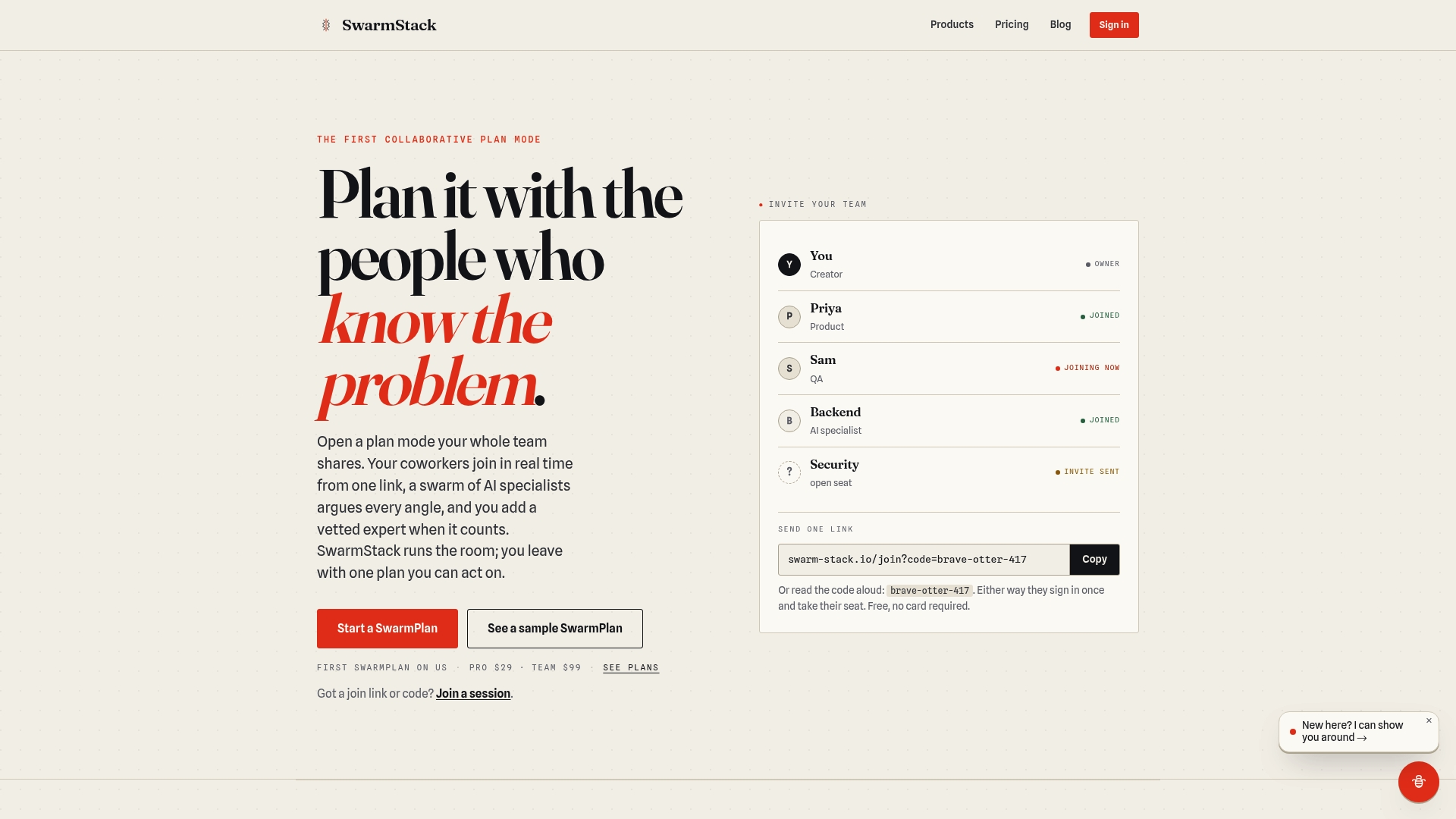
Swarm-stack is built for exactly that transition. Where a whiteboard session ends with a photo and a follow-up email, a Swarm-stack session ends with a versioned deliverable, a decision log, and an export ready for GitHub or Jira. The platform combines real-time collaboration via a single invite link, structured prompts that surface objections the way a good facilitator would, and an integrated marketplace for bringing in vetted human experts when a premise needs domain knowledge your team does not have.
For teams producing RFP rationale or procurement documentation, that means every argument behind a vendor decision is recorded, attributed, and auditable. No more reconstructing why a requirement was included six months after the fact.
Review trust and data privacy commitments or check current pricing to see which plan fits your team's session volume. When you are ready to run your first structured mapping session, Swarm-stack.
Sources
- Argument map
- Argument Mapping - Critical Thinking Tutorial - Library Guides
- Using Argument Mapping to Improve Critical Thinking Skills
- A10 Argument mapping
- Argument_maps_helpsheet 2025