RFP for Software Development: A 2026 Complete Guide
Unlock success with the right RFP for software development. Ensure clear requirements, gain leverage, and attract top vendors. Learn how!

A software development RFP is a formal document that invites vendors to propose how they will deliver a software solution against your specific business and technical requirements. Done well, it attracts qualified firms, filters out poor fits, and gives you a structured basis for comparison. Done badly, it produces proposals ranging from $50,000 to $500,000 for the same project because every vendor is guessing at scope.
Here is what a strong software development RFP delivers:
- Stakeholder alignment before any vendor conversation begins
- Comparable proposals because every vendor answers the same questions
- Risk reduction through documented requirements and evaluation criteria
- Negotiating leverage because vendors know they are competing
- A contract foundation that reduces scope disputes later
Per 2026 guidance, the right document length is 8–15 pages. Shorter and vendors fill gaps with assumptions. Longer and they skim past your critical requirements. Technical standards like SAML and OAuth belong in the document explicitly, not as implied expectations.
What goes into an effective RFP for software development?

Every section of a software RFP carries a specific job. Skip one and vendors either guess or ignore the gap entirely.
Core sections every RFP needs:
- Company and project overview: Who you are, what the software replaces, and the business problem it solves
- Scope of work: Core user workflows described as narratives, not feature lists
- Technical requirements: Preferred stack, hosting environment (cloud, on-premise, or hybrid), authentication methods (SAML, OAuth), performance benchmarks, and accessibility standards
- Deliverables and milestones: Phase definitions with measurable "done" criteria
- Budget range: A specific range like "$150K–$200K" lets vendors scope realistically; withholding it produces wildly variable proposals that waste everyone's time
- Timeline: Hard deadlines and their drivers (regulatory, contractual, or market)
- Submission instructions: Format, deadline, required sections, and Q&A process
- Evaluation criteria: Weighted scoring rubric published upfront
On technical requirements specifically, defining technology and performance parameters is what makes proposals comparable. "The system should be fast" is useless. "Pages must load under 1.5 seconds at p95 under normal traffic" is a requirement vendors can price and architect against.
Mandate proof-of-delivery artifacts too: sprint board snapshots, release checklists, and case studies with measurable outcomes. These force vendors to demonstrate actual working processes rather than describe them in marketing language.
Pro Tip: Set your weighted scoring rubric before you read a single proposal. Once you have read three compelling pitches, your weights will shift toward whoever told the best story. Decide what matters first.
Best practices for writing and managing a software RFP
The most common failure mode is an RFP that describes what to build without explaining why. Framing projects by business goals allows vendors to propose the right solution rather than just execute a feature list. "Reduce invoice processing from three days to four hours" is a business objective. "We want a dashboard" is not.
Practices that separate good RFPs from bad ones:
- Use MoSCoW prioritization (Must, Should, Could, Won't) for every requirement so vendors can propose phased approaches
- Publish your evaluation weights before distribution, not after reading proposals
- Allow at least two weeks from RFP distribution to the Q&A deadline, then another two weeks to proposal submission
- Send to 3–5 vendors, not 15. More than five dilutes your evaluation and signals you are shopping on price alone
- Run a 30-minute intro call before sending the full document to prune vendors who are clearly misaligned
A well-structured RFP also acts as an early professionalism test. How a vendor handles your Q&A period, whether they ask clarifying questions or just submit a generic response, tells you a great deal about how they will handle ambiguity during the actual build.
Common pitfalls to avoid:
- Vague requirements ("user-friendly," "modern") that two people would define differently
- No budget guidance, which produces proposals at incompatible price points
- Unrealistic timelines that push qualified vendors to decline
- Marking every requirement as "must-have," which prevents vendors from proposing phased approaches
- Omitting technical constraints alongside outcomes, which produces proposals built on incompatible architectural assumptions
How do RFP templates speed up the process?
Modern 2026-aligned templates cover sections that older templates missed entirely: zero-trust security architecture, AI-assisted development workflows, SLA definitions, and proof-of-delivery requirements. Starting from a template cuts drafting time and reduces the chance of forgetting a section that vendors will exploit as ambiguity.
What a current software RFP template should include:
- Company overview and project background
- Measurable success metrics (not just feature descriptions)
- Technical architecture preferences vs. hard constraints
- Security and compliance requirements (SOC 2, WCAG 2.2 AA, OAuth 2.0)
- Vendor qualification requirements with named team members
- Budget range and payment structure
- Weighted scoring rubric with defined score definitions
Customize by deleting irrelevant sections rather than leaving them blank. A blank section invites vendors to skip it or fill it with boilerplate. You can find copy-ready RFP structures that cover all seven core sections with example text for each.
| Template section | Typical length |
|---|---|
| Company and project overview | 1–2 pages |
| Scope and objectives | 2–4 pages |
| Technical context | 1–2 pages |
| Budget and timeline | — |
| Proposal requirements | 1 page |
| Evaluation criteria | — |
The total document should land in the 8–15 page range regardless of project complexity. Anything beyond that and vendors start skimming.
How Swarm-stack improves RFP planning and collaboration
Writing an RFP in isolation is where most documents go wrong. One person drafts it, two people review it, and the engineering team sees it for the first time when a vendor asks a question that reveals a gap. Swarm-stack addresses this by running structured collaborative sessions where AI specialists and human experts contribute simultaneously, with every argument tracked and every decision versioned.
What Swarm-stack brings to the RFP process:
- Real-time shared sessions so product, engineering, and procurement teams align on requirements before any vendor sees the document
- Argument-driven refinement that surfaces conflicting assumptions early, not mid-project
- Deliverable versioning with decision tracking, so you know why a requirement changed
- An integrated marketplace for hiring vetted human experts when your team lacks domain knowledge
- Direct export to GitHub and Jira once the RFP converts into a project plan
The platform's approach combines AI-generated structure with human judgment on priorities, which is exactly what a software RFP requires. AI can draft the technical requirements section from your inputs; a domain expert can validate whether the authentication requirements (SAML, OAuth) are appropriate for your compliance context. You can explore AI-driven RFP planning to see how this works in practice.
Pro Tip: Use Swarm-stack's versioning to maintain a single canonical RFP document across iterations. When a stakeholder requests a change after the Q&A period opens, version it rather than editing in place. Vendors who received the original document need to see exactly what changed.
How to engage and communicate with vendors during the RFP process
Vendor communication during the RFP process is where many organizations lose the best firms. Compressed Q&A windows, inconsistent answers, and informal side conversations all undermine the fairness that makes an RFP worth running.
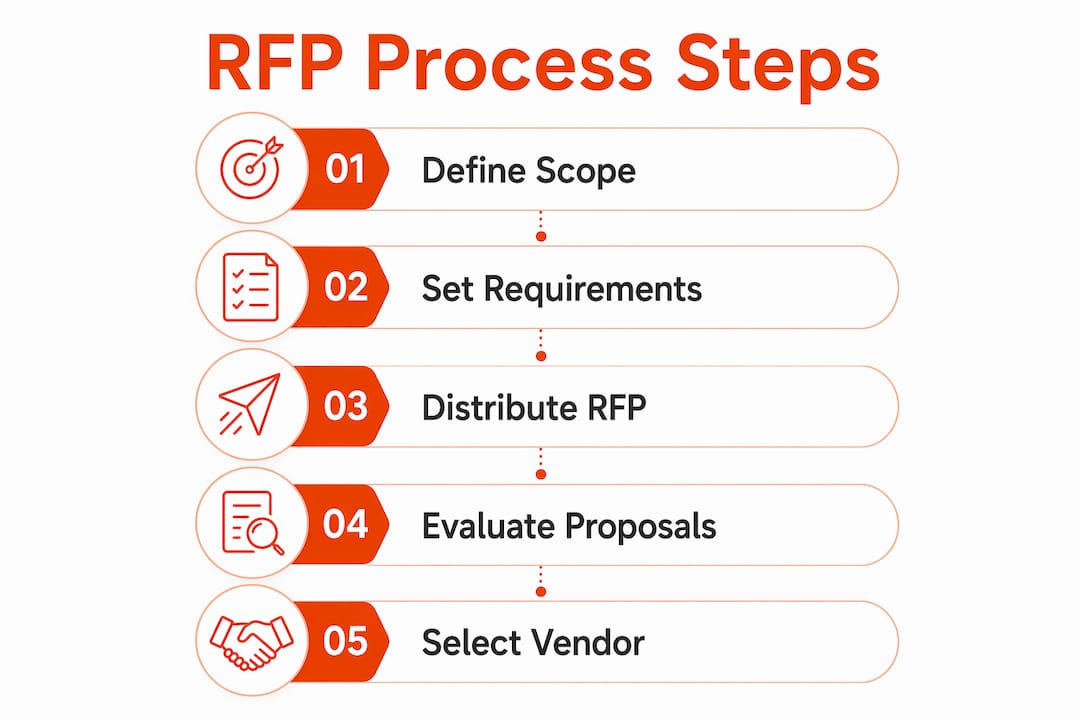
Structure the engagement in clear stages. Distribute the RFP with a published Q&A deadline, then collect all questions and publish answers to every vendor simultaneously. No private answers. If one vendor asks a question that reveals an ambiguity in your requirements, every vendor deserves the same clarification.
After proposals arrive, score them against your rubric before scheduling any calls. Early conversations bias your assessment toward whoever presents well rather than whoever proposed well. Score first, then invite your top two or three to a 60-minute technical discussion focused on their proposed architecture and team composition.
For teams looking to reduce the time between vendor selection and project kickoff, faster IT placement processes can help compress the gap between RFP close and contract signature. Keep communication formal and documented throughout. Every commitment made verbally during vendor calls should be confirmed in writing, because those conversations become the basis for scope disputes later.
Key Takeaways
A software development RFP structured around measurable outcomes, explicit technical constraints, and pre-defined weighted scoring criteria produces proposals that are genuinely comparable and reduces project risk.
| Point | Details |
|---|---|
| Target 8–15 pages | Documents in this range get read carefully; shorter invites guesswork, longer gets skimmed. |
| Publish your budget range | A range like "$150K–$200K" lets vendors scope realistically and self-select out when they can't deliver. |
| Set scoring weights first | Decide evaluation criteria before reading proposals to prevent the best pitch from overriding the best plan. |
| Mandate proof artifacts | Require sprint boards, release checklists, and case studies with metrics, not just narrative descriptions. |
| Use collaborative drafting | Platforms like Swarm-stack align stakeholders on requirements before vendors ever see the document. |