B2B AI SaaS: A Practical Guide for Business Leaders
Discover how B2B AI SaaS revolutionizes business operations. Learn to leverage AI tools for sales, support, and project success.

B2B AI SaaS is defined as cloud-based software-as-a-service platforms embedded with artificial intelligence capabilities, built specifically to accelerate business-to-business workflows across sales, support, and project coordination. These platforms go far beyond passive dashboards. They execute tasks, update records, and surface decisions in real time. Business leaders who treat AI SaaS solutions for businesses as simple automation tools miss the larger shift: these platforms are becoming the operational core of how B2B teams plan, sell, and deliver work. The gap between companies that adopt them well and those that don't is widening fast.
What is B2B AI SaaS and how does it work?
B2B AI SaaS combines machine learning, natural language processing, and agentic workflows inside a subscription-based cloud platform. The "B2B" distinction matters because enterprise use cases demand audit logs, role-based access controls, and integrations with systems like CRM, ERP, and billing. Consumer AI tools lack these controls. Enterprise-grade AI platforms wire into multiple business systems with strict governance, which is what separates them from general-purpose AI assistants.
The architecture typically includes three layers. A data layer connects to existing business systems. A reasoning layer applies AI models to that data. An action layer executes decisions, such as sending an email, updating a deal stage, or routing a support ticket. Context-aware retrieval engines that answer only from verified internal data achieve approximately 90% precise responses, which dramatically reduces the hallucination risk that makes consumer AI unreliable in enterprise settings.

What core capabilities do AI SaaS platforms offer B2B teams?
The most impactful AI capabilities in B2B platforms fall into three categories: automation, agents, and intelligence.
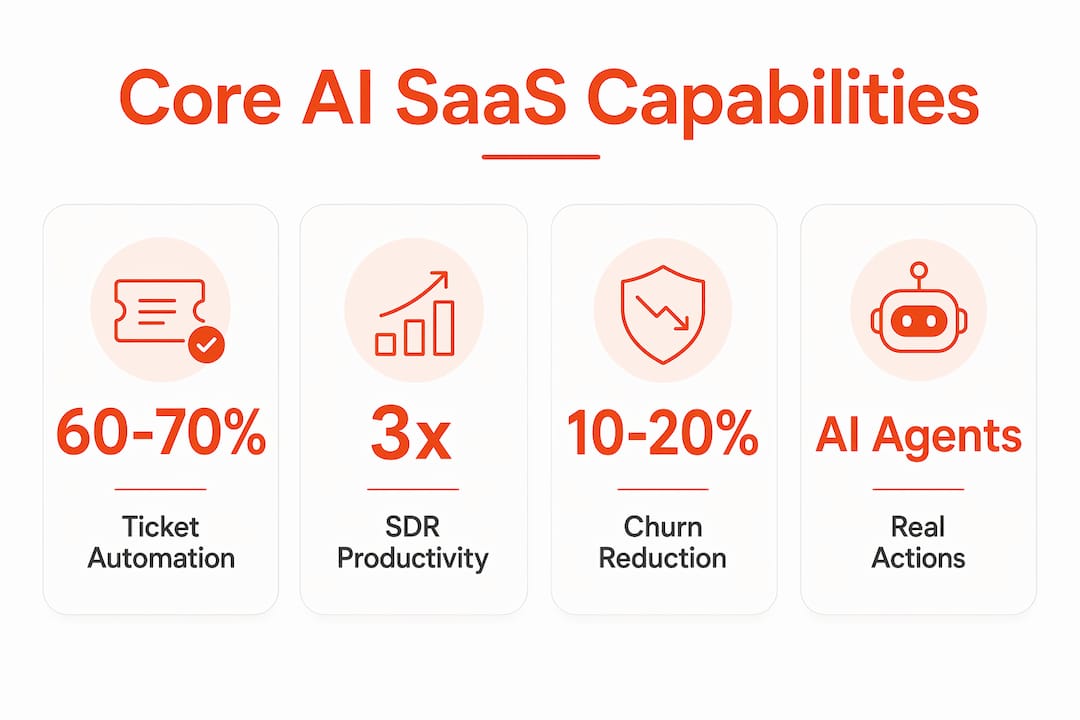
Automation handles repetitive, rule-based tasks without human input. Examples include ticket routing, invoice matching, and lead scoring. These free up team time for higher-value work.
AI agents are a step above automation. A critical distinction: AI agents execute real actions inside business systems with audit logs and permission controls, while chatbots only respond with text. An agent can send a follow-up email, update a CRM record, and flag a billing anomaly in a single workflow. A chatbot cannot.
Intelligence covers probabilistic modeling, forecast accuracy, and pattern detection across large datasets. This is where business intelligence AI tools earn their value, surfacing signals that human analysts would miss.
Key capabilities to evaluate in any B2B AI SaaS platform:
- Ticket automation with configurable routing rules and escalation paths
- AI chat agents with permission-scoped access to internal systems
- Multi-step workflow builders that span CRM, billing, and support
- Probabilistic sales forecasting with confidence intervals
- Role-based access control and full audit logging
Pro Tip: Before evaluating platforms, map your three highest-volume repetitive workflows. Any platform worth adopting should automate at least two of them out of the box, without custom engineering.
What measurable business impacts come from AI SaaS implementations?
The performance data on focused AI agent implementations is specific and consistent. B2B SaaS companies achieve 60–70% support ticket automation, 3x SDR productivity gains, and 10–20% churn reduction when they deploy AI agents on well-defined use cases. These are not theoretical projections. They reflect what happens when AI handles the volume work and humans handle the exceptions.
Sales teams see equally clear gains. AI-guided CRM automation produces 20–30% increases in selling time and improves forecast accuracy through probabilistic modeling. That means a 10-person sales team effectively gains the output of two to three additional reps without adding headcount.
"Moving beyond chatbots to agentic workflows that execute end-to-end actions is the key to realizing AI ROI in enterprise SaaS. Active agents execute workflows instead of passive content summaries."
The table below summarizes the key performance benchmarks observed across B2B AI SaaS deployments:
| Metric | Observed Impact |
|---|---|
| Support ticket automation | 60–70% of tickets resolved without human intervention |
| SDR productivity | 3x output per sales development representative |
| Selling time increase | 20–30% more time on active selling activities |
| Churn reduction | 10–20% decrease in customer churn rates |
| AI response precision | ~90% accuracy with verified internal knowledge layers |
ROI timelines vary by deployment scope. Basic cloud setups can go live in 24 hours. Complex, end-to-end commercial integrations typically take up to 8 weeks. The companies that see the fastest returns start with one high-volume use case, prove the numbers, and then expand.
How do AI SaaS solutions integrate with existing business systems?
Integration is where most AI projects stall. The instinct to replace existing tools is expensive and slow. Technology-agnostic platforms that plug into existing stacks avoid the 6–12 month engineering bottlenecks that rip-and-replace strategies create. The better approach is to add an AI layer on top of what you already have.
Fragmented data sources cause AI deployment failures. A semantic knowledge layer that connects enterprise data ensures traceable, correct AI reasoning. Without it, AI models pull from inconsistent sources and produce unreliable outputs. This is the single most common reason AI pilots fail to reach production.
Practical integration principles for business leaders:
- Use platforms with native connectors to Salesforce, HubSpot, Zendesk, and your billing system
- Require role-based access control at the data level, not just the application level
- Demand full audit logging for every AI action taken inside your systems
- Avoid platforms that require you to migrate data before they can function
- Test integration with a single department before expanding company-wide
Pro Tip: Ask any vendor to demonstrate a live connection to your CRM in a sandbox environment before signing. If they can't show it working in under an hour, the integration is not as native as advertised.
Deployment timelines range from 24 hours for basic cloud setups to 8 weeks for complex end-to-end integrations. Plan your rollout around that range and set internal expectations accordingly. Teams that expect instant results from complex integrations lose confidence in the technology before it has time to deliver.
What steps help business leaders scale AI SaaS adoption successfully?
Scaling AI SaaS adoption follows a clear pattern. The companies that succeed start narrow, prove value fast, and then expand with governance in place.
-
Pick one use case with measurable volume. Support ticket routing, lead qualification, and contract drafting are common starting points. Choose the one where your team spends the most time on repetitive tasks.
-
Run a time-boxed pilot. Four to six weeks is enough to generate real performance data. Track ticket resolution rates, response times, or deal velocity, depending on your use case.
-
Build a unified control layer before scaling. Shifting from pilot to production requires unified platforms that avoid stitching together multiple ungoverned tools. One governance layer beats five disconnected integrations every time.
-
Replace disconnected lead lists with live data. B2B companies that rely on static lead lists instead of real-time unified commercial data miss the compounding advantage of AI-driven growth strategies. A unified commercial digital twin combines internal CRM data with external market intelligence to give AI models accurate, current context.
-
Establish traceability standards before expanding. Every AI action should be logged, attributable, and reversible. This is not just a compliance requirement. It builds internal trust in AI outputs, which is what drives adoption across teams.
The teams that treat AI SaaS as a platform decision rather than a point-tool purchase scale faster. They avoid the fragmentation that kills ROI and build toward a unified AI governance model that works across departments.
Key Takeaways
B2B AI SaaS delivers measurable ROI only when AI agents execute real workflows inside governed, integrated business systems, not when chatbots answer questions in isolation.
| Point | Details |
|---|---|
| Agents beat chatbots | AI agents that act inside systems deliver 60–70% ticket automation; chatbots do not. |
| Integration first | Technology-agnostic platforms prevent costly rip-and-replace engineering delays. |
| Start narrow, scale fast | Pilot one high-volume use case for 4–6 weeks before expanding to other departments. |
| Governance enables scale | A unified control layer with audit logging is required to move from pilot to production. |
| Live data compounds returns | Real-time commercial data combined with CRM context improves AI decision accuracy. |
Why most B2B AI pilots never reach production
The pattern I see most often is this: a business leader approves an AI pilot, the vendor delivers a polished demo, and then the project quietly dies at the integration stage. The technology was not the problem. The data environment was.
Most B2B organizations have customer data in three or four systems that have never been properly connected. When an AI model tries to reason across that fragmented landscape, it produces outputs that no one trusts. The team loses confidence, the pilot gets shelved, and the conclusion is that "AI isn't ready for us." That conclusion is wrong. The infrastructure was not ready.
The companies that succeed treat the knowledge layer as the first investment, not an afterthought. They connect their CRM, support, and billing data into a coherent structure before they ask AI to reason on it. That single decision separates the teams that hit 3x SDR productivity from the ones still running disconnected pilots.
The other mistake I see is confusing AI governance with bureaucracy. Audit logs and role-based access controls are not obstacles to speed. They are what makes it safe to give AI agents real permissions inside your systems. Without them, you are one bad output away from a trust crisis that sets your adoption back by a year.
The future of cloud-based AI for B2B is not more tools. It is fewer, better-connected systems with AI woven into the workflow at every step. The leaders who get there first will not be the ones who bought the most software. They will be the ones who built the cleanest data foundation.
— Cody
How Swarm-stack fits into your AI SaaS strategy
Swarm-stack is built for the exact problem most B2B teams hit when they try to plan and execute complex work with AI. Misalignment between team members and AI outputs wastes time and produces deliverables no one can act on. Swarm-stack solves this by running structured sessions where multiple AI specialists and human experts argue every angle of a plan before a final output is produced.
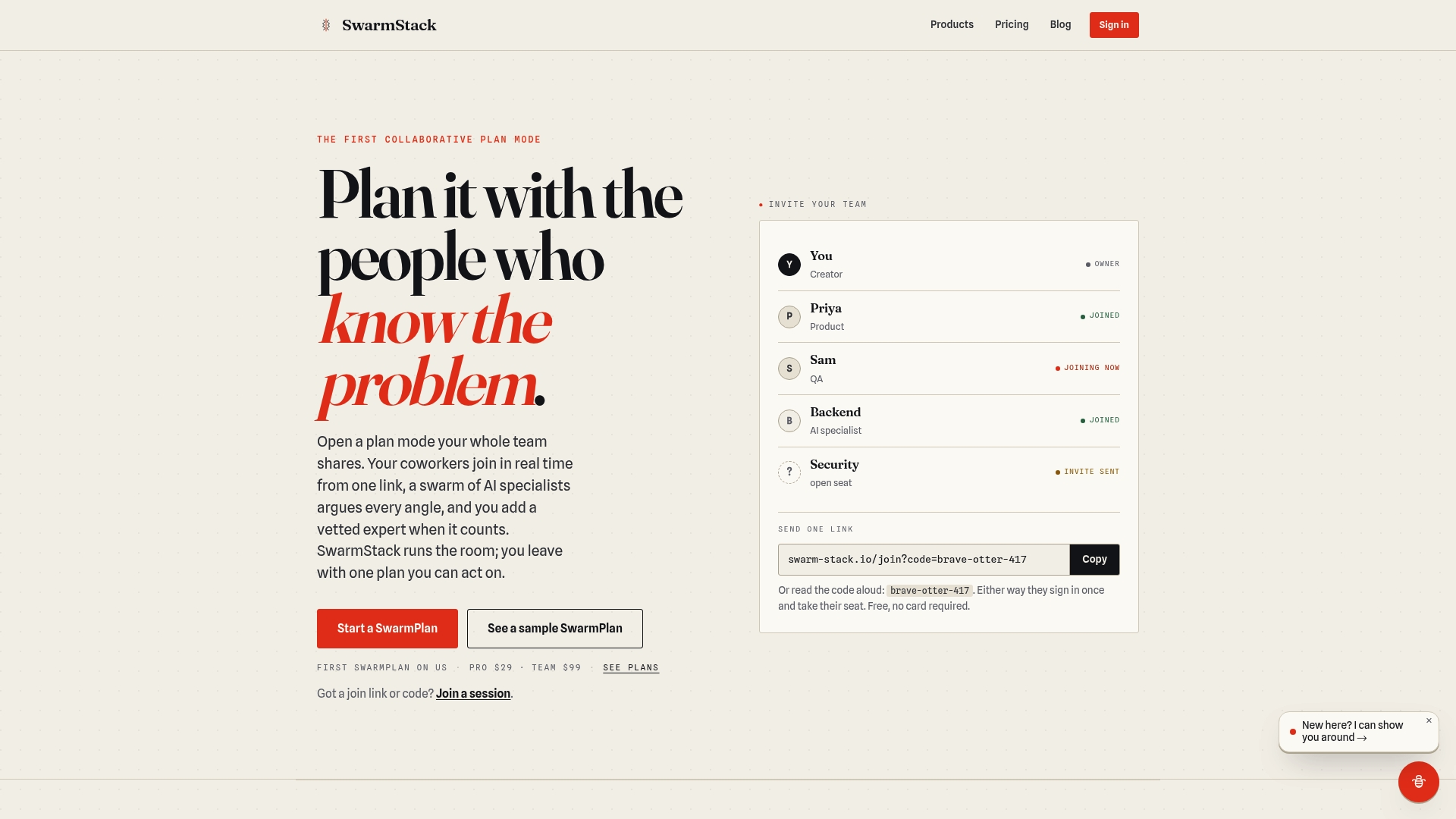
Teams connect via a single link, integrate their existing context, and produce ready-to-implement plans in one session. There is no stitching together of disconnected tools. The result is a well-defined deliverable with full human oversight baked in. Business leaders evaluating AI SaaS solutions for collaboration and project management can review Swarm-stack's platform and pricing to see how it fits their current stack.
FAQ
What is B2B AI SaaS?
B2B AI SaaS is a cloud-based software platform that embeds artificial intelligence into business-to-business workflows such as sales, support, and project management. It differs from consumer AI by including enterprise controls like audit logging, role-based access, and system integrations.
How is an AI agent different from a chatbot?
An AI agent executes real actions inside business systems, such as updating CRM records or sending emails, while a chatbot only generates text responses. Agents require permission controls and audit logs; chatbots do not.
What ROI can B2B companies expect from AI SaaS?
Focused AI agent deployments produce 60–70% support ticket automation, 3x SDR productivity, and 10–20% churn reduction. Sales teams also see 20–30% more time spent on active selling through AI-guided CRM automation.
How long does it take to integrate an AI SaaS platform?
Deployment timelines range from 24 hours for basic cloud setups to 8 weeks for complex end-to-end commercial integrations, depending on the number of systems involved and the depth of data connectivity required.
What is the biggest reason AI SaaS pilots fail?
Fragmented data sources are the leading cause of AI deployment failures. When enterprise data sits in disconnected systems, AI models produce unreliable outputs that teams do not trust, which stalls adoption before it reaches production.