Insurance Request for Proposal: A 2026 Guide for Procurement Teams
Unlock the secrets of an insurance request for proposal in 2026. Learn how procurement teams can effectively evaluate brokers to meet complex needs.

What is an insurance request for proposal?
An insurance request for proposal is a formal document an organization issues to solicit detailed proposals from qualified insurance brokers or consultants. It goes well beyond asking for a price. The goal is to evaluate complex, often intangible factors: claims advocacy, industry expertise, market access, and the broker's ability to serve as a long-term advisory partner.
Most organizations that issue these documents are public agencies, large corporations, or institutions with layered coverage needs across multiple lines. The process gives procurement and risk management teams a structured way to compare brokers on equal footing, rather than relying on relationships or informal pitches.
Why use an RFP instead of a simpler solicitation?
- Insurance RFPs evaluate complex service needs such as claims handling, industry expertise, and long-term advisory potential, unlike RFQs, which focus mainly on price for commoditized products.
- An RFP creates transparency: all brokers receive the same information and respond to the same questions.
- It forces internal alignment. Before you issue one, your team must agree on what you actually need from a broker relationship.
- It produces a documented, defensible selection process, which matters especially for public entities subject to procurement regulations.
- It captures qualitative differences between firms that a price comparison alone would miss entirely.
The distinction between an RFP and an RFQ (request for quotation) is worth spelling out clearly. An RFQ works when you are buying something standardized and price is the primary differentiator. Insurance brokerage is neither standardized nor purely price-driven. A broker who wins on premium alone may lack the claims advocacy skills or industry contacts you need when a loss actually occurs. That is precisely why the RFP format exists for this category of procurement.
Key components of an effective insurance RFP
A well-structured insurance RFP covers six core sections. Each one serves a specific purpose, and missing any of them tends to produce vague or incomplete proposals.
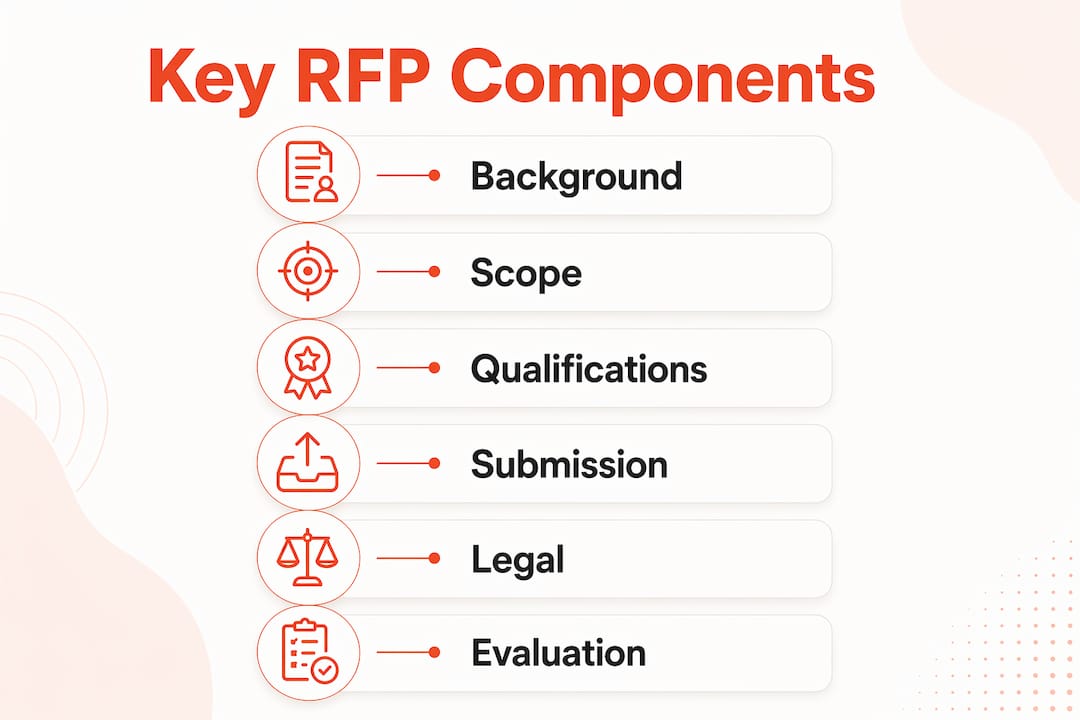
Background and organizational context
Open with a clear description of your organization: its size, industry, operations, existing coverage lines, and the reason you are issuing the RFP. Brokers need this context to propose a service team with relevant experience. The Dormitory Authority State of New York (DASNY), for example, opens its broker services RFP with a full description of its statutory authority and program structure before listing a single requirement.
Scope of work
This section defines exactly what you expect the broker to do. Typical broker services include market analysis, risk review, policy specification preparation, coverage placement, claims management support, and ongoing advisory roles. Be specific. If you need the broker to deliver a written cost analysis by line of coverage before each renewal, say so here.

Qualification and evaluation criteria
State your minimum requirements upfront: licensing, years of experience, relevant industry specializations, and financial stability. Then describe how you will weight the evaluation. Communicating evaluation criteria to RFP participants encourages proposals focused on substantive capabilities rather than polished presentation.
Questionnaire
This is where most RFPs either succeed or fall flat. A well-constructed questionnaire assesses market access strategy, claims advocacy models, data analytics capabilities, service team continuity, and governance communication. Sample questions worth including:
- Which insurers are best aligned with our risk profile, and why?
- How do you support clients during complex or disputed claims?
- Who interprets your data analytics, and what expertise do they bring?
- How do you help management communicate insurance issues to the board?
- What should we expect in the first 12–24 months of the relationship?
Submission instructions
Specify the format (PDF, tabbed sections), the submission method (email, portal, or physical delivery), the deadline, and a single point of contact for questions. The Public Building Commission of Chicago required electronic submissions to two named contacts by a specific time, with a non-mandatory virtual pre-submission conference scheduled beforehand. That level of specificity removes ambiguity and reduces late or incomplete responses.
Legal and insurance requirements
Contractors responding to your RFP will typically need to carry their own coverage. The Maryland State Treasurer's Office, for instance, requires responding brokers to maintain commercial general liability of $1,000,000 per occurrence and $3,000,000 annual aggregate, professional errors and omissions coverage of $10,000,000, crime insurance of $1,000,000, and cyber liability coverage of $10,000,000. These thresholds vary by organization and contract size, but spelling them out in the RFP protects you from awarding a contract to a firm that cannot meet your risk transfer requirements.
Pro Tip: Include a sample contract or certificate of insurance template as an attachment. Requiring brokers to confirm they can meet your insurance requirements before submission saves significant time during the award phase.
Typical proposal submissions include a cover letter, organizational experience, mandatory and desirable specifications, financial stability evidence, and detailed pricing proposals segmented by coverage category. Organizing your RFP to mirror that structure makes evaluation faster and more consistent.
How does the insurance RFP process work from start to finish?
The timeline for an insurance RFP follows a predictable sequence, though the exact duration varies by sector and coverage complexity. Public entities tend to run longer, more formal processes. Private organizations often move faster, but the core milestones remain the same.
A standard insurance RFP timeline includes an official issue date, a question period lasting a few weeks, an optional pre-submission conference, and a firm submission deadline typically within one to one and a half months from the issue date.
| Milestone | Typical timing |
|---|---|
| RFP issued | Day 1 |
| Questions deadline | 2–3 weeks after issue |
| Responses to questions posted | 1–2 weeks after questions close |
| Pre-submission conference (optional) | 2–4 weeks after issue |
| Proposal submission deadline | 4–6 weeks after issue |
| Oral presentations / interviews | 2–4 weeks after submission |
| Notice of award | 1–2 weeks after presentations |
For public procurements, however, a three-week window from issue to submission, as seen in the DASNY commercial general liability RFP, is also a common model. Always refer to the specifics of your sector and coverage complexity.
Pre-submission conferences deserve more credit than they usually get. Even when attendance is not mandatory, they improve proposer understanding, reduce questions during evaluations, and enhance proposal quality. A broker who attends and asks sharp questions in that session is already showing you something about how they work.
Recommended procedural steps:
- Obtain internal clearance and legal review before issuing the RFP.
- Identify and brief all internal stakeholders who will participate in evaluation.
- Post the RFP to your procurement portal and notify invited brokers simultaneously.
- Log all questions received and distribute answers to every participant, not just the one who asked.
- Receive and timestamp submissions; reject any received after the deadline.
- Score proposals against your stated criteria before oral presentations.
- Conduct structured interviews with finalists using the same questions for each.
- Document the selection rationale and notify all participants of the outcome.
Best practices for managing insurance RFPs effectively
The biggest mistake organizations make is treating the RFP as a procurement formality rather than a strategic exercise. Companies that focus too narrowly on premium pricing often miss critical benefits like effective claims advocacy, board-level risk reporting, and specialized industry insights. The RFP process is your best opportunity to surface those differences before you sign a multi-year contract.
Define your objectives before you write a single line. Is the priority stronger claims advocacy? Better market access for a hard-to-place line? More sophisticated data analytics? The answer shapes every section of the document, from the scope of work to the questionnaire.
Keep the broker list short. Inviting a large number of brokers may seem thorough, but it typically produces superficial engagement. A smaller, well-considered group produces deeper, more tailored responses. Including the incumbent broker plus one to three additional firms is a reasonable starting point.
Build the right internal team. Risk management, finance, legal, and procurement each bring a distinct perspective that is essential to evaluating broker capabilities beyond price. Involving a focused core team of these functions enables evaluation that goes beyond simple cost considerations. For coverage lines that touch operations, HR, or IT, consult those stakeholders before the RFP goes out, even if they are not part of the formal evaluation committee.
Pro Tip: Solicit input from coverage-specific stakeholders (IT for cyber, HR for benefits, operations for property) before drafting the RFP. Their input sharpens the scope of work and prevents misaligned expectations after award.
Maintain strict timeline discipline. Extending deadlines or allowing informal communication outside the official question period creates fairness problems and, for public entities, potential compliance exposure. Every deviation from the published schedule should be documented and communicated to all participants through a formal addendum.
When you are also evaluating AI-driven RFP tools to help draft and manage the process, the same principle applies: clarity of scope and stakeholder alignment matter before you bring any technology into the workflow.
Common pitfalls in insurance RFPs and how to avoid them
Even experienced procurement teams run into the same problems repeatedly. Most are avoidable with a bit of advance planning.
- Compliance failures: Missing a mandatory requirement, such as an unsigned cover letter or an absent certificate of insurance, can disqualify an otherwise strong proposal. Build a compliance checklist into your evaluation scorecard and check it before scoring begins.
- Timeline compression: Rushing the evaluation phase to meet an internal deadline produces poor decisions. If your policy renewal date is fixed, work backward from it to set an RFP issue date that gives you adequate evaluation time.
- Overemphasis on price: Common risks in insurance RFPs include missing compliance requirements, tight timelines, overemphasis on price, and insufficient stakeholder engagement. Weighting price too heavily in your scoring matrix almost guarantees you will undervalue advisory capability.
- Too many invited brokers: More respondents does not mean better options. It means more proposals to read, more superficial responses, and less meaningful engagement from each firm.
- Weak questionnaire design: Generic questions produce generic answers. If your questionnaire does not ask brokers to describe a specific complex claim they managed for a similar client, you will not learn much about their actual advocacy capability.
- Inadequate stakeholder involvement: Selecting a broker without input from the functions that will interact with them daily, such as finance for premium allocation or legal for contract disputes, creates friction after award.
- Poorly communicated evaluation criteria: When brokers do not know how they will be scored, they default to polished marketing materials. Transparency about your criteria produces responses that actually address what you care about.
For technology and SaaS organizations, cyber coverage deserves particular attention in the scope of work. A broker's approach to cyber claim coordination and incident response support is a meaningful differentiator that a price-focused RFP will never surface.
Sample insurance RFP templates and real-world examples
No template replaces judgment, but starting from a real example is far faster than building from scratch. Several publicly available RFPs from U.S. government entities provide strong structural models.
DASNY Commercial General and Excess Liability Broker Services RFP (2026): This document from the Dormitory Authority State of New York covers background, scope of services, technical proposal requirements, cost proposal requirements, and evaluation criteria across five numbered sections. It requires a minimum of $10,000,000 in errors and omissions coverage from responding brokers and specifies that fee quotes must remain irrevocable for 120 days. The table of contents alone is a useful checklist for any organization drafting its own document.
Maryland State Treasurer's Office Property/Package RFP (December 2025): This RFP covers two distinct coverage categories (excess blanket property and bridges/tunnels property services) and includes a detailed insurance requirements section with specific dollar thresholds for commercial general liability, professional liability, crime, and cyber coverage. It also sets a 25% MBE subcontracting goal, which is relevant context for public sector procurement teams.
Public Building Commission of Chicago Insurance Brokerage Services RFP (July 2025): The PBC document organizes broker services into three response categories, requires a separate pricing proposal tab, and weights pricing at 15% of the total evaluation score. That weighting is a deliberate signal to respondents that advisory capability matters more than cost.
A practical template outline for your own RFP:
- Cover page: solicitation number, issue date, submission deadline, and primary contact
- Section 1: background and organizational overview
- Section 2: scope of services and broker responsibilities
- Section 3: minimum qualifications and certification requirements
- Section 4: technical proposal requirements and questionnaire
- Section 5: cost proposal requirements and fee structure
- Section 6: evaluation criteria and weighting
- Section 7: submission instructions and key dates
- Section 8: legal, compliance, and insurance requirements
- Attachments: sample contract, certificate of insurance template, required forms
Swarm-stack's collaborative platform lets your risk management and procurement teams build and refine an RFP together in real time, with AI specialists and human experts contributing to each section simultaneously. The result is a versioned, argument-tested document rather than a draft that circulates by email for weeks. If your team has struggled with misalignment between risk, legal, and procurement during past RFP cycles, that structured approach addresses the root cause directly.
Swarm-stack's pricing plans are designed for procurement teams that run multiple RFP cycles per year, with optional access to vetted human experts through the integrated marketplace for specialized insurance or risk management input.
Key Takeaways
An effective insurance RFP evaluates advisory capability, claims advocacy, and market access, not just premium cost, and that distinction determines the quality of your broker relationship for years.
| Point | Details |
|---|---|
| RFP vs. RFQ | Insurance RFPs assess qualitative factors like claims handling and expertise; RFQs focus on price for standardized products. |
| Core RFP sections | Every RFP needs background, scope of work, qualifications, a questionnaire, submission instructions, and insurance requirements. |
| Timeline structure | Plan for a one to one-and-a-half month window from issue to submission, with a questions period and optional pre-submission conference built in. |
| Broker list size | Limit invitations to the incumbent plus one to three additional firms to produce deeper, more tailored responses. |
| Evaluation team | Risk management, finance, legal, and procurement should form the core evaluation committee for every insurance RFP. |