Project Feedback Questions for Every Phase of Work
Discover key project feedback questions to enhance communication and success at every phase. Get insights for better collaboration today!

The highest-value project feedback questions you can ask right now are these eight, covering clients, sponsors, and your own team:
- "On a scale of 1–10, how well did the final deliverable match what you expected at kickoff?"
- "What one thing would have made this project more successful for you?"
- "Did you feel informed about project status at the right frequency? (Yes / No / Too often / Not enough)"
- "What slowed us down most this sprint, and what would have removed that blocker?"
- "What went well that we should protect in our next project?"
- "How confident are you that the delivered solution will meet your business goals six months from now? (1–5)"
- "What did we promise that we didn't fully deliver?"
- "If you were advising a colleague on working with our team, what would you tell them?"
Use this shortlist at handoff or immediately after a major milestone, when context is fresh and stakeholders are still engaged. PMI's 2026 Pulse research shows that teams navigating complexity effectively are far more likely to deliver successful projects, and structured feedback is one of the clearest levers for building that capability.
Pro Tip: Send this shortlist within 24 hours of a milestone or handoff. Response rates drop sharply after 48 hours as stakeholders shift attention to the next priority.
Key Takeaways
Structured, phase-specific project feedback questions, paired with named owners and a closing-the-loop message, are the most reliable way to convert stakeholder input into measurable process improvements.
| Point | Details |
|---|---|
| Use phase-specific templates | Match your question set to the project stage: alignment at kickoff, progress at milestones, satisfaction at closeout. |
| Pair ratings with open follow-ups | A closed scale gives you comparable data; the follow-up question gives you the reason behind the score. |
| Assign owners and due dates | Every action item from a feedback review needs a named person, a specific task, and a deadline. |
| Close the loop with respondents | Send a brief summary of what you heard and what you're changing within five days of survey close. |
| Swarm-stack for feedback workflows | Swarm-stack provides phase-based templates, versioned results, action tracking, and Jira/GitHub export in one platform. |
Table of Contents
- What project feedback questions should you ask at each phase?
- How do you write questions that produce usable answers?
- When should you collect feedback, and how often?
- How do you turn feedback into decisions and improvements?
- Ready-to-use survey templates you can copy today
- What mistakes kill the value of a project feedback survey?
- How does systems thinking change the way you use feedback?
- What actually changes when you run feedback well
- How Swarm-stack helps you collect, version, and act on feedback faster
- Sources
What project feedback questions should you ask at each phase?
Phase-based question sets are the most practical format for project managers because the right question depends entirely on where you are in the project lifecycle. A kickoff question about success criteria is useless at closeout; a retrospective prompt about what slowed the team is irrelevant to a client satisfaction survey. The sections below give you copy-paste sets for each stage.
Kickoff: aligning on goals and constraints
These questions confirm that everyone starts from the same map.
- "What does a successful outcome look like to you, in concrete terms?"
- "What constraints (budget, timeline, technology, regulatory) are non-negotiable?"
- "Who has final decision authority when the team disagrees?"
- "What has caused similar projects to fail in your organization before?"
- "How often do you want status updates, and in what format?"
- "What would make you consider this project a failure, even if we hit the stated scope?"
Milestone and mid-project check-ins
Mid-project surveys catch drift before it becomes a crisis. Keep them to five questions or fewer and include at least one rating scale so you can track trends across milestones.
Sample mid-project mini-survey:
- "On a scale of 1–5, how satisfied are you with progress toward the agreed goals?" (1 = far off track, 5 = ahead of plan)
- "Is the current communication frequency meeting your needs?" (Too frequent / About right / Not frequent enough)
- "What is the single biggest risk you see to the project right now?"
- "Have any requirements or priorities changed since our last check-in?"
- "On a scale of 1–5, how confident are you in the team's ability to deliver on time?" (1 = very concerned, 5 = fully confident)
Client handoff and closeout
These are your project satisfaction survey questions. They measure perceived value, unmet expectations, and likelihood of a continued relationship.
- "How well did the delivered solution match the goals we agreed on at kickoff? (1–10)"
- "What aspect of the project exceeded your expectations?"
- "What aspect fell short of your expectations?"
- "How would you rate the team's communication throughout the project? (1–5)"
- "How likely are you to recommend our team to a colleague? (0–10)" (classic NPS format)
- "What one change would most improve how we work together next time?"
Internal team retrospectives
Prime Directive retrospectives create the psychological safety that makes honest answers possible by starting from the assumption that every team member did their best given what they knew at the time. That framing matters because without it, people protect themselves instead of diagnosing the system.

Blameless retro template (copy-paste):
Open with the Prime Directive: "Regardless of what we discover, we understand and truly believe that everyone did the best job they could, given what they knew at the time, their skills and abilities, the resources available, and the situation at hand."
Then ask:
- "What went well that we should actively protect?"
- "What slowed us down or caused rework?"
- "What still puzzles you about how this project unfolded?"
- "What one change would make the next sprint noticeably better?"
- "What did we learn that we haven't yet built into our process?"
Blameless retrospectives work best when they follow a clear structure: set ground rules, gather data, generate insights, decide actions, and always assign an owner and a due date to every action item before the session ends.
Stakeholder-specific prompts
Sponsors: "Is the project still aligned with the business priority that funded it?" / "What would cause you to reprioritize resources away from this project?"
Vendors and contractors: "What information from our team would have helped you deliver faster or better?" / "Were the acceptance criteria clear enough for you to scope your work accurately?"
End users: "Does this solution fit how you actually work, or does it require you to change your workflow to accommodate it?" / "What feature or capability do you wish had been included?"
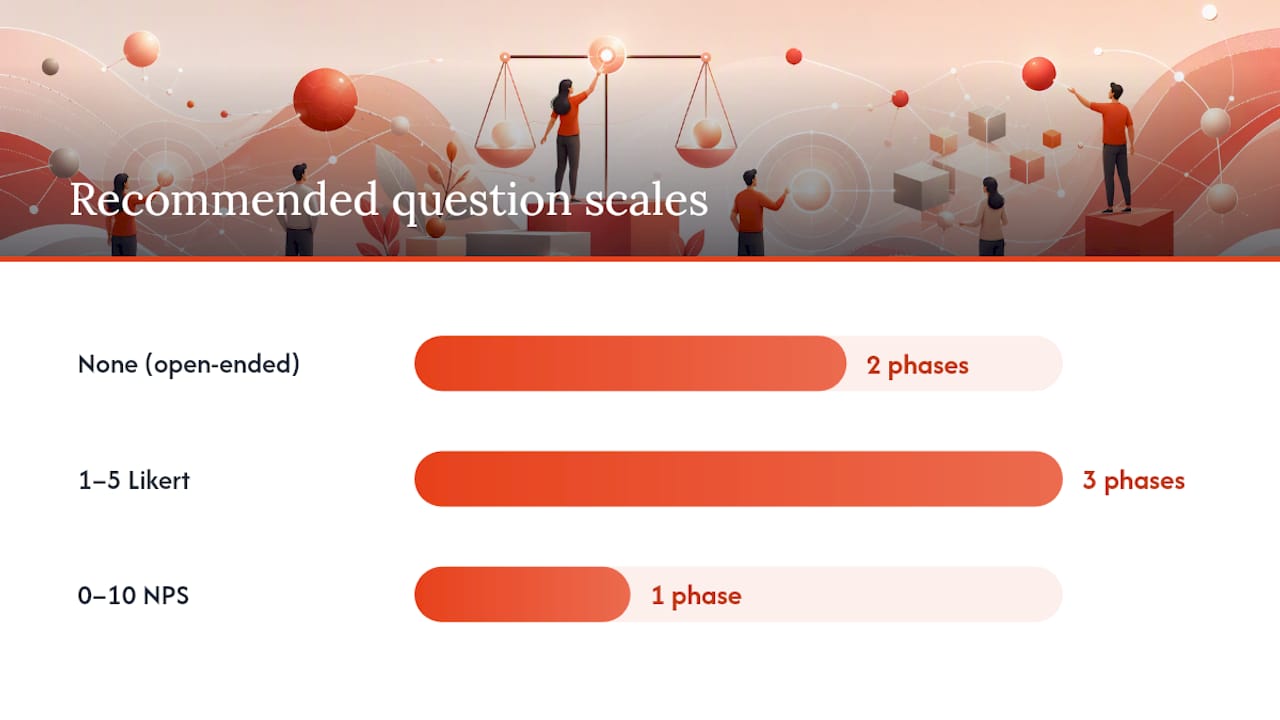
| Phase | Audience | Recommended scale | Key metric |
|---|---|---|---|
| Kickoff | Client, sponsor | None (open-ended) | Goal alignment |
| Mid-project | Client, team | 1–5 Likert | Progress confidence |
| Handoff/closeout | Client | 0–10 NPS, 1–5 Likert | Satisfaction, likelihood to recommend |
| Retrospective | Team | None (open-ended) | Process improvement themes |
| Vendor/contractor | External partner | 1–5 Likert | Clarity, collaboration quality |
How do you write questions that produce usable answers?
Short, neutral prompts paired with a targeted follow-up are the most reliable format for getting answers you can actually act on. Survey design guidance from Penn State's Office of Planning, Assessment, and Institutional Research recommends concise, neutrally worded questions and pairing ratings with brief open follow-ups to increase both response quality and interpretability.
Closed vs. open questions
Closed questions (rating scales, yes/no, multiple choice) are fast to answer and easy to analyze across respondents. Open questions give you the "why" behind a score. Neither works as well alone.
The practical rule: lead with a closed question to get a comparable data point, then follow immediately with a targeted open prompt that asks for the reason behind the rating.
Before and after phrasing examples:
| Weak version | Stronger version |
|---|---|
| "Was the project successful?" | "On a scale of 1–5, how well did the project meet your original goals?" |
| "Did you like working with us?" | "How would you rate the team's responsiveness to your questions? (1–5)" |
| "What problems did you have?" | "What one thing most slowed your ability to use the delivered solution?" |
| "Was communication good?" | "Did you receive status updates at the right frequency? (Too often / About right / Not enough)" |
Which rating scale should you use?
- NPS (0–10): Use for likelihood-to-recommend and overall satisfaction at closeout. Scores of 9–10 are promoters, 7–8 are passive, 0–6 are detractors.
- 1–5 Likert: Best for mid-project check-ins and process questions where you want to track trend over time. Anchor both ends clearly (1 = strongly disagree, 5 = strongly agree).
- 1–10 importance/effort: Useful in prioritization exercises where you want respondents to rate both how important an issue is and how much effort fixing it would require.
Neutral wording vs. leading wording
Leading questions push respondents toward a particular answer, which makes the data useless for decision-making.
- Leading: "Don't you think the timeline was too aggressive?"
- Neutral: "How realistic was the project timeline? (1–5, where 1 = far too tight and 5 = very comfortable)"
Anonymity vs. attribution
Anonymous collection increases candor, especially on sensitive topics like team dynamics or sponsor behavior. Attributed responses are more useful when you need to follow up individually. A practical split: make internal retro inputs anonymous by default, and make client surveys attributed so you can close the loop with the specific person.
Pro Tip: For internal surveys, collect responses anonymously and then share aggregated themes with the team. Showing the data without names removes defensiveness and keeps the conversation focused on the system, not the person.
When should you collect feedback, and how often?
Timing determines whether feedback is useful or just noise. A survey sent three weeks after a milestone captures faded impressions; one sent the day after captures sharp, specific detail.
Recommended checkpoints
- Kickoff (day 1–3): Confirm alignment on goals, constraints, and decision rights before work begins.
- After each major milestone or sprint: Mid-project check-in (five questions maximum) to catch drift early.
- Handoff: Client satisfaction survey within 24 hours of delivery, while the experience is still vivid.
- 30-day follow-up: Check whether the delivered solution is working in practice. Adoption gaps surface here.
- 90-day follow-up: ROI and business-outcome questions. "Has this project delivered the value you expected?"
Frequency rules of thumb
- Client surveys: no more than once per major milestone. Sending them too often trains clients to ignore them.
- Internal retros: weekly for Agile sprints, biweekly or per-phase for Waterfall projects.
- Stakeholder pulse checks: monthly for long projects (six months or more), per-phase for shorter ones.
Tactics for higher response rates
Survey best practices consistently point to a few reliable levers: keep the survey short (under seven questions for clients), send a single reminder at 24–48 hours, use a subject line that states the time commitment ("2-minute project check-in"), and pilot-test questions with one colleague before sending to catch ambiguous wording.
- Keep client surveys to five to seven questions.
- Send one reminder at 24–48 hours with a short subject line: "Quick follow-up: 2 minutes on [Project Name]."
- For internal retros, use anonymous digital input before the live session so quieter team members contribute before group dynamics take over.
- Avoid sending surveys on Mondays or Fridays; mid-week timing typically yields higher open rates.
How do you turn feedback into decisions and improvements?
Raw scores and open-ended comments don't improve anything on their own. The gap between collecting feedback and acting on it is where most project managers lose the value they worked to gather.
Use a simple scoring approach first. Average the numeric responses for each question across all respondents. Flag any average below 3.5 on a 1–5 scale or below 7 on a 1–10 scale as a priority for follow-up. Open-ended answers that repeat the same theme across three or more respondents deserve the same escalation treatment.

Scoring and prioritization
| Question area | Average score | Threshold for action | Suggested owner |
|---|---|---|---|
| Goal clarity (1–5) | Below 3.5 | Escalate to PM and sponsor | Project manager |
| Communication frequency (1–5) | Below 3.5 | Adjust cadence immediately | PM or comms lead |
| Deliverable quality (1–10) | Below 7 | Root-cause review with team | Technical lead |
| Team morale (1–5) | Below 3.5 | 1:1 conversations + retro | Team lead |
| Likelihood to recommend (0–10) | Below 7 | Executive review | Account lead |
Once you have scores, plot the top issues on a simple impact-versus-effort matrix. High impact, low effort items go first. High impact, high effort items need a sponsor decision. Low impact items go to the backlog.
Assigning owners: every action item from a feedback review needs a named owner, a specific action, and a due date. "The team will improve communication" is not an action item. "Sarah will send a weekly status email every Monday by noon, starting next week" is.
Closing the loop with respondents
Respondents who never hear what happened with their feedback stop responding. A brief follow-up message maintains trust and response rates for future surveys.
Closing-the-loop email template:
Pro Tip: Share the aggregated results publicly with the team before the retrospective session. When people see their input reflected in the data, participation in the live discussion increases noticeably.
Track recurring themes across multiple projects. If "unclear requirements at kickoff" appears in three consecutive project surveys, that is a process problem, not a one-time miss. Feed it into your PMO backlog or process improvement register as a systemic issue.
Ready-to-use survey templates you can copy today
Quick client survey (6 questions)
- "On a scale of 1–10, how well did the final deliverable match your original expectations?"
- "How would you rate the team's communication throughout the project? (1–5)"
- "Did the project finish within the timeline you expected? (Yes / No / Ahead of schedule)"
- "What aspect of the project most exceeded your expectations?"
- "What one thing would you change about how we worked together?"
- "How likely are you to work with our team again? (0–10)"
Full closeout survey (12 questions)
Value delivered:
- "Did the project deliver the business value you expected? (1–5)"
- "How well did the solution solve the original problem? (1–10)"
- "What outcomes have you already seen from the delivered work?"
Process and communication:
- "How clear were the project goals and success criteria from the start? (1–5)"
- "How well did the team manage scope changes? (1–5)"
- "Was the frequency and format of status updates right for you? (Too frequent / About right / Not enough)"
- "How responsive was the team to your questions and concerns? (1–5)"
Outcomes and relationship:
- "Did the project finish on time and within budget? (Yes / Mostly / No)"
- "What would you do differently if you ran this project again?"
- "What did the team do particularly well?"
- "What unmet expectation, if any, do you still have?"
- "How likely are you to recommend our team to a colleague? (0–10)"
Blameless internal retro template
Psychological safety in retrospectives grows when the facilitator models vulnerability first and uses anonymous input before the group discussion. Collect written responses to these prompts before the live session:
- "What went well that we should protect?"
- "What slowed us down or caused rework?"
- "What still puzzles you about how this project unfolded?"
- "What one change would make the next project noticeably better?"
- "What did we learn that we haven't yet built into our default process?"
Survey invitation email template:
Subject: 5-minute project survey — your input shapes what we do next
Hi [Name], we're wrapping up [Project Name] and want to make sure we learn from it. This survey takes about 5 minutes. Your answers directly influence how we run our next project. [Survey link] — closes [date].
What mistakes kill the value of a project feedback survey?
Most project feedback surveys fail for one of four reasons: the questions are leading, there are too many open-ended prompts, no one owns the follow-up, or the results get filed and forgotten. Each one is fixable.
Common pitfalls
- Leading questions push respondents toward the answer you want, which makes the data useless. "Don't you think the kickoff meeting was productive?" is a leading question. "How would you rate the kickoff meeting's effectiveness? (1–5)" is not.
- Too many open-ended questions exhaust respondents and produce walls of text that are hard to analyze. Limit open-ended prompts to two or three per survey, and pair each one with a closed question that anchors the response.
- No named owner for follow-up. If the survey results go to "the team" with no specific person responsible for acting, nothing changes. Every theme needs a name, an action, and a date.
- Treating feedback as a reporting activity. Collecting feedback and presenting it in a slide deck is not the same as acting on it. The value is in the change, not the data.
- Skipping anonymity when it matters. On sensitive topics like team dynamics, leadership behavior, or process failures, attributed surveys suppress honest answers. Anonymous input raises participation from less vocal team members and surfaces issues that attributed surveys miss.
Owner-assignment checklist
| Role | Task | Review cadence |
|---|---|---|
| Project manager | Aggregate scores and identify top themes | Within 3 days of survey close |
| Team lead | Assign action items with owners and due dates | At retrospective session |
| Account lead | Send closing-the-loop message to client | Within 5 days of survey close |
| PMO or process owner | Log recurring themes into process backlog | Monthly |
Agile vs. Waterfall tailoring
In Agile settings, sprint retrospective questions run every one to two weeks and focus on the immediate sprint. Keep them to four or five prompts and rotate the format occasionally (Start/Stop/Continue, 4Ls, Mad/Sad/Glad) to prevent retro fatigue. In Waterfall projects, phase-gate reviews replace sprint retros, and the question sets are longer because the feedback window is wider. Post-project survey questions in Waterfall also tend to cover a longer timeline, so include questions about whether early decisions held up over the full project duration.
Pro Tip: For Agile teams, rotate your retrospective format every three to four sprints. Using the same questions every sprint produces diminishing returns as team members start answering from habit rather than reflection.
How does systems thinking change the way you use feedback?
The most common mistake project managers make with feedback is treating each comment as an isolated data point about an individual's performance. A client who says "communication was poor" is not describing one person's failure. They are describing a gap in your communication system: the cadence, the format, the escalation path, or the decision-making structure.
PMI recommends shifting from linear cause-and-effect thinking to systems thinking to identify high-leverage changes rather than applying simple fixes to complex problems. The distinction matters because a person-level fix (coaching one team member on communication) rarely prevents the same problem from recurring on the next project. A system-level fix (changing the default status-update cadence and format) does.
A four-step method for systemic feedback analysis
- Identify recurring patterns. If the same theme appears in three or more surveys across different projects, it is a system signal, not a one-off.
- Map likely system causes. Ask: what in our default process, information flow, or decision structure allowed this to happen repeatedly?
- Propose a default or flow change. Change the template, the cadence, the handoff checklist, or the kickoff agenda so the fix is built into the process rather than dependent on individual vigilance.
- Measure impact. Run the same question in the next project's survey and compare scores. If the score improves, the fix worked. If it doesn't, the root cause was elsewhere.
Mini case example: A project team noticed that "unclear requirements at handoff" appeared in client surveys across four consecutive projects. The person-level response would have been to coach the business analyst. The system-level response was to add a requirements sign-off step to the project kickoff template, requiring client confirmation of acceptance criteria before development began. The next two projects showed a measurable improvement in handoff satisfaction scores.
It is explained by whether teams have the systems, including feedback systems, to surface and fix complexity before it compounds. PMI's 2026 Pulse research makes the case that system-level thinking is the differentiator for teams that consistently deliver.
What actually changes when you run feedback well
Most project feedback guides focus on what to ask. The harder question is what happens after you ask it. The teams that get the most value from structured feedback share one habit: they treat the survey results as a design brief for the next project, not a performance review of the last one.
Phased question sets, blameless retrospectives, and a clear owner-assignment process tend to produce a specific kind of improvement: fewer surprises at handoff. When clients have been asked mid-project whether their expectations are still aligned, they rarely arrive at closeout with a list of unmet expectations they never mentioned. The feedback loop itself changes the conversation.
Tying feedback to measurable criteria and named owners is what separates a team that learns from one that just collects data.
How Swarm-stack helps you collect, version, and act on feedback faster
Collecting feedback across project phases is straightforward in theory. In practice, the friction is in the coordination: building the right template for each phase, keeping versions straight as the project evolves, tracking which action items came from which survey, and exporting those items into the tools where work actually happens.
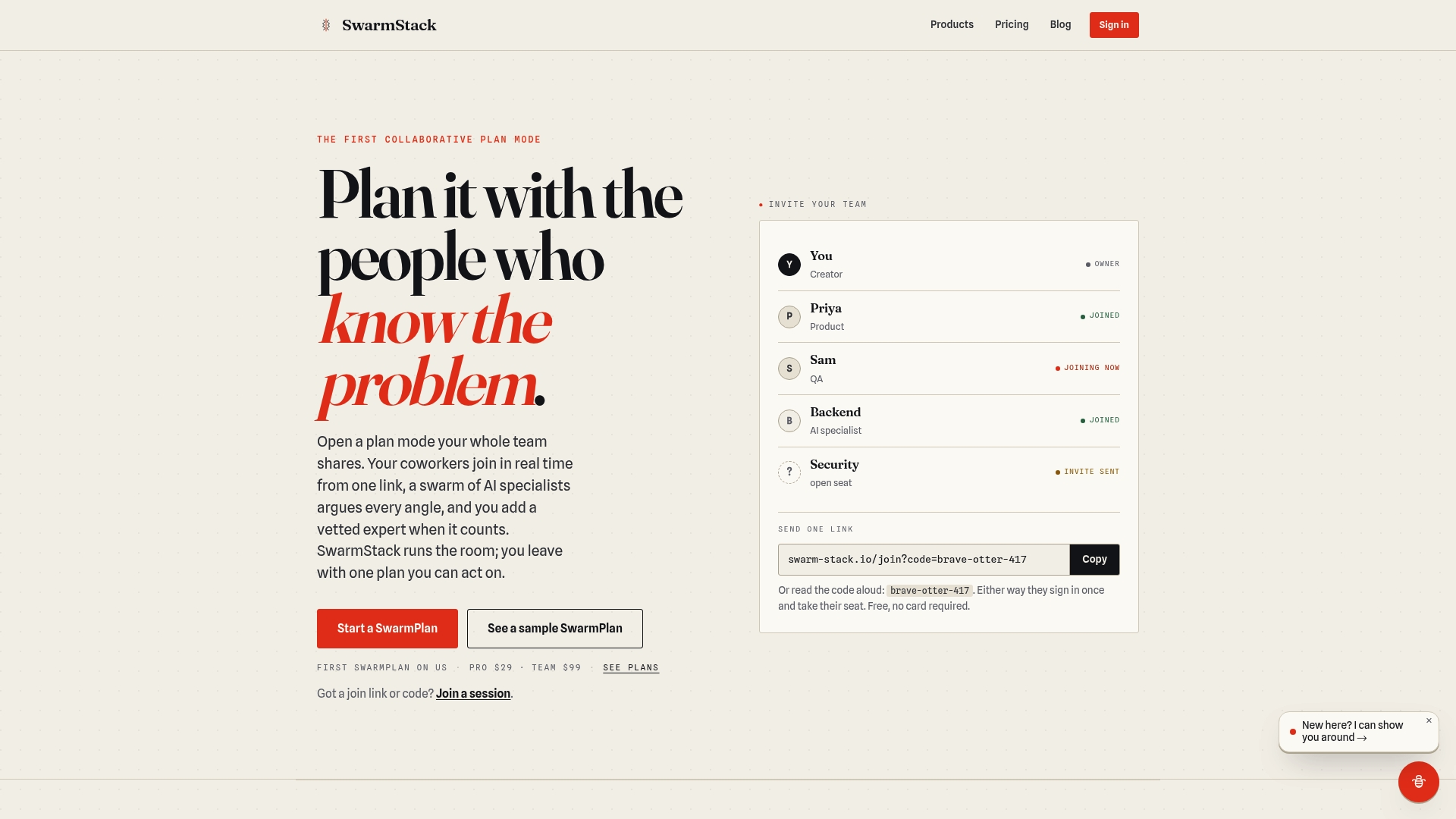
Swarm-stack addresses that coordination problem directly. The platform lets teams run structured feedback sessions combining AI-driven templates and human expert input, so the right questions for each phase are already built in rather than drafted from scratch each time. Four capabilities map directly to what this article covers:
- Phase-based templates: Pre-structured question sets for kickoff, milestone check-ins, handoff, and retrospectives, with both anonymous and attributed collection modes.
- Versioned deliverables: Every survey iteration and its results are versioned with decision tracking, so you can see how feedback changed the project plan over time.
- Action-item tracking: Themes and action items from feedback sessions are tracked with owners and due dates, directly inside the platform.
- Export to Jira and GitHub: Action items export directly to the tools your team already uses, closing the loop between feedback and execution without manual copying.
For teams handling sensitive feedback, Swarm-stack's data privacy and trust practices cover how responses are stored and who can access them. Start a session at Swarm-stack to see how the platform shortens the path from a completed survey to a tracked, owned action item.
Sources
- Systems thinking and project outcomes (PMI)
- Opair
- Norm Kerth's Prime Directive Retrospective - Original Four Template (TeamRetro)
- Blameless Retrospectives Best Practices | 2026 (GitScrum Docs)
- Building Psychological Safety in Retrospectives: The Complete Guide - TeleRetro