Strategic Planning RFP: A Guide for Project Teams
Create a winning strategic planning RFP to attract top vendors. Clearly define goals, scope, and evaluation criteria for better proposals.

A strategic planning RFP is a vendor-evaluable document that defines objectives, scope, methodology, timeline, fees, evidence of experience, and clear evaluation criteria — structured so proposals are directly comparable. Build it right and you get responses you can actually score. Build it vague and you get a pile of incompatible pitches that waste everyone's time.
Every compliant RFP for strategic planning services needs these elements:
- Executive summary with desired outcomes and organizational context
- Objectives and scope with explicit boundaries (what is and is not included)
- Methodology requirements (workshops, stakeholder interviews, deliverable formats)
- Project timeline with milestones and decision points
- Fee breakdown format (phase-based, time-and-materials, or tiered)
- Firm experience, references, and relevant case studies
- Assumptions, constraints, and resource expectations
- Evaluation criteria and submission instructions
Two trust signals worth adding to every RFP: require at least three client references with contact information, and ask vendors to disclose whether they use generative AI and describe their human oversight process. Procurement teams that skip the AI-disclosure ask often discover mid-engagement that deliverables were drafted by a tool with no human review.
Table of Contents
- What does a strategic planning RFP template look like?
- How to write each section of the RFP
- What timeline should you build into the RFP?
- How should you score vendor proposals?
- What fee formats should you request from vendors?
- What methodology and stakeholder engagement should you require?
- How do you co-create the RFP with your team using AI?
- Release checklist and vendor management after the RFP goes out
- Key Takeaways
- Why collaborative drafting beats solo document work
- Swarm-stack makes this RFP faster to build
- Useful sources and RFP examples
What does a strategic planning RFP template look like?
Use this structure as a starting point. Drop it into a shared document or a Swarm-stack session and fill each section.
Cover Page: RFP title, issuing organization, RFP identifier, submission deadline, and primary contact.
Executive Summary (2–3 sentences): Describe the organization, the planning horizon, and the core outcome expected. Example: "[Organization] seeks a qualified consultant to facilitate development of our 2026–2029 strategic plan. The engagement will produce a board-adopted plan with measurable objectives, an implementation roadmap, and a stakeholder engagement summary."
Objectives and Scope: List 4–6 specific objectives. State what is explicitly out of scope.
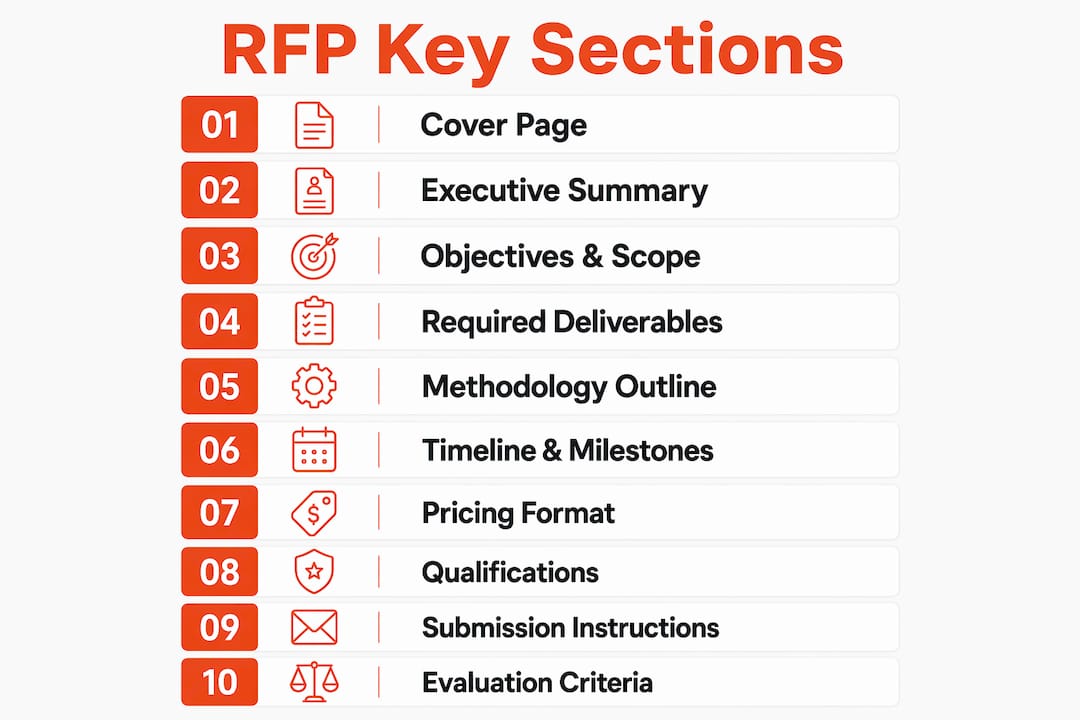
Required Deliverables: Numbered list of outputs (draft plan, final plan, stakeholder summary, implementation roadmap, presentation deck).
Methodology Outline: Describe the engagement approach expected — workshops, interviews, board sessions, and any equity-focused engagement requirements.
Timeline and Milestones: Key dates from kickoff through board adoption.

Pricing Format Requested: Specify whether you want fixed-price, time-and-materials, or tiered pricing separated by phase.
Qualifications and References: Minimum years of experience, sector relevance, and three client references with contact details.
Submission Instructions: File format (PDF preferred), submission portal or email, page limits, and Q&A deadline.
Evaluation Criteria Summary: Weighted categories so vendors understand how they will be scored.
Pro Tip: Add a one-line addenda rule: "Questions received after [date] will not receive a response. All addenda will be posted to [location] within five business days of the Q&A deadline."
How to write each section of the RFP
Executive summary and desired outcomes
State the planning horizon, the trigger for the engagement (expiring plan, new leadership, strategic shift), and the primary output. Keep it to a short paragraph. Vendors use this to calibrate their approach — a vague summary produces vague proposals.
- Include the organization's mission in one sentence
- Name the planning period (e.g., 2027–2030)
- State the expected board adoption date
Objectives and scope
Be specific. Standard RFP checklists consistently list clear objectives and scope as required elements because vague scope is the single biggest driver of cost overruns and misaligned deliverables.
- List 4–6 numbered objectives (e.g., "Identify three strategic priorities for the next four years")
- State what the consultant is NOT responsible for (e.g., implementation, fundraising strategy)
- Specify any required frameworks (OKRs, balanced scorecard, logic model)
Methodology, deliverables, and timeline
Public RFPs routinely specify phase-by-phase scopes, session counts, and required deliverable formats. Follow that model.
- Require a draft and final version of the strategic plan (not just a slide deck)
- Specify deliverable acceptance criteria: "The final plan must include measurable objectives, an implementation roadmap, and an annotated stakeholder engagement summary"
- Ask for a sample project timeline with major tasks and milestones
Pro Tip: Phrase acceptance criteria around operational outputs. "Deliverable accepted upon board approval of final plan document in editable format" prevents a vendor from submitting a PDF presentation and calling the engagement complete.
Assumptions, constraints, and submission instructions
List resource constraints (staff time available, data access, travel budget), technology requirements, and any conflict-of-interest rules. Require proof of insurance. The Delaware DHSS RFP requires proof of insurance prior to contract start — a standard clause worth copying.
What timeline should you build into the RFP?
A typical strategic planning engagement runs 4–9 months depending on organizational complexity. RochesterWorks specifies a 4–6 month window for a focused 3–4 year plan. Larger public agencies like NVTA set six-month completion timelines with explicit evaluation and interview windows.
| Phase | Key Deliverable | Typical Duration | Decision Point |
|---|---|---|---|
| Kickoff and discovery | Project charter, stakeholder list | Weeks 1–2 | Confirm scope and contacts |
| Stakeholder engagement | Interview summaries, survey results | Weeks 3–6 | Approve engagement findings |
| Strategy workshops | Draft priorities, SWOT/PESTLE | — | Leadership alignment session |
| Draft plan | Draft strategic plan document | — | Internal review and revision |
| Revision and adoption | Final plan, board presentation | — | Board vote |
| Implementation planning | Roadmap, KPIs, monitoring plan | — | Operational handoff |
Include these calendar items in the RFP itself: proposal questions due date, addenda posting date, interview window, expected contract start, and board adoption target.
How should you score vendor proposals?
A defensible scoring matrix keeps your evaluation panel aligned and documents the selection rationale. The Covered California RFP 2026-04 uses explicit weighted criteria and minimum qualifications — a model worth following for any public or regulated procurement.
| Evaluation Category | Weight | What to Look For |
|---|---|---|
| Approach and methodology | — | Specificity, stakeholder engagement plan, equity focus |
| Relevant experience | 25% | Similar sector, similar scale, named projects |
| Stakeholder engagement plan | 20% | Session types, facilitator qualifications, inclusion evidence |
| Price | — | Clarity, phase-based breakdown, assumptions stated |
| References and sample deliverable | — | Quality of references, relevance of sample plan |
Required attachments: resumes of lead consultants, a sample project timeline, two relevant case studies, three client references with contact details, proof of insurance, and a conflict-of-interest declaration. Set a minimum pass score (e.g., 70 out of 100) before price is considered.
What fee formats should you request from vendors?
Three formats work well for strategic planning services. Ask vendors to provide all three if the engagement has optional components.
Fixed-price, phase-based: One price per phase with defined deliverables. Easiest to compare across proposals. Best for well-scoped engagements.
Time-and-materials with a not-to-exceed cap: Hourly or daily rates with a ceiling. Useful when scope may shift. Require vendors to list staffing rates by role.
Tiered pricing: Separate core facilitation from optional add-ons (advanced data modeling, long-term implementation support). The GHF RFP sets a $14,000 all-in budget for a small nonprofit engagement — a useful benchmark for scoping smaller projects. Separating core from optional components eases budget approval and lets you expand scope later without renegotiating the base contract.
Sample language: "Provide a fee breakdown by phase, including staffing rates by role, assumptions about travel and reimbursable expenses, and a brief explanation of how the pricing structure reflects the proposed approach."
What methodology and stakeholder engagement should you require?
Facilitators must combine strategic planning skills with public engagement expertise to build genuine consensus — not just produce a document leadership signs off on. Require vendors to describe both.
A solid engagement mix includes executive interviews (6–12), staff workshops (at least 2), community or listening sessions where relevant, and one board retreat. Require facilitators to document participant input with annotated meeting notes, raw themes, and a traceable decisions log. For organizations working with equity-deserving communities, ask for evidence of prior experience with those groups specifically. Teams in regulated sectors like healthcare can also reference healthcare SaaS customer success practices when designing engagement requirements for health-adjacent planning engagements.
How do you co-create the RFP with your team using AI?
The fastest way to produce a defensible, complete RFP is a structured collaborative session where every stakeholder contributes in real time. Here is a repeatable five-step workflow:
- Define scope — document objectives, constraints, and non-negotiables before the session
- Invite stakeholders to a Swarm-stack session via a single link (procurement lead, data owner, department heads, facilitator)
- Synthesize drafts with AI specialists — Swarm-stack's AI specialists argue each section from multiple angles, surfacing gaps your team might miss
- Iterate with decision-tracked comments — every revision is versioned and every decision is logged, so the rationale is auditable
- Export the final RFP to your preferred format or directly to project management tools like GitHub or Jira
Capture decision logs, version history, and key assumptions during the session. When the RFP asks vendors to disclose AI use, your own process should be documented the same way — transparency builds credibility on both sides. For teams new to AI-assisted RFP creation, this workflow cuts drafting time significantly and reduces the back-and-forth that typically delays release.
Pro Tip: Assign four roles before the session starts: Facilitator (owns the agenda), Data Owner (brings internal data and constraints), Procurement Lead (owns compliance and submission rules), and AI Specialist (manages AI synthesis and flags gaps). Clear roles keep the session productive and the output auditable.
Release checklist and vendor management after the RFP goes out
Pre-release:
- Final internal approvals obtained (legal, finance, leadership)
- Conflict-of-interest checks completed for evaluation panel members
- RFP published to the correct procurement portal or website
- Contact information and addenda rules confirmed
Post-release:
- Centralized Q&A log maintained (all questions and answers shared with all vendors)
- Addenda issued promptly and posted to the same location as the original RFP
- Proposal receipt confirmed in writing to each submitter
- Interview schedule sent to shortlisted vendors within five business days of proposal review
Post-selection:
- Contract negotiation timeline set (target: within 20 days of selection notice)
- Performance milestones written into the contract
- Reporting cadence agreed (monthly check-ins, milestone sign-offs, final deliverable acceptance)
Key Takeaways
A well-structured strategic planning RFP produces directly comparable proposals, a defensible selection rationale, and a faster path from vendor selection to board-adopted plan.
| Point | Details |
|---|---|
| Structure drives comparability | Include all nine required sections so every vendor responds to the same criteria. |
| Weighted scoring matrix | Use a 100-point matrix (methodology —, experience 25%, engagement 20%, price —, references —) for defensible selection. |
| Timeline realism | Budget 4–6 months for a focused engagement; larger public-agency projects typically run up to six months. |
| AI disclosure is now standard | Require vendors to state whether they use generative AI and describe their human oversight process. |
| Swarm-stack accelerates drafting | Collaborative AI-assisted sessions with decision tracking cut RFP drafting time and produce a versioned, auditable document. |
Why collaborative drafting beats solo document work
The conventional wisdom is that one person — usually the project manager or procurement lead — drafts the RFP and circulates it for comments. That process almost always produces a document that reflects one perspective, misses constraints other departments know about, and requires multiple revision rounds before it is ready to release.
What actually works is getting the right people in the same session before a single word is written. When a procurement lead, a department head, and a finance contact all contribute to scope definition simultaneously, the assumptions surface early instead of appearing as surprises after vendor selection. Versioned decision logs mean you can trace why a particular deliverable requirement was included — useful when a vendor pushes back during contract negotiation.
The transparency argument matters too. Proposals that sell a vision and demonstrate contextual intelligence consistently outperform generic process descriptions. The same logic applies to the RFP itself: a document that clearly reflects organizational complexity and real stakeholder input attracts better proposals than a generic template. Collaborative drafting is how you get there without three weeks of email threads.
Swarm-stack makes this RFP faster to build
Drafting a strategic planning RFP from scratch takes days when it is done through email chains and disconnected documents. Swarm-stack compresses that to hours. In a single session, your team defines scope, surfaces assumptions, and produces a versioned draft with every decision logged and traceable.
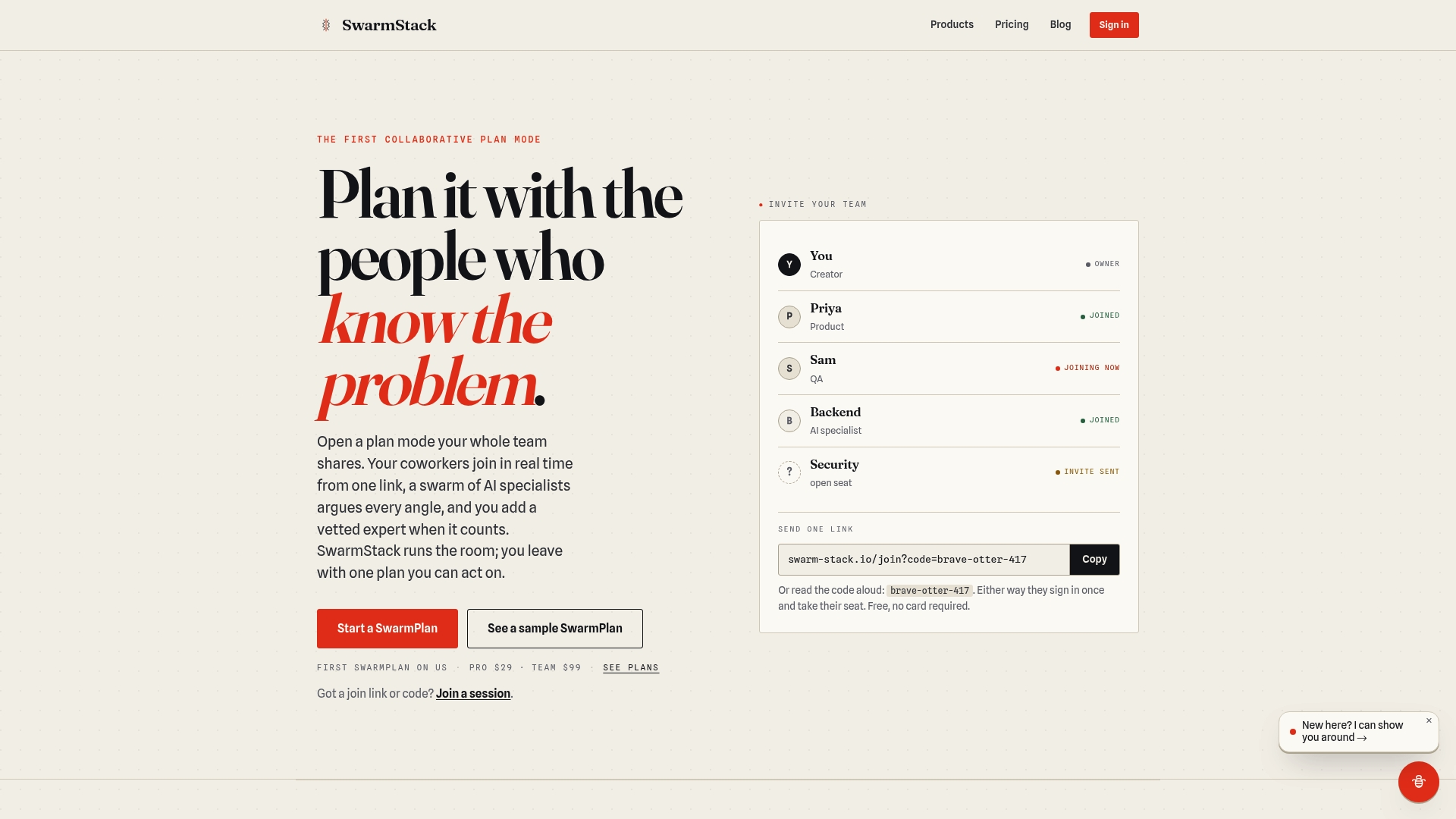
Four features matter most here: real-time collaborative sessions where human experts and AI specialists argue each section from multiple angles; deliverable versioning so you always know which draft is current; a built-in decisions log that documents why each requirement was written the way it was; and direct export to tools like GitHub and Jira when the RFP feeds into a larger project workflow. Swarm-stack also addresses the AI-transparency question directly — its data privacy and trust practices are documented so your procurement team can include that information in your own AI-disclosure language.
Ready to build your next RFP in a single session? Start with Swarm-stack or review pricing options to find the plan that fits your team.
Useful sources and RFP examples
These public RFPs and guidance documents are worth reviewing before you finalize your own document.
Delaware DHSS Strategic Plan Development RFP — A state-agency example with a $500,000 budget ceiling, explicit evaluation criteria weights, and a clear scope of work covering assessment, implementation planning, and monitoring. Use it for procurement-compliant language and contract terms.
Covered California RFP 2026-04 — Demonstrates how to publish fixed key dates, minimum qualifications, and a proposal cap ($1,000,000). Strong model for OKR and KPI requirements in a multi-year plan.
Wellesley Institute RFP for Strategic Planning Consultants — Nonprofit example with explicit equity-focused engagement requirements, AI-disclosure ask, and a sample deliverable requirement. Best for organizations prioritizing stakeholder diversity and transparency.
IHCDA Strategic Plan Development Services RFP — Public housing agency RFP with phase-by-phase scope, session counts, and required deliverable formats. Use it to populate methodology and deliverable sections.
RochesterWorks Strategic Planning Consulting Services RFP — Focused 4–6 month engagement model that emphasizes right-sized deliverables and internal capacity. Useful when you want to avoid over-specifying complexity.
GHF Strategic Planning Consultant RFP — Small nonprofit example with a $14,000 all-in budget. Shows how to structure tiered pricing and optional deliverables for budget-constrained organizations.