AI RFP: A Project Manager's Guide for 2026
Discover how to craft an effective AI RFP. Evaluate vendors' capabilities and ensure compliance to avoid costly misalignments.

An AI RFP is a specialized procurement document designed to evaluate vendors' AI capabilities, compliance alignment, and integration readiness before any contract is signed. Unlike a standard request for proposal, an artificial intelligence RFP filters vendors based on AI-specific risks: model governance, data residency, audit trail integrity, and regulatory compliance under frameworks like the EU AI Act, COSO, and PCAOB AS 2201. Most organizations still use outdated SaaS templates that miss these distinctions entirely. The result is misaligned vendor expectations, costly post-deployment fixes, and compliance gaps that surface at the worst possible time.
What does an AI RFP actually include?
Effective AI RFPs are concise, running 3–5 pages, and follow seven core sections that produce comparable, actionable vendor responses. Keeping the document tight signals to serious vendors that your team knows what it wants. Bloated RFPs attract boilerplate replies.
The seven sections are:
- Business context: Your organization's industry, size, and the strategic goal driving this project.
- Problem definition: A precise, outcome-focused description of the problem. State measurable targets, not technical prescriptions.
- Scope: Explicit in-scope and out-of-scope boundaries. Ambiguity here generates wildly inconsistent bids.
- Technical environment: Current systems, APIs, data formats, and infrastructure the vendor must integrate with.
- Weighted evaluation criteria: Scored categories covering integration, data handling, governance, and production track record. Price is one factor, not the primary one.
- Commercial terms: Budget range, contract structure, SLA expectations, and post-deployment ownership requirements.
- Submission logistics: Deadline, format, point of contact, and demo expectations.
The problem definition section deserves extra attention. Over-specifying technical solutions reduces the quality of vendor responses because it constrains innovation. State the business outcome you need and let vendors propose the method. A procurement document that says "reduce manual invoice processing time by 40%" attracts better proposals than one that specifies a particular model architecture.
Pro Tip: Include your budget range in the RFP. Vendors who cannot deliver within that range self-select out, saving everyone time.

How should you score and evaluate AI vendors?
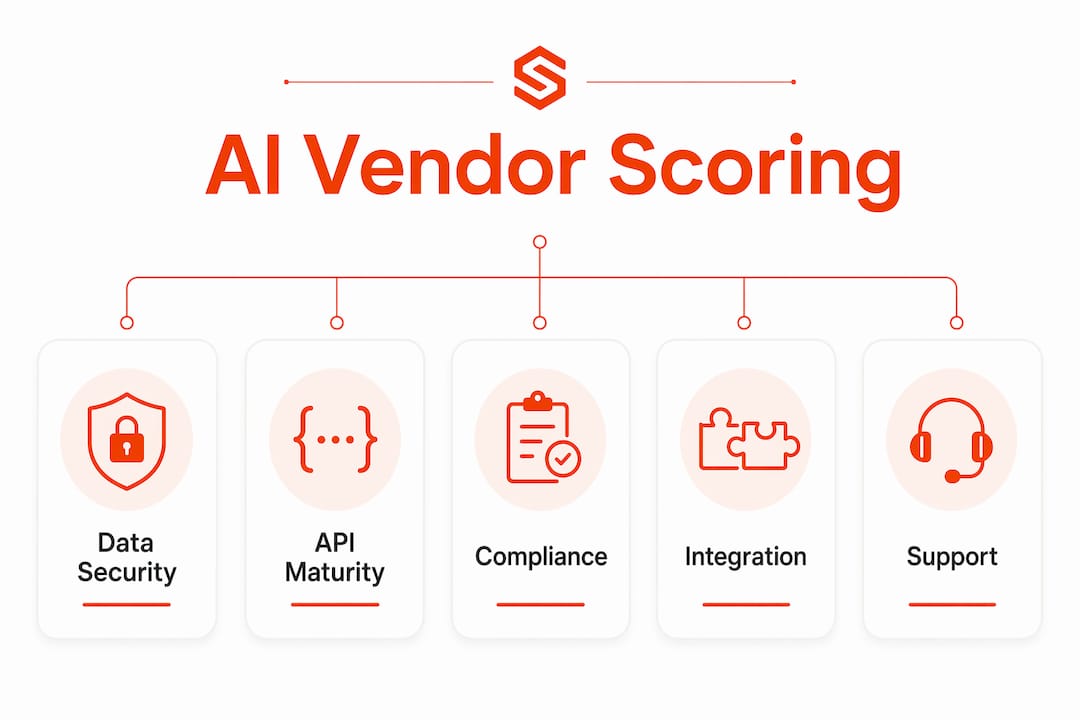
Scoring an AI vendor on price and feature count is the fastest path to a failed deployment. The structured 60-question scoring matrix across nine domains is the standard for AI procurements above $100,000 or involving sensitive data. This approach improves finalist selection by filtering out unfit vendors before pricing conversations begin.
The nine scoring domains are:
- Model capability and accuracy benchmarks
- Data security and residency controls
- System integration and API maturity
- Governance and version control practices
- Indemnity and liability terms
- SLA definitions and breach remedies
- Regulatory compliance documentation
- Product roadmap and vendor stability
- Exit strategy and data portability
Each domain carries a weight that reflects your organization's priorities. A healthcare team weights data security and compliance higher. A logistics team weights integration and SLA performance higher. The matrix forces that conversation internally before vendors ever respond.
The most critical feature of this scoring model is the hard-stop rule. Vendors scoring zero on critical compliance questions are eliminated immediately, regardless of how well they score elsewhere. This prevents the sunk-cost fallacy from keeping a non-compliant vendor in contention simply because they scored well on features.
| Scoring domain | Suggested weight |
|---|---|
| Data security and residency | 20% |
| Integration and API maturity | 18% |
| Model governance and version control | 17% |
| Regulatory compliance | 15% |
| SLA and breach remedies | 12% |
| Model capability benchmarks | 10% |
| Indemnity and liability | 5% |
| Roadmap and vendor stability | 2% |
| Exit strategy and data portability | 1% |
Pro Tip: Score vendors on the honesty and specificity of their responses, not just the content. A vendor who admits limitations is more trustworthy than one who claims perfection across every category.
Why do compliance and audit trails matter in an AI RFP?
Compliance requirements for AI systems changed significantly in 2026. Agentic AI RFPs now require explicit questions across architecture, audit trail design, model governance, human-in-the-loop (HITL) controls, and EU AI Act compliance. Generic checklists from prior years do not capture these requirements.
The EU AI Act Articles 11–14 establish documentation, transparency, and human oversight obligations for high-risk AI systems. Your RFP must ask vendors to demonstrate compliance with each article, not simply assert it. Ask for architecture diagrams, governance policies, and sample audit logs as part of the submission.
Audit trail requirements under COSO February 2026 and PCAOB AS 2201 specify that logs must capture prompts, inputs, outputs, model version information, and human review evidence for every AI-assisted decision. Logs must be immutable and reconstructable. A vendor who cannot demonstrate this capability is not ready for regulated environments.
Specific questions to include in your compliance section:
- How does your system log every AI decision, including the model version and input data used?
- What controls prevent retroactive modification of audit logs?
- Where is data processed and stored, and can you guarantee residency within our required jurisdiction?
- How does your HITL design work, and at what decision thresholds does human review trigger?
- What is your process for notifying clients of model updates that affect output behavior?
These questions separate vendors who have built compliance into their architecture from those who treat it as a documentation exercise. The AI RFP software guide from Swarm-stack covers how project teams can structure these compliance questions within a collaborative RFP workflow.
What are the most common AI RFP mistakes?
Most AI RFP failures trace back to three root causes: vague problem statements, price-centric evaluation, and missing technical environment details. Each one is avoidable with deliberate preparation.
A vague problem statement produces vague proposals. If your RFP says "improve our customer service," vendors will propose anything from a chatbot to a full CRM replacement. Define the specific process, the measurable outcome, and the constraints. "Reduce first-response time for tier-1 support tickets from 4 hours to under 30 minutes, without replacing the existing Zendesk environment" gives vendors a real target.
Vendors who produce fixed quotes without a discovery phase are a red flag. Serious AI vendors need to understand your data quality, system architecture, and team capabilities before pricing a project. A vendor who skips discovery is either guessing or selling a pre-packaged product that may not fit your needs. Similarly, absent or vague post-deployment ownership terms create disputes the moment something breaks.
A well-run AI procurement process follows five phases:
- Preparation (weeks 1–2): Define the problem, scope, technical environment, and evaluation criteria. Align internal stakeholders before writing a single word of the RFP.
- Issuance (week 3): Distribute the RFP to a shortlist of qualified vendors. Include a Q&A window to handle clarification requests.
- Scoring (weeks 4–5): Apply the weighted matrix to written responses. Eliminate any vendor triggering a hard-stop rule.
- Demos (week 6–7): Require finalists to demonstrate their solution against your actual data or a representative sample.
- Negotiation (weeks 8–10): Finalize commercial terms, SLAs, and post-deployment ownership before signing.
A full AI RFP process spans 6–10 weeks. Compressing that timeline to save time consistently produces security, compliance, and deployment problems that cost more to fix than the time saved.
Pro Tip: Require vendors to describe a past deployment that failed and what they did to recover. The answer reveals more about their reliability than any feature list.
For teams managing vendor qualification across multiple projects, the pre-qualification guide from Swarm-stack offers a practical framework for eliminating unsuitable vendors early in the process.
Key Takeaways
An AI RFP succeeds when it combines a precise problem definition, weighted compliance-focused scoring, and hard-stop elimination rules that prevent non-compliant vendors from advancing.
| Point | Details |
|---|---|
| Keep the RFP concise | A 3–5 page document with seven defined sections attracts serious, comparable vendor responses. |
| Weight compliance over price | Score vendors across nine domains; data security and integration should carry the most weight. |
| Apply hard-stop rules | Eliminate any vendor scoring zero on critical compliance questions before comparing costs. |
| Require audit trail evidence | Vendors must demonstrate immutable, reconstructable logs meeting COSO 2026 and PCAOB AS 2201 standards. |
| Budget 6–10 weeks | Rushing the evaluation phase creates compliance and deployment risks that cost more to fix later. |
The uncomfortable truth about AI procurement
I have reviewed a lot of AI procurement processes, and the pattern that keeps appearing is this: organizations spend weeks debating features and pricing, then sign a contract with a vendor who cannot answer basic questions about where their data lives or how their model logs decisions.
The AI RFP is not a formality. It is the only moment in the procurement cycle where you hold all the leverage. Once the contract is signed and the integration is underway, your negotiating position collapses. Vendors know this.
What I have found actually works is treating the compliance and audit trail sections as non-negotiable filters, not aspirational checkboxes. If a vendor cannot produce a sample audit log during the RFP phase, they will not produce one after deployment either. The hard-stop rule exists precisely because teams rationalize exceptions under deadline pressure.
The other thing worth saying plainly: the EU AI Act and COSO 2026 guidance are not bureaucratic obstacles. They exist because AI systems fail in ways that are hard to detect and harder to explain after the fact. Building those requirements into your RFP from the start is not extra work. It is the work.
— Cody
How Swarm-stack supports AI RFP collaboration
Building a rigorous AI request for proposal requires input from legal, technical, procurement, and operations teams simultaneously. Getting that alignment through email threads and sequential document reviews wastes weeks and produces inconsistent criteria.
Swarm-stack brings multiple AI specialists and human experts into a single structured session, so every evaluation criterion gets argued from every angle before the document is finalized. Teams join via a single link, contribute in real time, and leave with a complete, ready-to-issue RFP. The result is a document that reflects genuine cross-functional consensus, not whoever sent the last email. Start building your RFP with Swarm-stack and see how real-time AI collaboration produces better procurement outcomes from the first session.
FAQ
What is an AI RFP?
An AI RFP is a specialized request for proposal that evaluates vendors on AI-specific criteria including model governance, data residency, audit trail integrity, and regulatory compliance. It differs from a standard RFP by addressing the unique technical and compliance risks of AI systems.
How long should an AI RFP be?
An effective AI RFP runs 3–5 pages and covers seven core sections: business context, problem definition, scope, technical environment, weighted evaluation criteria, commercial terms, and submission logistics. Shorter documents attract more specific, comparable vendor responses.
What are hard-stop criteria in AI vendor scoring?
Hard-stop criteria are scoring rules that eliminate a vendor immediately if they score zero on a critical compliance or security question, regardless of their overall score. This prevents non-compliant vendors from advancing based on strong feature scores alone.
How long does an AI RFP process take?
A well-run AI procurement process spans 6–10 weeks, covering preparation, issuance, scoring, demos, and negotiation. Compressing this timeline increases the risk of security, compliance, and deployment failures that cost more to fix than the time saved.
What compliance standards apply to AI RFPs in 2026?
The EU AI Act Articles 11–14, COSO February 2026 guidance, and PCAOB AS 2201 all establish documentation, audit trail, and human oversight requirements for AI systems. Vendors must demonstrate compliance with these standards during the RFP process, not after contract signing.