RFIs in Construction: A Project Manager's 2026 Guide
Master RFIs in construction with our comprehensive 2026 guide. Streamline your project communications and avoid costly delays.

A Request for Information (RFI) in construction is a formal, documented inquiry used to resolve ambiguities in project drawings, specifications, or field conditions before work proceeds. RFIs in construction are not optional paperwork. They are the primary mechanism that keeps subcontractors, general contractors, architects, and engineers aligned when documents fall short. 30% of all project delays trace directly to poorly managed RFIs. That number alone explains why mastering the construction RFI process is one of the highest-leverage skills a project manager can develop.
What is the RFI process in construction?
The construction RFI process follows a defined chain of communication. Understanding each step prevents bottlenecks and protects all parties during disputes.
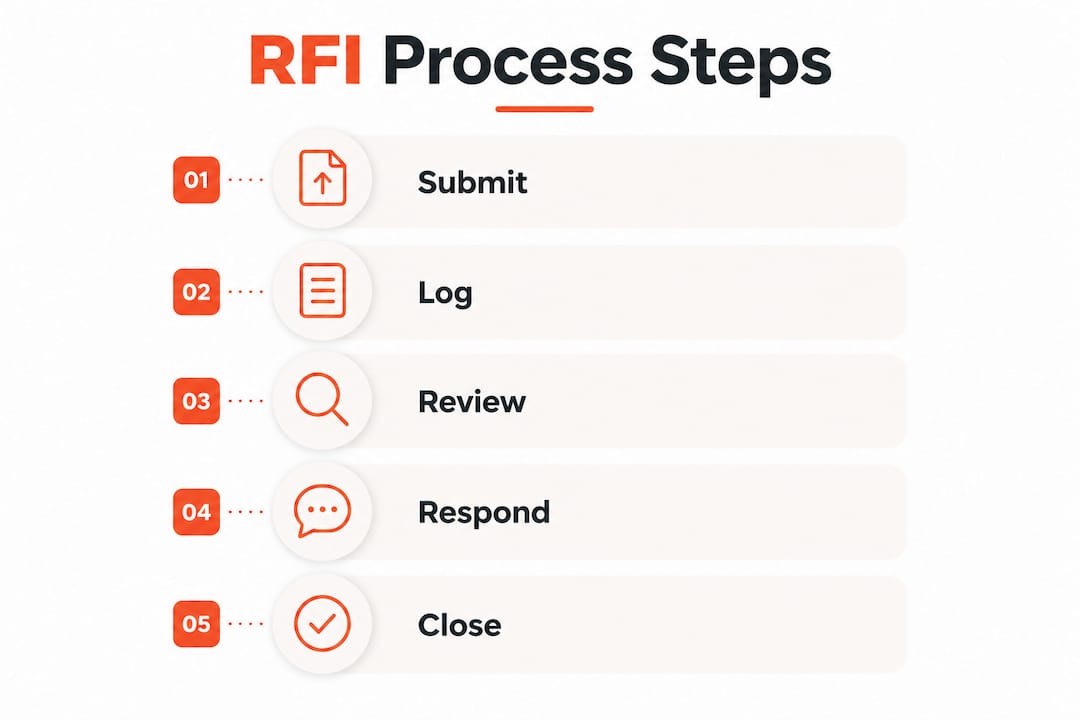
RFIs typically flow from subcontractors to general contractors, then to architects or engineers, creating a formal communication chain. Each handoff must be documented with timestamps and assigned owners. Here is how the full workflow runs:
- Identification. A subcontractor or field crew encounters an unclear detail, a conflict between drawings, or a missing specification. They document the issue with specific drawing references and a proposed solution.
- Submission. The subcontractor submits the RFI to the general contractor (GC). The GC reviews it for completeness before forwarding it up the chain.
- Review and routing. The GC logs the RFI, assigns a priority level, and routes it to the appropriate design professional, typically the architect or engineer of record.
- Response. The design team reviews the RFI and issues a written response. If additional input is needed from the owner or a specialist, the RFI may be re-routed before a final answer is issued.
- Distribution and closure. The GC distributes the approved response to all affected parties. The RFI is formally closed only when the answer is complete and actionable.
- Documentation. Closed RFIs are archived in the project log. This record becomes critical evidence during claims review or dispute resolution.
Every RFI must be logged with a unique number, submission date, required response date, and current status. Gaps in this log create liability. When a project goes to dispute, an incomplete RFI log is often the first thing an attorney examines.
What best practices improve RFI quality and response time?

A well-written RFI gets a faster, more useful answer. A vague one generates a vague response and restarts the clock. 15%–25% of RFIs get returned for clarification upon first submission, adding 5–10 days per bounce-back. That delay compounds across a project with hundreds of open items.
Strong RFIs share these characteristics:
- One question per RFI. Bundling multiple questions into one document forces the respondent to answer everything before the RFI can close. Split complex issues into separate submissions.
- Specific drawing and specification references. Cite the exact sheet number, detail, and specification section. Vague references force the design team to search before they can even begin answering.
- A proposed solution. Including a proposed solution speeds up response time by approximately 40%. It gives the design team a concrete option to approve, modify, or reject rather than starting from scratch.
- A priority flag tied to schedule impact. Label RFIs as standard or critical-path. Priority flags help design teams triage their workload without guessing which items will stop work first.
- A required response date. Best practice response deadlines are five business days for standard RFIs and two business days for critical-path items.
Pro Tip: Never close an RFI based on a partial or verbal answer. Closing RFIs prematurely creates false security and can trigger costly disputes during claims review. Require a written, complete response before marking any RFI closed.
Escalation procedures matter as much as deadlines. If a response is overdue by more than one business day, the GC should escalate directly to the project architect or owner's representative. Waiting silently for an answer is not a neutral act. It transfers schedule risk to the party waiting.
How can technology reduce RFI cycle times?
Technology does not replace good RFI discipline. It enforces it at scale. The most impactful operational change a project team can make is the daily RFI triage meeting. A daily RFI triage meeting reduces average cycle time from 12 days to 4.3 days within the first project month. That is a 64% reduction in turnaround time. A 15-minute daily meeting where the GC reviews open RFIs, confirms priorities, and escalates overdue items produces that result consistently.
Beyond meetings, digital tools change what is possible:
- Integrated RFI tracking software. Platforms that link RFIs directly to drawing sheets and project schedules let teams see exactly which open questions affect which upcoming activities. This connection makes priority decisions faster and more accurate.
- Automated escalation alerts. RFI tracking software with built-in deadline monitoring sends alerts when responses approach or pass their due dates. Manual follow-up is unreliable at scale.
- BIM coordination. Well-coordinated BIM models reduce RFI volume by 30%–40% by catching clashes before construction starts. Investing in pre-construction BIM coordination pays for itself in avoided field RFIs.
- AI-assisted scope review. RFIs are communication tools, not signs of project failure. Excessive RFIs often reveal gaps in pre-construction scope clarity. AI scope review tools, like those integrated into Swarm-stack's platform, identify missing or conflicting scope items before the project breaks ground.
Pro Tip: Use your RFI log as a leading indicator of project health. A spike in new RFI submissions during a specific phase often signals a drawing package problem, not a field execution problem. Catch it early and push for a design clarification meeting rather than managing hundreds of individual RFIs.
Top-performing projects maintain average RFI response times between 3 and 5 business days. Teams that hit this benchmark consistently use a combination of structured meetings, digital tracking, and pre-construction coordination. No single tool achieves it alone.
What are the cost and schedule impacts of unresolved RFIs?
Unresolved RFIs are not administrative inconveniences. They are direct cost drivers. Each RFI costs $600–$1,500 in administrative overhead, before accounting for delay impacts. When a critical-path RFI sits unanswered, idle labor costs can reach thousands of dollars per day. A project with 300 open RFIs and average administrative costs at the low end of that range carries $180,000 in overhead before a single delay is counted.
The downstream effects compound quickly:
- Rework. Crews who proceed without a formal RFI answer often build to their best interpretation. When the design team's actual intent differs, rework follows. Rework costs typically run two to three times the original installation cost.
- Schedule slippage. Delayed RFI responses push activity start dates. On a critical path, one delayed RFI can shift project completion by weeks.
- Change order disputes. Unresolved RFIs that result in field decisions create ambiguity about who authorized the work. Without a documented RFI response, cost recovery through change orders becomes difficult to defend.
The most effective mitigation strategies are front-loaded:
- Submit RFIs at least two weeks before scheduled work. This lead time gives the design team room to respond without creating a schedule emergency.
- Conduct pre-construction coordination meetings to resolve as many drawing conflicts as possible before mobilization.
- Link every RFI that results in a scope change directly to a potential change order. Document the connection at the time of submission, not after the fact.
- Use AI-driven RFP and scope tools during pre-construction to identify ambiguous scope language before it generates field RFIs.
The financial case for disciplined RFI management is straightforward. The cost of a structured process is a fraction of the cost of managing the delays and disputes that result from the absence of one.
Key Takeaways
Disciplined RFI management requires a formal workflow, clear response deadlines, and technology that enforces accountability across every stakeholder in the communication chain.
| Point | Details |
|---|---|
| Submit RFIs early | Submit at least two weeks before scheduled work to avoid creating schedule emergencies. |
| Write one question per RFI | Single-question RFIs close faster and generate cleaner documentation for claims review. |
| Include a proposed solution | RFIs with proposed solutions resolve approximately 40% faster than those without. |
| Use daily triage meetings | A 15-minute daily meeting can cut average RFI cycle time from 12 days to 4.3 days. |
| Link RFIs to change orders | Document the connection at submission time to protect cost recovery rights. |
The discipline gap nobody talks about
After working through complex construction projects, the pattern I see most often is not a technology problem. It is a discipline problem. Teams adopt RFI tracking software and then undermine it by closing RFIs on verbal answers, skipping the proposed solution field, or letting the log go stale for two weeks at a time.
The teams that manage RFIs well treat the log like a live project document, not a filing cabinet. They review it every morning. They escalate the same day a deadline passes. They refuse to close an RFI until the written answer is complete and distributed to every affected party. That discipline is harder to build than any software implementation, and it matters more.
The other thing I have learned is that including a proposed solution in every RFI is not just a time-saving trick. It changes the dynamic of the conversation. When you show up with a solution, you signal that you have thought through the problem. Design teams respond faster and more completely to RFIs that demonstrate that kind of preparation. It also gives you a stronger position if the answer comes back incomplete and you need to escalate.
Technology, including AI scope review and BIM coordination, genuinely reduces avoidable RFIs. But it only works when the team behind it maintains the same discipline they would apply to a manual process. The pre-qualification and coordination work done before mobilization determines how many RFIs you will face in the field. Invest there first.
— Cody
How Swarm-stack helps project teams manage RFIs

Swarm-stack brings AI-assisted collaboration directly into the project planning and RFI workflow. Teams use Swarm-stack's structured sessions to surface scope gaps before they become field RFIs, with multiple AI specialists and human experts reviewing documents simultaneously. The platform flags priority items automatically and keeps every team member aligned through a single shared workspace. Project managers report faster resolution cycles and cleaner documentation when RFI responses feed directly back into the project record. If your team is ready to cut RFI volume and cycle time, explore Swarm-stack's platform to see how AI-augmented coordination fits your workflow.
FAQ
What does RFI stand for in construction?
RFI stands for Request for Information. It is a formal document used to request clarification on drawings, specifications, or field conditions from the design team or owner.
How long should an RFI response take?
Best practice sets five business days for standard RFIs and two business days for critical-path items. Top-performing projects maintain average response times between 3 and 5 business days.
Who is responsible for responding to an RFI?
The architect or engineer of record typically responds to RFIs. The general contractor routes the RFI to the appropriate design professional and is responsible for distributing the final answer.
How many RFIs does a typical construction project generate?
RFI volume varies by project size and drawing quality. Projects with poorly coordinated drawings generate significantly more RFIs. BIM coordination can reduce RFI volume by 30%–40% compared to projects without pre-construction clash detection.
Can an RFI be used to support a change order claim?
Yes. A documented RFI response that confirms a scope change provides the written record needed to support a change order. Linking RFIs to potential change orders at the time of submission protects cost recovery rights throughout the project.