Inventory Your AI Systems in One Session: AI Governance for PMs
Practical AI governance for project managers: build an AI inventory in one session, follow a 30/60/90 starter plan, and run governance sprints that...

AI project governance is the set of policies, roles, and checkpoints that decide who can build, deploy, and monitor an AI system, and how risk gets caught before it becomes damage. It works because it's risk-based rather than one-size-fits-all, and cross-functional rather than owned by a single department. If you do nothing else this quarter, do this: inventory every AI system touching your projects and assign one accountable owner to each.
TL;DR:
- Most organizations should prioritize inventorying all active AI systems and assigning a clear owner for each to establish accountability and oversight.
- AI systems require risk-tiering based on potential impact, with high-risk models needing thorough validation, bias testing, and ongoing monitoring before deployment.
- Documentation such as model cards, datasheets, and risk assessments is essential to support audits, incident response, and future system retraining or retirement.
- Building governance skills through role-specific training, certifications, and practical exercises is crucial to develop effective oversight capabilities.
- Conducting focused, in-person governance sprints accelerates policy alignment, risk assessment, and decision-making, especially on high-stakes or problematic projects.
Table of Contents
- What Is AI Project Governance and Why Does It Matter?
- Who Owns AI Governance? Roles and Accountability Structures
- How Do You Operationalize AI Governance Across the Project Lifecycle?
- What Documentation Do You Need for Audits and Incident Response?
- What Training and Certifications Build AI Governance Skills?
- Your 30/60/90-Day AI Governance Starter Playbook
- Running a Governance Sprint: What Actually Works in Practice
- What Successful AI Governance Actually Looks Like
- Build Your AI Governance Inventory in a Single Working Session
- Where to Go for the Primary Governance Frameworks
- Sources
What Is AI Project Governance and Why Does It Matter?
Most project managers already run governance without calling it that. Change control boards, risk registers, sign-off gates: all governance. AI project governance takes that same instinct and points it at a specific problem: machine learning systems fail in ways traditional software doesn't. A model can perform well in testing and then drift silently in production. It can pass a bias audit at launch and still produce skewed outcomes six months later as the input data shifts. Traditional QA doesn't catch that. Governance does, if it's built right.
Core principles and canonical frameworks for AI project governance
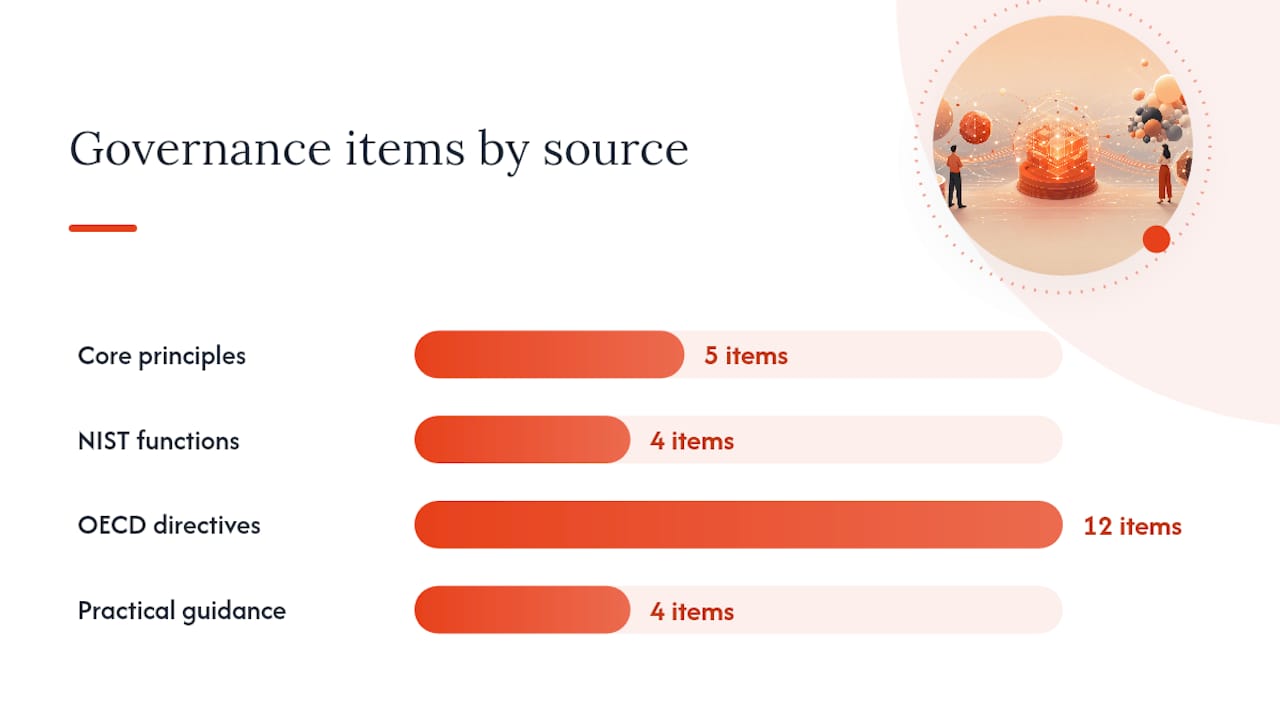
Every credible framework converges on the same handful of principles, even when the language differs. Fairness means the system doesn't produce disparate outcomes across protected groups. Transparency means stakeholders can understand, at some reasonable level, why the system made a decision. Accountability means a named person or body owns the outcome, not "the algorithm." Privacy and security cover data handling and protection against misuse or breach. Human oversight means a person can intervene, override, or shut the system down.
Two frameworks do the heavy lifting for turning those principles into practice. The NIST AI Risk Management Framework structures governance around four functions: govern, map, measure, and manage, applied continuously across the AI lifecycle rather than as a one-time checklist. The OECD AI Governance Playbook takes a more strategic angle, embedding twelve directives across corporate strategy, risk and compliance, workforce readiness, and day-to-day operations, and it explicitly ties AI governance to business strategy rather than treating it as a compliance add-on.
For project managers who need to know where governance efforts concentrate by sector, the MIT AI Governance Map catalogs real cases of AI risk governance across industries and scope. It's useful when you're building a case internally and want examples closer to your own sector than a generic template provides.
Practical guidance from enterprise practitioners tends to boil these principles into an operating model rather than a poster on the wall:
- Centralize the risk standards, but let domain teams execute against them.
- Assign a named accountable owner to every system, not a committee.
- Build human-in-the-loop checkpoints into any decision that materially affects a person.
- Treat monitoring as a lifecycle requirement, not a launch-day formality.
Databricks' enterprise guidance frames this as centralized standards with federated execution: one group sets the risk tiers and policy, and individual teams implement and stay accountable for their own systems. That structure scales better than either a single centralized bottleneck or a free-for-all across teams.
Who Owns AI Governance? Roles and Accountability Structures
Governance fails most often not because nobody wrote a policy, but because nobody knows whose job it is to enforce it. A workable structure starts at the top and runs through three distinct layers of defense.
The governing body, often a subcommittee of the executive team or the risk committee, sets risk appetite, approves high-risk deployments, and reviews incidents. Executive sponsorship matters here more than people expect. A governing body with no budget authority becomes a rubber stamp within two quarters.
Below that, the three lines of defense model, adapted from financial-services risk management, maps cleanly onto AI work. The Saidot framework on AI governance roles lays this out well:
- First line: product owners and development teams who build and operate the system and own day-to-day risk decisions.
- Second line: AI governance managers and compliance staff who set policy, run risk assessments, and challenge first-line decisions.
- Third line: internal or external auditors who independently verify that the first two lines are actually doing what they say.
Role-level checklists keep this from becoming abstract. A product owner should be able to name their system's risk tier, last validation date, and rollback plan without checking a spreadsheet. An AI governance manager should maintain a live risk register and sign off before anything crosses into a higher risk tier. A validation specialist tests for drift, bias, and performance decay on a fixed schedule, not only when someone complains. Auditors sample a percentage of deployed systems each quarter against documented policy, independent of whoever built them.
Decision-rights models like DACI or RACI help clarify who's a Driver versus who's merely Consulted, which matters enormously once a governance decision needs to move fast. Publish these role responsibilities somewhere every team can find them. A documented project governance model that lives in a wiki nobody reads accomplishes nothing.
Pro Tip: Give your AI governance manager veto power over deployment, not just advisory input. Advisory-only roles get overridden the first time a deadline is tight, and that's exactly when governance is needed most.
How Do You Operationalize AI Governance Across the Project Lifecycle?
Principles and org charts don't stop a bad model from shipping. Operational checkpoints do. Here's what that looks like in practice, from inventory through retirement.
-
Build the inventory first. Every AI system in use, whether homegrown or vendor-supplied, needs an entry capturing owner, purpose, data sources, training data provenance, performance metrics, current risk tier, last validation date, and deployment endpoints. This metadata set comes directly from NIST's AI RMF guidance and it's the backbone of every audit you'll ever run. Skip this step and every later control is guesswork.
-
Tier every system by risk. A practical three-tier model works for most organizations. Low risk covers internal tools with no material impact on people, like an AI writing assistant for internal memos, requiring only basic documentation. Medium risk covers systems that inform but don't finalize decisions, like a resume screener that flags candidates for human review, requiring a documented risk assessment and periodic monitoring. High risk covers systems that make or heavily weight consequential decisions, like credit approval or medical triage support, requiring a full pre-deployment review, bias testing, and continuous monitoring with defined rollback triggers.
-
Set approval thresholds by tier. Low-risk systems might need only team-lead sign-off. High-risk systems should require governing-body approval before launch, with a documented escalation path if performance degrades post-launch.
-
Run pre-deployment reviews as a gate, not a formality. Ask: What data trained this system, and does it represent the population it will affect? What's the false-positive and false-negative rate, and who absorbs the cost of each type of error? What's the rollback plan if monitoring detects drift?
-
Monitor continuously after launch. Track accuracy drift against a baseline, input data distribution shifts, and rates of human override or escalation. Log every automated decision on a high-risk system with enough detail to reconstruct why it happened. Set alert thresholds that trigger human review automatically rather than waiting for someone to notice a problem in a monthly report.
A risk assessment playbook built for general project risk adapts well here; the tiering logic is the same, just applied to model behavior instead of schedule slippage.
What Documentation Do You Need for Audits and Incident Response?
Governance without paperwork is just good intentions. Auditors, regulators, and your own future self all need a paper trail that reconstructs what happened and why.
The core documentation set includes:
- Model cards summarizing intended use, performance across subgroups, and known limitations.
- Datasheets describing training data provenance, collection methods, and known gaps.
- Risk assessment records for every tiering decision and the reasoning behind it.
- Procurement rubrics for vendor-supplied AI, covering questions the vendor must answer before purchase, useful reference material lives in a vendor selection guide for AI systems.
When something breaks, incident response needs a classification scheme before the incident happens, not during it. Classify by severity: did the system produce a materially wrong decision affecting a person, or was it a near-miss caught by human review? Triage assigns an owner and a response window based on that severity. A post-incident review documents root cause, immediate remediation, and whether the risk tier needs revisiting. Skipping the post-incident review is the single most common shortcut teams take under deadline pressure, and it's the one that guarantees the same failure recurs.
Retirement deserves its own criteria. A model gets retrained when drift crosses a defined threshold, patched when a specific vulnerability or bias is identified and fixable, or retired outright when the cost of maintaining accuracy exceeds the value it delivers, or when a better-governed replacement exists. Keep every artifact tied to the system's inventory ID so an audit three years from now can reconstruct the full history without a scavenger hunt.
What Training and Certifications Build AI Governance Skills?
Governance capability doesn't appear because leadership wants it. It gets built, deliberately, through training and hiring. The IAPP AI Governance Profession Report found that 77% of surveyed organizations are actively working on AI governance, and staffing and skill gaps remain the most common obstacle to doing it well. Practical programs often close that gap by assigning interim responsibility to existing privacy or compliance staff while recruiting dedicated specialists.
Certification pathways like the AIPGF and comparable credentials give teams a shared vocabulary and a baseline standard for what "governance-literate" means, useful when hiring or when justifying budget to leadership. Internally, role-based curricula matter more than generic AI-literacy training: product owners need risk-tiering training, governance managers need policy-writing and audit-prep training, and everyone benefits from periodic tabletop exercises simulating an incident.
Hire for these specific skills where you can:
- Policy translation: turning regulatory or framework language into workable checklists.
- Model literacy: enough technical grounding to ask the right diagnostic questions.
- Red teaming: actively trying to break or bias a system before it ships.
- Incident response: calm, methodical triage under pressure.
Your 30/60/90-Day AI Governance Starter Playbook
Governance programs stall when they try to boil the ocean in month one. Sequence it instead.
-
Days 1 to 30: Build the AI inventory across every active project. Appoint one accountable owner per system, even if that person is wearing the hat temporarily. Classify your top five highest-exposure projects into risk tiers.
-
Days 31 to 60: Draft a pre-deployment review template and pilot it on one project already in flight. Stand up basic monitoring, even manual spreadsheet tracking counts, for your highest-risk system. Kick off role-based training for the people who'll actually run this day to day.
-
Days 61 to 90: Brief the governing body or executive sponsor on inventory results and open risks. Run a tabletop incident-response drill using a realistic scenario. Pilot the full governance workflow, inventory through monitoring, on one new project end to end before scaling it further.
Ninety days won't get you a mature program. It will get you further than most organizations manage in a year of talking about it.
Running a Governance Sprint: What Actually Works in Practice
Governance work often stalls in meetings that produce documents nobody reads. A tighter format works better: a one or two-day collaborative sprint where the accountable owner, a governance manager, and one technical lead work through inventory, risk tiering, and a draft pre-deployment review together, in the same room or the same session, rather than passing a document back and forth over email for three weeks.

Structuring that sprint around versioned deliverables, tracked decisions, and invite-based review makes it far easier to show an auditor exactly who agreed to what and when. Building in a human-in-the-loop review checkpoint and a lightweight red-teaming pass, even just one person actively trying to break the system's assumptions, catches problems a checklist alone misses.
Pro Tip: Run your first governance sprint on a live project already causing friction, not a hypothetical one. Real stakes get real engagement, and you'll have a usable artifact by the end of day two.
- Assign one facilitator to keep the session moving and one scribe to capture decisions in real time.
- Export the resulting risk assessment and inventory entries directly into your project management or ticketing system so they don't live in an orphaned document.
- Revisit and version the deliverable at each major project milestone rather than treating it as a one-time exercise.
What Successful AI Governance Actually Looks Like
Governance that works doesn't slow projects down; it stops the expensive failures that would have slowed them down far more. The biggest mistake I see is treating governance as a gate at the end instead of scaffolding built in from day one. By the time a system is ready to ship, retrofitting fairness checks or documentation is painful and gets skipped under deadline pressure.
Executive sponsorship comes faster than people expect if you frame it around risk avoided, not compliance theater. Show one near-miss you caught early, and budget conversations get easier. The pitfall to watch for isn't too little governance. It's governance so heavy that teams route around it entirely.
— Cody
Build Your AI Governance Inventory in a Single Working Session
Most governance stalls at the inventory step because gathering owner names, risk tiers, and data provenance from five different teams by email takes weeks nobody has. Swarm-stack replaces that email chain with a single invite link: your accountable owners, governance manager, and technical leads join one structured session, work through the AI system inventory and risk tiering together in real time, and walk out with a versioned deliverable instead of a half-finished spreadsheet.
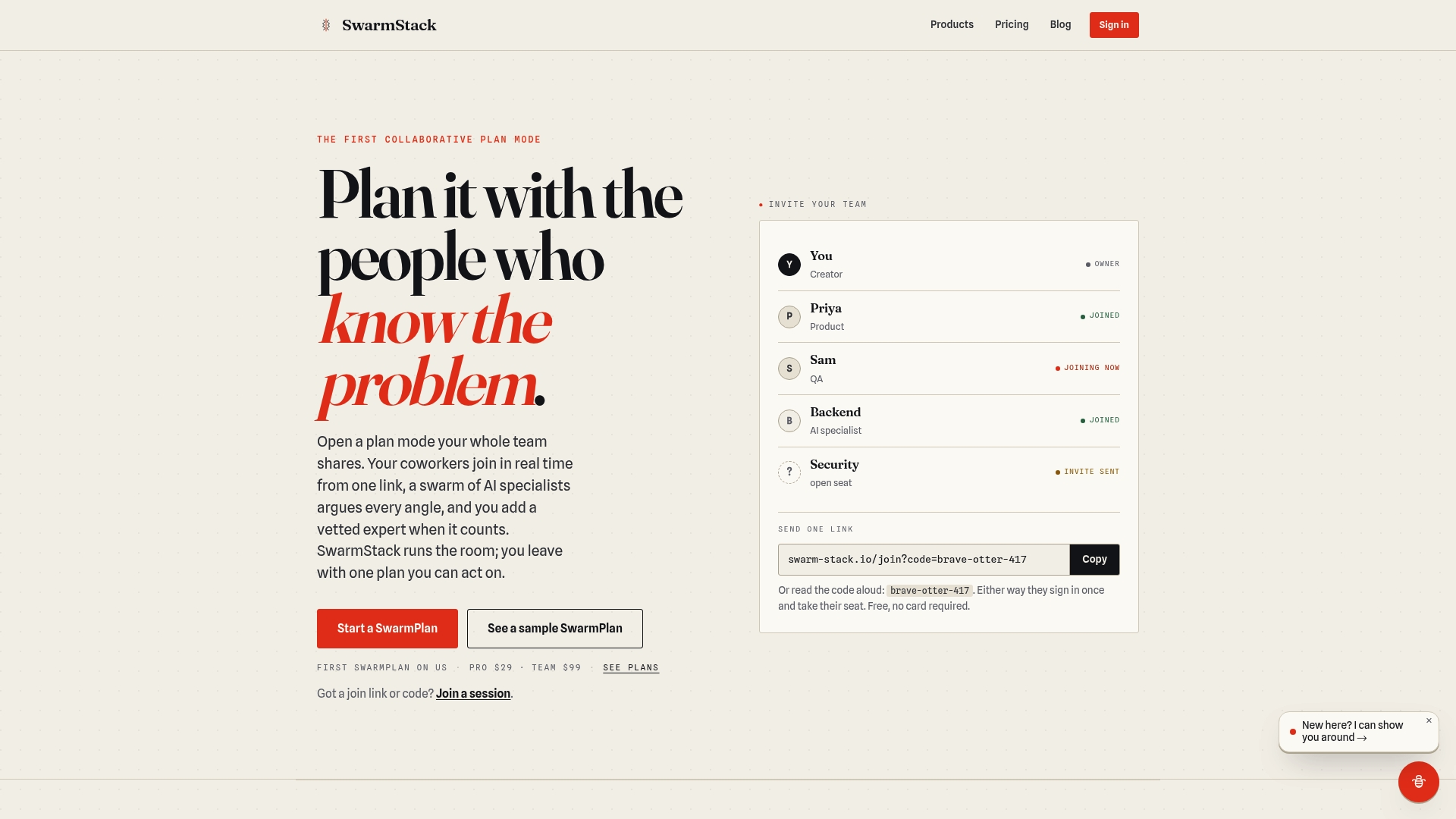
Every decision made during that session gets tracked automatically, so when an auditor asks who approved a risk tier six months later, you have a record instead of a guess. Finished inventories and risk assessments export directly into the PM and ticketing tools your teams already use, and Swarm-stack's own data handling and security practices are documented for teams who need to vet the platform before running sensitive governance work through it. If your governance program is still stuck in the inventory stage, start a session on Swarm-stack and get your first risk-tiered inventory built this week.
Where to Go for the Primary Governance Frameworks
For the source material itself: the NIST AI RMF covers lifecycle risk management, the OECD AI Governance Playbook covers strategic directives, the MIT AI Governance Map catalogs sector-specific cases, and the IAPP profession report tracks adoption trends and staffing challenges. For a broader look at ethical risk framing beyond these core frameworks, Proud Lion Studios' overview of AI's ethical implications is worth a read.
Sources
- Oecd
- NIST AI Risk Management Framework
- AI Governance Best Practices: How to Build Responsible and Effective AI Programs | Databricks Blog
- MIT AI Governance Map
- AI Governance Profession Report 2025 | IAPP