Risk Assessment in Project Management: A Team Playbook
Master risk assessment in project management with our four-stage playbook. Transform risks into actionable plans and achieve project success.

Risk assessment in project management is a recurring, four-stage decision discipline that surfaces the exposures requiring funded actions and named owners. Every session should end with these outputs in hand:
- A prioritized risk register with scored entries
- A named owner for every treated risk
- Concrete response actions with deadlines
- Tickets exported to Jira, GitHub, or your execution tool of choice
- Residual risk scores documented after treatment
Pro Tip: Before the session starts, write "no owner, no action" on the whiteboard. Analysis-only workshops produce documents. Decision-focused sessions produce tickets.
Table of Contents
- What does a risk assessment workflow actually look like?
- How do you score risks and build a usable priority list?
- How do you decide what to do with a prioritized risk?
- How do you run a real-time AI-enhanced risk assessment session?
- Who owns risk assessment and how often should you reassess?
- What artifacts should you produce during and after the session?
- What mistakes do teams make most often?
- Key Takeaways
- Why risk assessment only works when it's an operating habit
- Swarm-stack turns risk sessions into owned, executable plans
What does a risk assessment workflow actually look like?
The four-stage process — Identification, Analysis, Prioritization, and Response planning — is iterative, not linear. You cycle back through it on a cadence tied to project pace.
Identification is idea generation, not judgment. Use cause-event-effect statements ("Because the API vendor has no SLA, the integration milestone could slip, causing a two-week delay in UAT") and category prompts: technical, schedule, resource, external, compliance. Resist the urge to score risks while you are still surfacing them. Conflating identification with analysis is one of the most common session killers.
Analysis interrogates each risk for probability, impact, proximity (how soon it could hit), and interdependencies. For most projects, qualitative probability × impact scoring is sufficient. Reserve Monte Carlo simulation or Expected Monetary Value modeling for high-exposure, cost-heavy projects where the math justifies the effort.
Prioritization converts scores into an actionable shortlist. Define thresholds before the session: risks above a certain score get active treatment; those below go on a watch list. Without pre-agreed thresholds, prioritization debates eat the session.
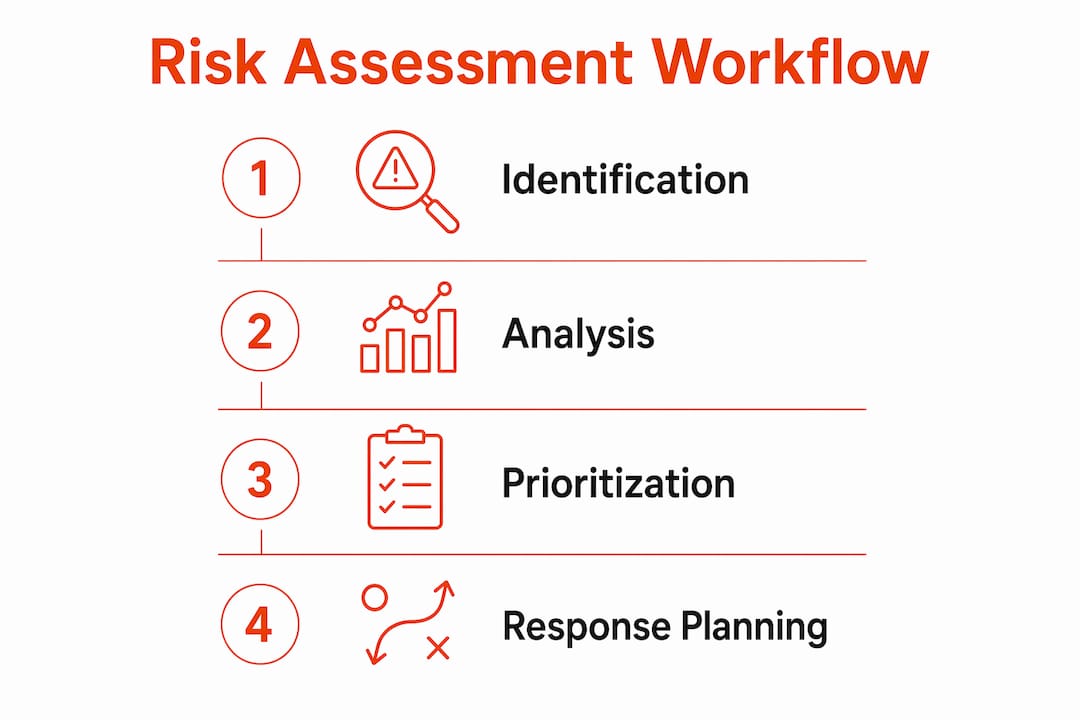
Response planning is where the session earns its keep. Every prioritized risk gets a treatment type, a named owner, a due date, and a contingency reserve estimate. Residual risk is scored after treatment and logged. Review frequency should match project pace: weekly for active delivery sprints, bi-weekly or monthly for slower programs.

Pro Tip: Tie each response planning item to a ticket before the session closes. A risk without a ticket is a good intention.
How do you score risks and build a usable priority list?
A 1–5 scale works for most projects. Low/Medium/High labels suit executive reporting. Use 1–5 when you need to rank a long list; use Low/Medium/High when you are presenting to a steering committee.
The core formula: Risk Score = Probability × Impact. A risk scored P3 × I4 = 12. A risk scored P5 × I2 = 10. The first one is higher priority despite lower probability because the impact is worse.
| Score range | Priority | Default action |
|---|---|---|
| 15–25 | Critical | Immediate treatment, owner assigned this session |
| 8 | High | Treatment plan within one sprint |
| 4–7 | Medium | Monitor; reassess next cycle |
| 1–3 | Low | Accept; log and watch |
Impact should cover multiple dimensions, not just schedule. Score each risk against cost, quality, reputational exposure, and compliance separately, then take the highest dimension as the impact score. A risk that barely moves the schedule but triggers a regulatory audit is not a medium risk.
Expected Monetary Value adds precision when you need it: EMV = Probability (as a decimal) × Financial Impact. An example of Expected Monetary Value (EMV) calculation: multiplying the probability of occurrence by the potential financial impact gives a value used for contingency planning. That figure feeds directly into your contingency reserve calculation. For most software or mid-size projects, qualitative scoring gets you 90% of the way there without the overhead.
Pro Tip: Add a "proximity" column to your register. A critical risk landing in six months is managed differently than one landing next week. Proximity changes the urgency of the response, even when the score is identical.
For construction or cost-heavy projects, quantitative benchmarking methods can sharpen your impact estimates before you run EMV calculations.
How do you decide what to do with a prioritized risk?
The five treatment options aligned to ISO 31000-style approaches give every team a decision menu:
- Avoid: Eliminate the risk by changing scope, approach, or timeline. Descoping a dependency that carries unacceptable exposure is avoidance. Use it when the cost of the risk exceeds the value of the work.
- Reduce: Lower probability, impact, or both. Add redundancy, run earlier testing, or build in buffer. This is the most common treatment for technical and schedule risks.
- Transfer: Shift the financial consequence to a third party via contract clauses, insurance, or SLA penalties. Transfer does not eliminate the risk; it changes who bears the cost.
- Share: Distribute the risk across partners or stakeholders, common in joint ventures or co-development agreements. Governance and communication requirements increase accordingly.
- Retain (Accept): Consciously accept the risk when the cost of treatment exceeds the expected loss. Document the acceptance, the trigger that would force escalation, and who made the call.
After treatment, log the residual risk score — the score that remains after your response is implemented. Contingency reserve covers identified residual risks; management reserve covers unknowns. The project manager controls contingency; management reserve requires sponsor approval.
Pro Tip: Never accept a risk without documenting the trigger. "We accept this risk" without a stated escalation condition is not a decision — it is a deferral.
How do you run a real-time AI-enhanced risk assessment session?
A 90-minute session can cover all four stages if it is structured tightly. Here is a working agenda:
- 0–15 min: Context setting. Share project objectives, assumptions, and any existing register entries. Assign a facilitator and a scribe (or use AI for both).
- 15–40 min: Identification. Use AI assistants to generate category-based prompts and draft cause-event-effect statements. Human participants validate, add, and challenge. Aim for 15–25 candidate risks.
- 40–60 min: Analysis and scoring. Score each risk collaboratively. AI can suggest initial scores based on project context; humans confirm or override. Log every override with a reason.
- 60–75 min: Prioritization. Apply pre-agreed thresholds. Move low-priority risks to the watch list. Focus the remaining time on the top 5–8.
- 75–90 min: Response planning. Assign owners, set due dates, define treatment types, and export tickets before the session closes.
When using AI assistants, require explicit human validation at every step. Capture the prompt, the AI-suggested output, and the human confirmation that converted the suggestion into an owned action. That audit trail matters when a sponsor asks why a risk was scored the way it was.
Structured prompts accelerate identification. Try: "For a [project type] with [key constraint], what are the top five technical risks in the [category] domain? Format each as: Because [cause], [event] could occur, causing [effect]." The output is not gospel; it is a starting point for the team to challenge.
For export targets, map each register entry to a ticket: summary = event statement, description = full cause-event-effect, acceptance criteria = residual score target, owner = named owner, due date = response deadline, linked ID = register row ID. AI-enabled project workflows follow the same export logic for RFPs and procurement artifacts.
Pro Tip: Predefine your Jira or GitHub ticket template before the session. Filling in a blank ticket mid-session kills momentum.
Who owns risk assessment and how often should you reassess?
Effective risk management is an operating discipline, not a compliance checkbox. Roles need to be explicit:
- Executive sponsor: Approves management reserve, makes go/no-go calls on critical risks, receives the top-risk summary report.
- Project manager: Owns the process, facilitates sessions, maintains the register, escalates when thresholds are breached.
- Functional owners: Own individual risks in their domain. Responsible for executing response actions and reporting trigger changes.
- Risk register custodian (coordinator): Keeps the register current between sessions, tracks due dates, flags overdue actions.
Every treated risk must have a single named owner. Shared ownership is no ownership. Reassessment cadence should match project complexity: weekly for active sprints, bi-weekly or monthly for slower programs. Trigger an ad hoc reassessment whenever scope changes materially, a key team member leaves, or a risk trigger fires.
Executive reporting should highlight three things: top risks by score, changes since the last report, and decisions the sponsor needs to make. A full register dump is not a risk report.
Pro Tip: Put the risk review on the standing sprint agenda. A five-minute check-in beats a two-hour catch-up after something goes wrong.
What artifacts should you produce during and after the session?
A functional risk register needs these minimum fields:
| Field | Purpose |
|---|---|
| Unique ID | Links register to tickets and reports |
| Cause-event-effect statement | Describes the risk precisely |
| Category | Technical, schedule, cost, compliance, etc. |
| Probability (1–5) | Likelihood of occurrence |
| Impact (1–5) | Worst-case dimension score |
| Risk score | Probability × Impact |
| Proximity | Time to impact |
| Owner | Single named person |
| Treatment type | Avoid / Reduce / Transfer / Share / Retain |
| Response action | Specific action with due date |
| Residual score | Score after treatment |
| Status | Open / In progress / Closed |
A register missing these fields degrades into a historical artifact within weeks. For version control of exported register files, treat CSV exports the same way you treat code: commit on every update, tag each release with the session date.
For Jira or GitHub exports, use these CSV headers: risk_id, summary, description, category, probability, impact, score, proximity, owner, treatment_type, response_action, due_date, residual_score, status, linked_ticket_id. Automate the export via webhook or API trigger at session close so tickets appear in the backlog before the team logs off.
What mistakes do teams make most often?
The most damaging pitfalls are structural, not technical:
- Conflating identification with analysis. Scoring risks while you are still surfacing them shuts down idea generation. Keep the stages separate.
- Static registers. A register updated once at project kickoff is a historical document. Build the update cadence into the project calendar.
- Shared ownership. "The team owns this risk" means nobody does. Every treated risk needs a single name.
- Analysis-only sessions. If the session ends without tickets, owners, and due dates, it produced paperwork, not decisions.
- Single-dimension impact scoring. Scoring only against schedule misses cost, quality, and compliance exposures that can be more damaging.
Best-practice checklist for every session:
- Pre-agree scoring thresholds before the session starts
- Use cause-event-effect phrasing for every risk statement
- Score impact across at least three dimensions
- Assign a single named owner to every treated risk
- Set a due date for every response action
- Export tickets before the session closes
- Log residual scores after treatment
- Schedule the next reassessment before the team leaves
Pro Tip: Run a two-minute "owner check" at the end of the session. Read each treated risk aloud and ask the owner to confirm. Public commitment increases follow-through.
Key Takeaways
Effective risk assessment in project management requires a four-stage iterative process, pre-agreed scoring thresholds, named owners for every treated risk, and tickets exported before the session closes.
| Point | Details |
|---|---|
| Four-stage workflow | Run Identification, Analysis, Prioritization, and Response planning as a repeating loop tied to project cadence. |
| Score across dimensions | Use Probability × Impact on cost, schedule, quality, and compliance — not schedule alone. |
| Named owners only | Every treated risk needs one person's name; shared ownership produces no accountability. |
| Export before you leave | Convert each treated risk to a Jira or GitHub ticket during the session, not afterward. |
| Swarm-stack sessions | Swarm-stack's real-time AI-enhanced sessions produce a versioned risk register with named owners and direct ticket exports in a single 90-minute swarm. |
Why risk assessment only works when it's an operating habit
Most teams treat risk assessment as a project-launch ritual. They run one workshop, produce a register, and file it. Three months later, the register is stale, the owners have changed, and the risks that actually derailed the project were never on the list.
The teams that consistently deliver on time and on budget treat risk assessment the way a pilot treats a pre-flight checklist: every flight, every time, no exceptions. The discipline is not in the template. It is in the cadence. Weekly reviews catch emerging risks before they become incidents. Pre-agreed thresholds remove the politics from escalation. Named owners create accountability that survives personnel changes.
The measurable payoff is real: fewer surprises in steering committee meetings, faster sponsor decisions because the data is current, and a team that builds risk awareness into how it works rather than treating it as overhead. The shift from compliance exercise to operating discipline is the single biggest lever available to a project manager who wants to stop firefighting.
Swarm-stack turns risk sessions into owned, executable plans
Running a structured risk assessment is straightforward in theory. Getting a distributed team to align on scores, assign owners, and export tickets in a single session is where most platforms fall short.
Swarm-stack is built for exactly that gap. Its real-time swarm sessions combine AI specialists and human experts in a structured format where every participant argues for their position, AI assistants draft cause-event-effect risk statements, and the session produces a versioned SwarmPlan with named owners and decision tracking baked in. No post-session cleanup. No chasing people for ticket numbers.
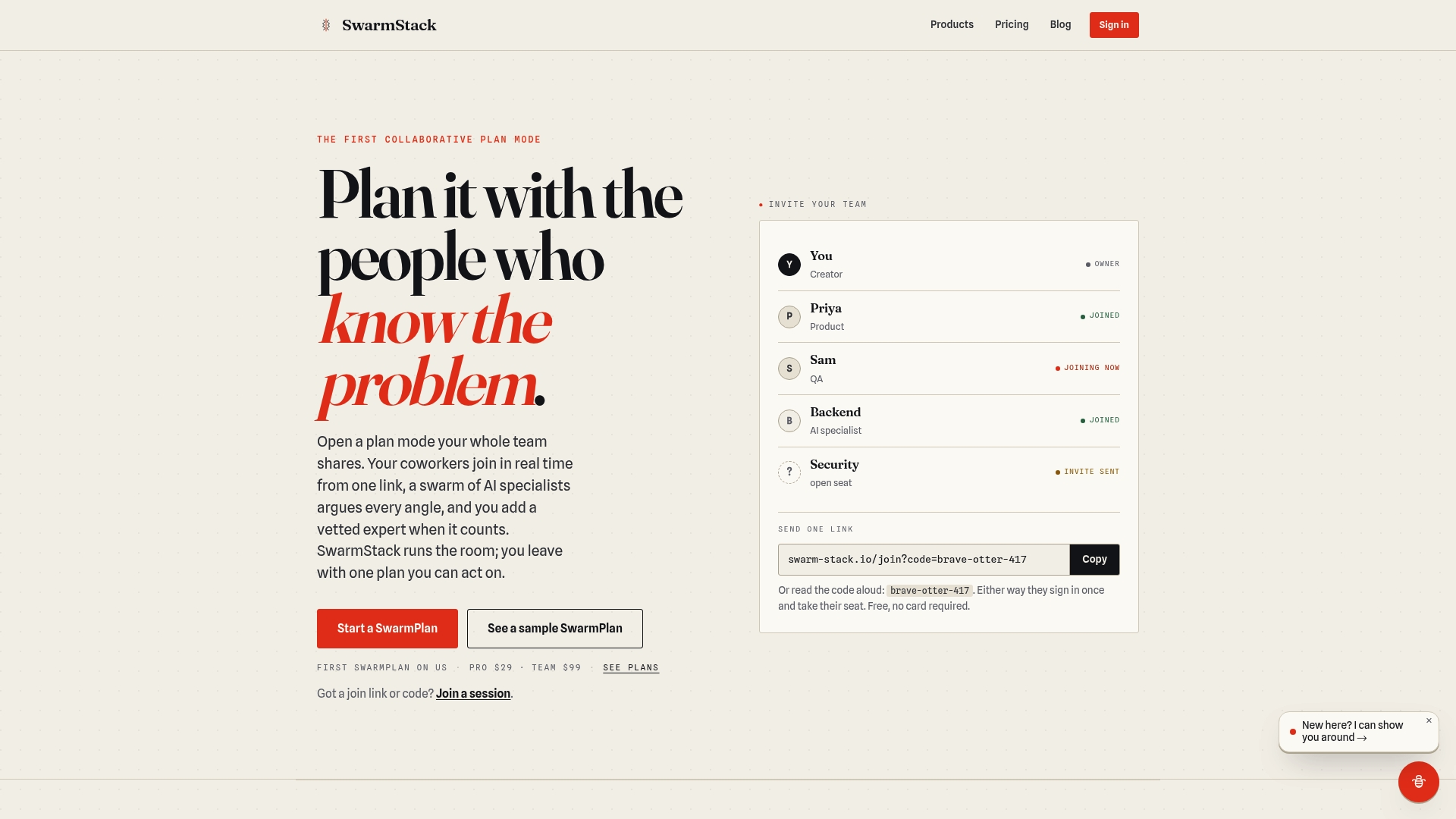
Exports go directly to Jira or GitHub. The register is versioned from the first session. And if you need a vetted risk expert in the room, the integrated marketplace connects you to one without a separate procurement process. Data handling meets enterprise standards — see security and privacy details before your first session.
Start your first risk assessment swarm at swarm-stack.io, or review pricing to find the plan that fits your team.