Alignment Workshop Agenda Templates for Facilitators
Discover effective alignment workshop agenda templates to ensure focused discussions, defined roles, and actionable outcomes in every session.

Use one of three ready-to-run agendas here (60 to 90 minutes, half-day, or full-day) to run a focused alignment workshop that ends with documented decisions, named owners, and a follow-up plan. Every version below is built to be copied into a calendar invite or shared doc as-is.
An agenda alone won't save a workshop. It needs four fixed elements or it drifts into a meeting that feels productive but produces nothing: a stated objective, defined outputs, clear attendee roles, and hard timeboxes with a named follow-up owner.
| Element | Why it matters |
|---|---|
| Objective statement | Keeps discussion from wandering into unrelated topics |
| Expected outputs | Defines what "done" looks like before the room fills up |
| Attendee roles | Separates deciders from contributors from observers |
| Timeboxes + owner | Forces decisions instead of endless discussion |
- Write the objective as a decision, not a topic ("Decide Q3 pricing tiers," not "Discuss pricing")
- Assign a timekeeper and a notetaker before the session starts
- Build in a 10 minute buffer for every 90 minutes of programming
- Name a follow-up owner for every open item before people leave the room
Key Takeaways
An alignment workshop only works when its agenda forces a decision, names an owner, and gets documented within 48 hours of the room clearing out.
| Point | Details |
|---|---|
| Pick the right length | Match 60 to 90 minutes, half-day, or full-day to how many decisions and dependencies you're actually resolving. |
| Prep beats facilitation skill | Stakeholder outreach and a pre-written brief done before the workshop prevent most post-session reversals. |
| Sequence exercises deliberately | Move from diagnose to explore to converge to commit; don't run convergence exercises in the diagnosis phase. |
| Document within 48 hours | A decisions register, named owners, and deadlines are the minimum output of any real alignment session. |
| Speed up prep with the right tool | Swarm-stack turns live session outputs directly into a versioned decisions log, cutting the manual write-up step out entirely. |
Table of Contents
- Three Ready-To-Run Alignment Workshop Agendas
- How Do You Prepare Stakeholders Before the Workshop?
- Which Exercises Work Best for a Team Alignment Workshop?
- How Do You Handle Conflict in an Alignment Meeting?
- What Happens After the Workshop Ends?
- What Most Facilitators Get Wrong About Prep
- Run Your Next Alignment Workshop With Less Prep Work
- Frequently Asked Questions
- Sources
Three Ready-To-Run Alignment Workshop Agendas
Pick the version that matches how much time and how many decisions you actually have. A 90-minute sprint forces one decision through; a full day earns you the room to map, debate, and commit to several.
60 to 90 minute sprint agenda (best for 4 to 8 people, one clear decision needed):
| Time | Activity | Output |
|---|---|---|
| — | Framing: objective, stakes, ground rules | Shared understanding of the decision |
| 10 to 30 min | Activity 1: option mapping | List of viable paths, ranked |
| 30 to 60 min | Activity 2: trade-off discussion and dot voting | Narrowed choice with visible rationale |
| 60 to 90 min | Decision checkpoint: confirm and stress-test | Documented decision |
| — | Owners and next steps | Named owners, deadlines logged |
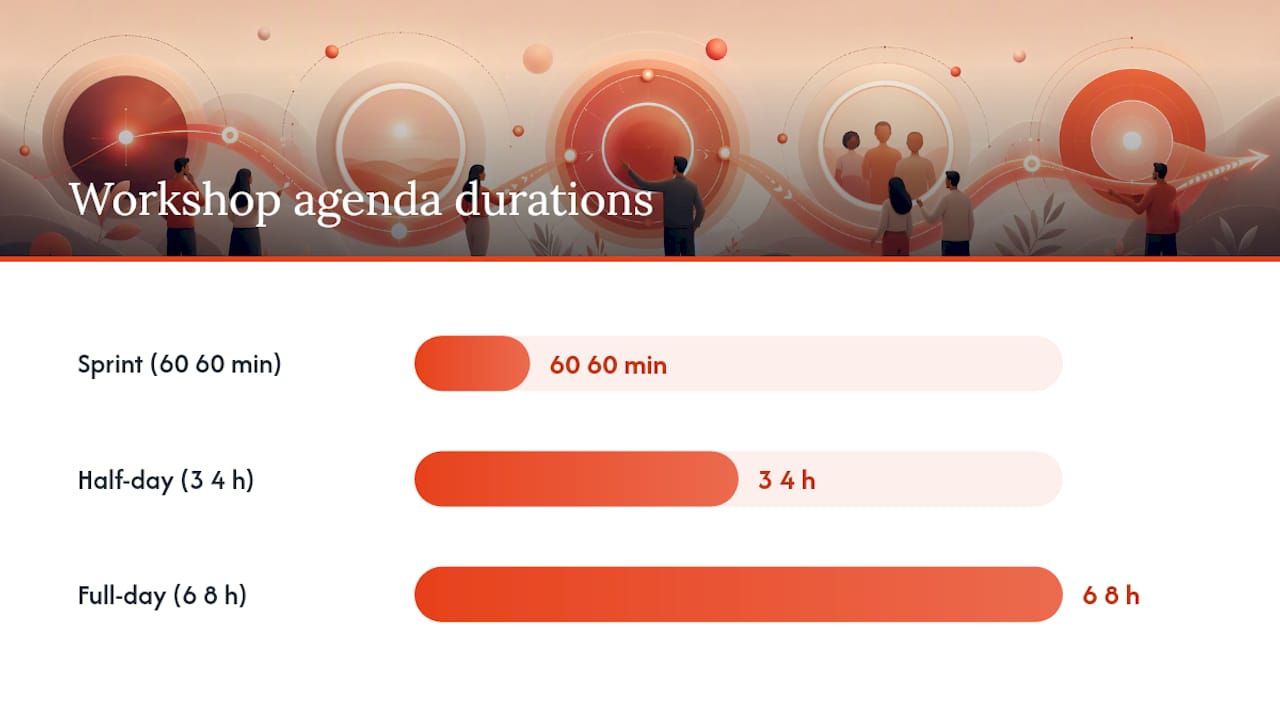
Half-day agenda (3 to 4 hours), for 8 to 15 people and a decision with several dependent parts: open with a 20 minute strategy framing brief (prepared in advance, not drafted live), run a stakeholder mapping exercise, break into small groups for 45 minutes to work competing options, reconvene for synthesis and trade-off debate, then close with a structured commitment round where each functional lead states what they will change based on the decision.
Full-day agenda (6 to 8 hours), for cross-functional groups of 12 to 25 tackling strategic scope: morning blocks handle framing and influence mapping using a matrix approach that locates overlapping interests instead of forcing a single negotiation. Afternoon runs two breakout cycles (explore, then converge), each followed by a plenary synthesis. The last 90 minutes are reserved entirely for prioritization and a public commitment session, no new discussion allowed.
For every version, list attendees and roles up front (decider, contributor, observer), specify materials (whiteboard software, sticky notes or digital equivalent, a timer visible to the room), and write facilitator prompts into the agenda itself so a co-facilitator could run it cold. A ready-made workshop toolkit can save you the setup time on the objectives and materials list if you're building your first one from scratch.
How Do You Prepare Stakeholders Before the Workshop?
Who attends matters more than how long the workshop runs. Invite the people who can actually commit resources or veto the outcome; consult everyone else beforehand instead of seating them at the table. A room over 15 people tends to produce plenary theater, not decisions, unless you break it into smaller groups.
Before the session, assign pre-reads, share any relevant data, and send a one-question survey to surface disagreement early rather than in the room. Skip drafting a full strategy document during the workshop itself. Bring a tight outcome-focused brief into the session so time goes toward choices, not writing.
A step-by-step outreach checklist:
- Map each stakeholder's influence and interest before sending invites
- Tailor outreach messages to what each stakeholder actually cares about, not a generic invite
- Build relationships during the "quiet period" well before the workshop date; leaders who do this face fewer reversals later
- Confirm known trade-offs privately with key stakeholders in advance so surprises don't derail the room
- Apply the four core moves consistently: map, build trust, tailor, and iterate
Pro Tip: Turn every pre-read response into an agenda line item. If three stakeholders flag the same concern in pre-work, give it its own timeboxed slot instead of letting it surface as a surprise objection twenty minutes before the session ends.
Which Exercises Work Best for a Team Alignment Workshop?
Match the exercise to the stage of the conversation. Diagnosing a problem calls for different tools than converging on a decision.
- Stakeholder/influence mapping (20 to 30 min, works for any group size): plots who cares about what and how much power they hold; run it early to guide the rest of the agenda
- Empathy mapping (15 to 20 min, small groups of 3 to 5): surfaces what different functions actually need, useful before option generation
- Value trade-off table (30 to 40 min, plenary or breakout): lines up competing priorities side by side so the room debates specifics instead of abstractions
- Dot voting (10 to 15 min, any size): converts open discussion into a visible, rankable preference signal
- Fishbowl discussion (20 to 30 min, groups over 15): a small circle debates while others observe and rotate in, which surfaces quieter voices that plenary formats tend to bury
- Prioritization matrix (20 to 30 min, small groups): sorts options by impact and effort to force a commitment conversation
For materials, a shared digital whiteboard (Miro and Mural are common choices), sticky notes for in-person rooms, a visible countdown timer, and a simple voting mechanism cover most of these. Sequence exercises diagnose, then explore, then converge, then commit. Save breakouts for exploration and reserve plenary time for convergence, where everyone needs to see the same trade-offs land. Running virtual? Swap physical sticky notes for a templated board and assign a co-facilitator to watch the chat for objections that would otherwise get lost.
How Do You Handle Conflict in an Alignment Meeting?
Set three ground rules before anything else starts: hard timeboxes, a visible speak-list instead of interruptions, and a parking lot for tangents. Enforce them out loud when they get broken, or they won't hold past the first agenda item.

Groupthink kills more workshops than open conflict does. Use silent brainstorming before group discussion, structured rounds where every person speaks once before debate opens, or a fishbowl for larger groups. These formats force disagreement to surface instead of letting the loudest voice set the room's direction.
Watch for false agreement. Nodding heads aren't alignment. Alignment is distinct from mere agreement, so check that people understand the rationale and trade-offs behind a decision, not just the decision itself. Ask someone to restate it back in their own words before moving on.
Pro Tip: After every break, spend the first two minutes recapping the last decision made before the break. Momentum dies in the gap between "we agreed on X" and picking the thread back up twenty minutes later.
What Happens After the Workshop Ends?
A workshop without documentation evaporates within a week. At minimum, produce a decisions register, named owners with deadlines, a one-page summary, and any visual artifacts (maps, voted lists) generated during the session.

Send a summary within 24 to 48 hours while memory is fresh. Check in at one week to confirm owners have started, and run a 30-day review to catch drift. Measure effectiveness with a few concrete signals: decision closure rate, whether implementation milestones were hit, and a short stakeholder satisfaction survey.
What Most Facilitators Get Wrong About Prep
The single habit that separates workshops that stick from ones that quietly get undone later is stakeholder work done before anyone enters the room. I've seen well-run sessions with sharp exercises and tight timeboxes fall apart in week three, purely because someone with veto power wasn't engaged early and reversed the call once they saw it in writing.
The fix isn't a better icebreaker. It's a five-minute private conversation two weeks out with the person most likely to object.
Run Your Next Alignment Workshop With Less Prep Work
Building a timed agenda by hand, tracking who said what, and turning sticky notes into a decisions register afterward eats hours you don't have between meetings. Swarm-stack cuts that prep and cleanup down by letting your team build the plan together in one live session, with AI specialists and your own experts arguing out the trade-offs in real time instead of in five separate Slack threads.
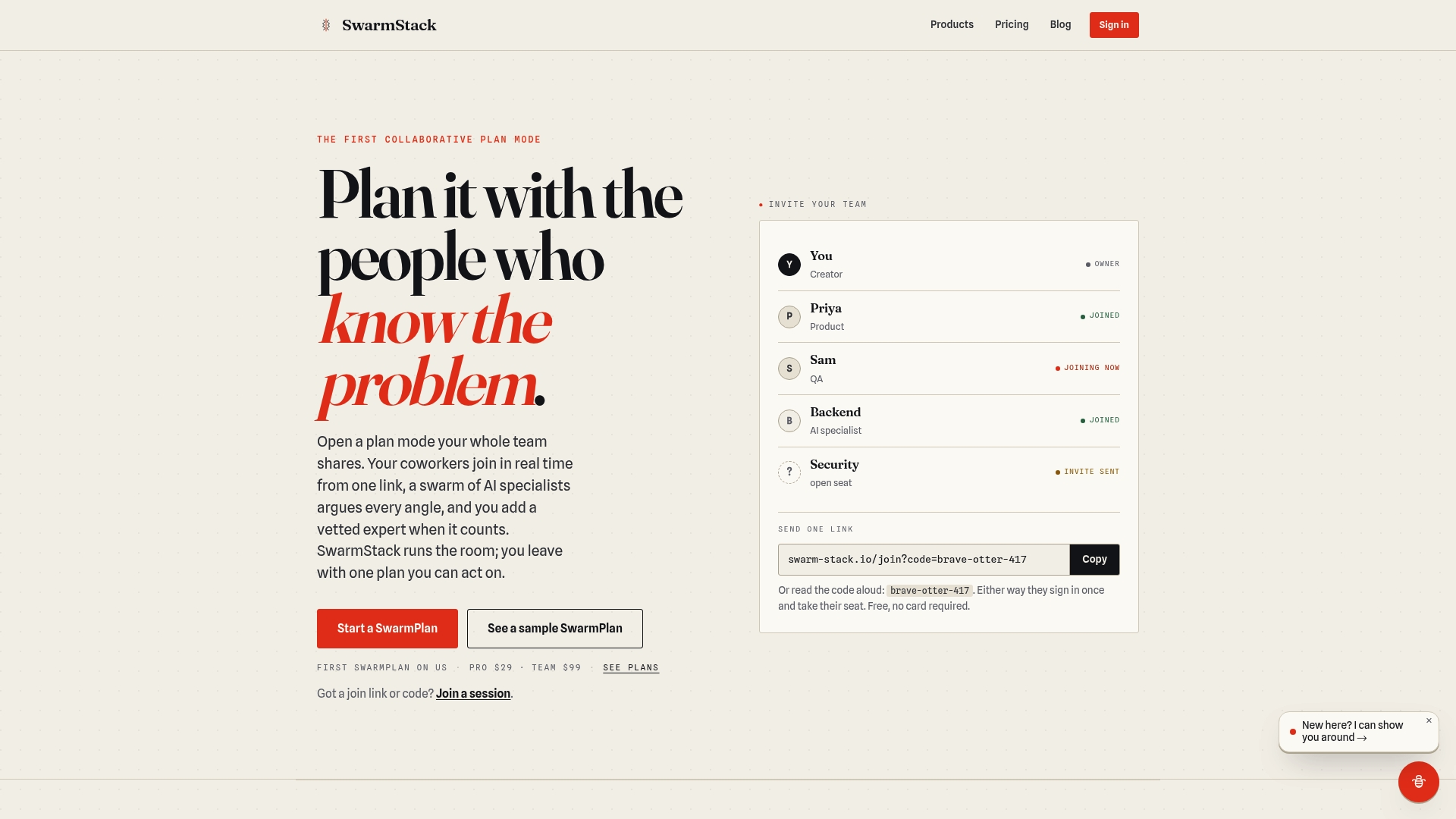
Invite your team with a single link, run structured interviews against the agenda you just built, and let the session generate a versioned deliverable with decisions already logged against owners. That's the same decisions register you'd otherwise assemble by hand after a full-day workshop, produced as you go instead of the next morning. If data handling is a concern for a cross-functional session, Swarm-stack's trust and privacy practices are worth a look before you invite outside stakeholders in.
Check out what a SwarmPlan produces and see whether your next alignment session is a fit.
Frequently Asked Questions
How long should an alignment workshop agenda be? It depends on how many decisions you need to close. A single clear decision fits a 60 to 90 minute sprint; multiple dependent decisions across functions usually need a half-day or full-day session.
Who should attend a stakeholder alignment workshop? Invite people who can commit resources or veto the outcome. Everyone else should be consulted through pre-work rather than seated in the room, especially once the group exceeds 15 people.
What's the difference between an alignment meeting agenda and a regular status meeting? A status meeting reports progress. An alignment workshop agenda is built around a specific decision, with timeboxed activities designed to surface disagreement and end in a documented commitment.
How do you know if the workshop actually worked? Track decision closure rate, whether the named owners hit their implementation milestones, and run a short stakeholder satisfaction check at the 30-day mark.
What if stakeholders keep disagreeing after the workshop ends? That usually signals false agreement during the session itself, not a failure of the follow-up plan. Build in an explicit understanding check next time, where each stakeholder restates the rationale in their own words before the meeting closes.
Sources
- Stakeholder Management: How Executives Build Alignment and Protect Decisions
- How to Build Effective Stakeholder Management & Engagement | HBS Online
- Simplify multiparty negotiations with stakeholder alignment - PON