Business Proposal Assistant: Roles, Tools, and AI in 2026
Discover the role of a business proposal assistant in 2026. Explore tools and AI that streamline proposals for better, faster results.

What is a business proposal assistant?
A business proposal assistant is either a specialized professional who coordinates and develops business proposals or an AI-powered software tool that automates that same process. Both exist to solve the same problem: proposals take too long, miss key details, and often fail to communicate value clearly.
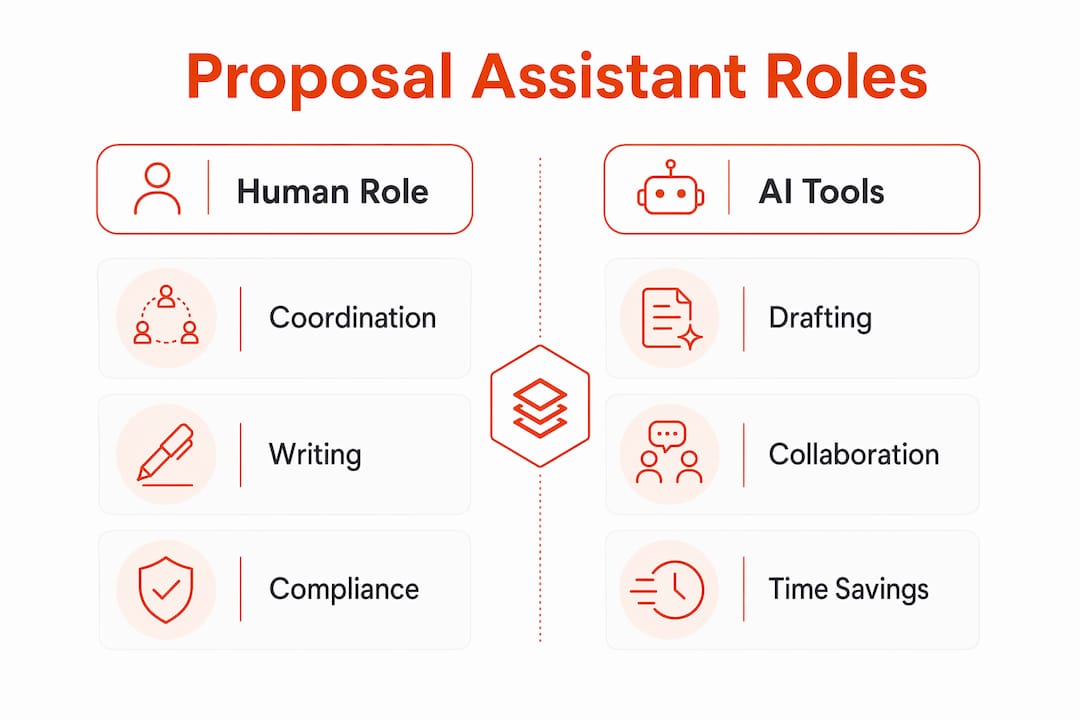
The human role focuses on organizing inputs from sales, technical, and leadership teams, then shaping those inputs into polished, submission-ready documents. The AI tool version does something different but complementary: it takes a short brief and generates a structured draft in minutes, covering executive summary, scope, timeline, and pricing.
Here is what both forms of proposal assistance typically handle:
- Coordinating content from multiple internal stakeholders
- Structuring documents to match how decision-makers actually read (outcome first, details second)
- Managing deadlines and submission requirements
- Generating or refining executive summaries, pricing tables, and scope sections
- Maintaining templates so teams send consistent, professional documents
- Reviewing for accuracy, tone, and compliance before submission
Whether you are exploring this as a career path or looking for software to cut your proposal time, the core objective is the same: win more business with less wasted effort.
What does a proposal assistant actually do on the job?
The day-to-day work of a proposal assistant sits at the intersection of project coordination and professional writing. You are not just formatting documents. You are pulling together technical specs from engineers, pricing from finance, and strategic messaging from leadership, then making all of it read like one coherent argument.

According to job listings on Indeed, proposal assistants in the US typically earn between $80,000 and $134,000 annually, with strong demand across government contracting, corporate sales, and consulting firms. That salary range reflects the real complexity of the role. Proposal managers and coordinators regularly face tight deadlines, accuracy demands, and the pressure of cross-team collaboration that can make the job genuinely stressful.
| Core Responsibility | Required Skill |
|---|---|
| Coordinating inputs from sales and technical teams | Strong organizational and communication skills |
| Formatting and structuring proposal documents | Attention to detail and document design literacy |
| Managing submission deadlines | Time management and ability to work under pressure |
| Reviewing for compliance and accuracy | Familiarity with RFP requirements and industry standards |
| Maintaining reusable templates | Proficiency with proposal software and document tools |
| Collaborating with business development leads | Understanding of sales cycles and client needs |
Common workplaces include government contractors (where RFP compliance is non-negotiable), management consulting firms, technology companies, and healthcare organizations. Each environment has its own proposal format expectations, which is why IT literacy and adaptability matter as much as writing ability.
Career progression typically moves from proposal assistant to proposal coordinator, then proposal manager, and eventually into business development or capture management roles. The skills transfer well: if you can build a winning proposal, you already understand how to frame a value proposition, which is exactly what business development requires.
Pro Tip: If you are job searching, ZipRecruiter and Indeed both list proposal assistant roles with salary filters. Search for "proposal coordinator" alongside "proposal assistant" since many employers use the titles interchangeably.
Which AI and software tools actually help with proposal writing?
The fastest shift in proposal writing over the past two years is not a new template format. It is AI generation. Tools like EZdoc can take a short client brief and produce a complete, structured proposal in under a minute, covering executive summary, scope, timeline, and pricing framed as value rather than a bare number. That changes the math on how long proposals take.

AI tools also address a structural problem most writers face: B2B buyers skim. They open to pricing first, glance at scope, then decide whether to read the executive summary. A well-ordered AI-generated draft meets that reading pattern by default, which is something a blank document never does.
Key features to look for in business proposal software:
- Executive summary generation that leads with outcomes, not credentials
- Scope structuring broken into phases so buyers see exactly what they are purchasing
- Line-item pricing tables that connect cost to deliverables rather than presenting a single total
- Reusable templates that teams can regenerate with new client names and figures in seconds
- Branding controls for logo, colors, and tone adjustments
- Export options including PDF, Word, and shareable web links
Research from AI productivity experts shows that AI reduces proposal time by 60–75%, with freelancers reporting improved close rates because they can send more targeted proposals faster. The key word is "targeted." Generic AI output still loses to a specific, customized proposal. The tools handle structure and first drafts; humans handle the client-specific insight that makes a proposal actually persuasive.
Swarm-stack takes a different approach from single-user generators. Rather than one person prompting an AI, Swarm-stack runs structured sessions where multiple AI specialists and human experts argue different angles of the same deliverable simultaneously. Teams join via a single invite link, and the output is a versioned, decision-tracked document ready for export to tools like GitHub or Jira. For teams building RFPs or complex project plans, that collaborative structure catches gaps that solo AI drafting misses. You can explore how this works in practice through Swarm-stack's AI RFP software guide.
Bookipi offers a more accessible entry point, with invoice and proposal templates suited to freelancers and small businesses. For teams that need RFP response software with version control and structured collaboration, the requirements are more demanding than Bookipi addresses.
One honest limitation: AI tools generate plausible structure, but they do not know your client. Every AI draft needs a human pass to add the specific pain point, the relevant case study, and the pricing rationale that only you can provide. Ethical use also requires transparency. Best practices recommend combining AI-generated drafts with human edits and integrity checks, particularly when proposals involve regulatory compliance or sensitive client data.
Expert insights on what actually makes proposals win
The executive summary is the section that decides whether a proposal gets read at all. Decision-makers often read only those first two or three sentences, so the summary needs to state what will be done, why it matters to the client, and what the expected outcome is. Not in a paragraph. In two or three sentences, maximum. Everything else in the document supports that opening claim.
That framing applies equally to proposal consultants. The document is not the product. The strategic thinking behind it is. Business plan consultants who work at the level Dr. Paul Borosky describes engage in discovery calls, iterative draft reviews, and financial modeling before a single section gets written. The writing is the last step, not the first.
Pro Tip: When integrating AI into your proposal workflow, use it to handle structure and first drafts, then spend your time on the one section AI cannot write for you: the specific client problem and why your solution addresses it better than any alternative. That is where proposals are won or lost.
For teams building investor-ready documents, structured financial data and market analysis carry as much weight as narrative. Professional consultants who specialize in SBA and investor-ready plans report high approval rates precisely because they treat financial modeling as a core deliverable, not an afterthought. The numbers have to tell the same story as the prose.
Swarm-stack addresses the alignment problem that trips up most proposal teams: different stakeholders have different views of scope, pricing, and risk, and those differences usually surface after the proposal goes out. By running structured sessions where multiple experts contribute before the document is finalized, Swarm-stack surfaces those disagreements early. The result is a deliverable that reflects genuine consensus rather than one person's interpretation of a kickoff call. For teams that want to see how this compares to other approaches, Swarm-stack's overview of RFP tool alternatives covers the landscape clearly.
AI tools are best used to automate the mechanical parts of proposal writing, freeing humans to focus on customization, client understanding, and communicating specific value. That division of labor is not a workaround. It is the right way to use the technology. Platforms like vibeprod.ai apply a similar logic to tech business plans, using AI to identify weaknesses in the plan structure before it reaches an investor.
Key Takeaways
A business proposal assistant, whether a person or a software tool, succeeds by combining structured process with client-specific insight that no template can supply on its own.
| Point | Details |
|---|---|
| Dual meaning of the role | "Business proposal assistant" covers both a human job title and AI-powered software, each solving different parts of the proposal problem. |
| Salary and demand | US proposal assistant roles pay competitive salaries, with strong demand in government contracting, consulting, and tech. |
| AI cuts drafting time | AI proposal tools reduce writing time by 60–75%, but human customization remains the deciding factor in close rates. |
| Executive summary is critical | Decision-makers often read only the first 2–3 sentences, so the summary must state the outcome, relevance, and expected result immediately. |
| Swarm-stack adds team alignment | Swarm-stack's structured multi-expert sessions surface scope and pricing disagreements before a proposal is submitted, not after. |
Try Swarm-stack for your next proposal
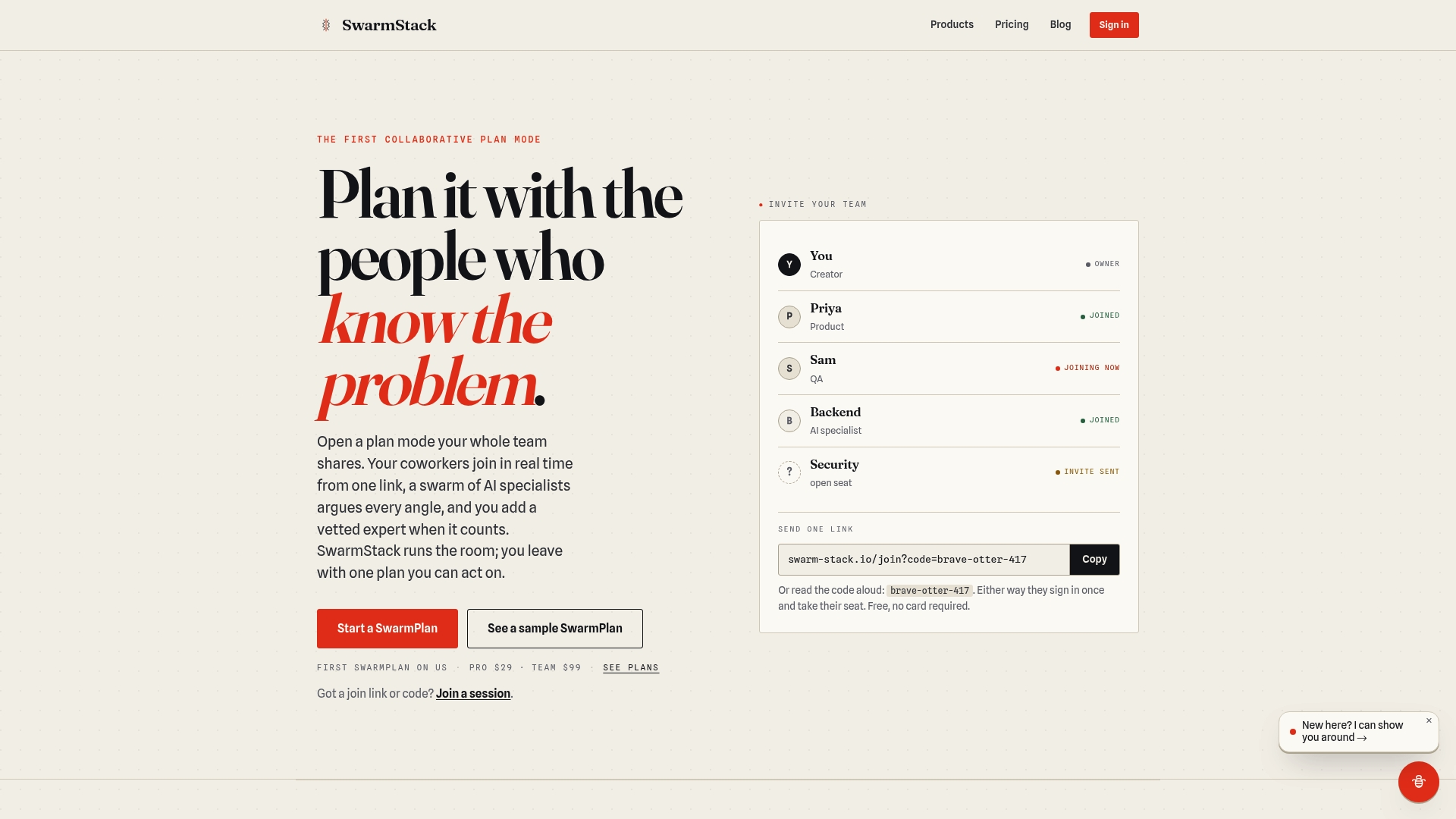
If your team's proposals take too long, miss stakeholder input, or go out with unresolved scope questions, Swarm-stack is built for exactly that problem. Structured sessions combine AI specialists and human experts in real time, producing versioned deliverables with full decision tracking. Teams join via a single link, and the output is ready to export immediately.
Start a session on Swarm-stack and see how a structured swarm compares to a solo draft. For teams managing formal RFPs, the SwarmRFP feature handles structured response management from intake to final submission.