Consent Decision Making: A Step-by-Step Team Guide
Unlock faster, more inclusive decisions with our step-by-step guide to consent decision making, ideal for teams needing to act swiftly.

Consent decision making is a group process where a proposal moves forward the moment no one has a reasoned objection to it, not when everyone agrees. It works best for small teams, policy groups, and organizations making recurring operational calls that need to move fast, stay inclusive, and remain easy to reverse if something goes wrong. If your team is stuck re-litigating the same decision for the third meeting in a row, this is the fix.
TL;DR:
- Consent decision making accelerates progress by focusing on whether anyone has a reasoned objection, not requiring full agreement from all team members.
- Objections are serious concerns that threaten harm or risk, while preferences or worries are logged and revisited, preventing unnecessary blocks.
- This approach is most effective for recurring decisions, policies, or experiments that benefit from quick reviews and future refinements.
- A structured process involving purpose confirmation, proposal presentation, objection testing, and documentation supports honest and efficient sessions.
- Keeping a detailed decision log of objections, amendments, and review dates ensures transparency and helps prevent repeated debates over time.
Table of Contents
- What Is Consent Decision Making, Really?
- Why Teams Choose Consent Over Consensus
- When Should You Actually Use Consent?
- The Step-by-Step Consent Decision Process
- Facilitation Techniques That Keep Sessions Honest
- Common Pitfalls (and How to Fix Them)
- A Meeting-Ready Consent Checklist
- What Consent Looks Like in Practice
- Why Logging Every Objection Changed How I Think About This
- Where to Learn More About Consent-Based Governance
- Sources
What Is Consent Decision Making, Really?
Consent and consensus get treated as synonyms constantly, and that mix-up is the biggest reason teams struggle to adopt either one well. Consensus asks everyone to agree, or at least to actively support a proposal. Consent asks a narrower, faster question: does anyone have a reasoned objection strong enough to block this? If the answer is no, the proposal passes, even if half the room would have chosen differently.
That gap matters because agreement is a much higher bar than tolerance. A proposal doesn't need to be everyone's favorite option. It needs to fall within the group's "range of tolerance," meaning it's good enough to move forward without causing real harm to anyone's ability to do their job or to the group's shared aim. This is the core mechanic described in Sociocracy 3.0's consent decision-making patterns, which frame objections as arguments that reveal risk, not expressions of preference.
The distinction that trips people up most is objection versus concern. Here's how to tell them apart:
- An objection shows the proposal would cause concrete harm, create unacceptable risk, or block someone from doing their role. Example: "This vendor contract locks us in for three years, and we have no exit clause if service quality drops."
- A concern is a preference, a hunch, or a "what if" that doesn't point to actual harm. Example: "I would have picked a different vendor, but I don't see this one causing a problem."
Only objections stop a decision. Concerns get logged and revisited, but they don't hold up the room.
Why Teams Choose Consent Over Consensus
The biggest practical payoff is speed. Groups running the Sociocracy For All process report moving topics that had stalled for months into a decided state in a single session, sometimes multiple decisions in under ten minutes once the group has practiced the format. Consensus tends to slow down as group size grows, because the bar of full agreement gets harder to clear with every added voice. Consent doesn't have that problem, since the bar is "no one is blocking," not "everyone is on board."
The second payoff is the mindset shift it forces. Consent treats decisions as experiments instead of permanent commitments, following the standard "good enough for now, safe enough to try" test used in Sociocracy 3.0. That reframing does a lot of quiet work: it lowers the stakes of every proposal, which means people stop over-engineering decisions before bringing them to the group, and it builds in a review point up front instead of treating the decision as final.
A few honest trade-offs worth naming before you switch a decision type over to consent:
- Consent works best when the group shares a clear aim; without one, "harm to the aim" becomes impossible to test against.
- Fast decisions can create fast mistakes, which is exactly why the review cycle isn't optional.
- Decisions with legal or contractual unanimity requirements still need full agreement, not consent.
Consensus, or a straight majority vote, still makes sense for one-time, high-stakes, irreversible calls where a broader mandate genuinely matters more than speed.
When Should You Actually Use Consent?
Consent isn't the right tool for every decision your team faces. It shines on choices you'll revisit and refine, not one-shot calls with no room for a do-over.
- Recurring operational rules. Meeting cadences, approval thresholds, on-call rotations, and similar policies that get reviewed and adjusted over time.
- Team-wide policy decisions. Remote work guidelines, expense limits, communication norms. Anything the whole group has to live with day to day.
- Pilot programs and experiments. Rolling out a new tool to one team before the whole org, testing a pricing tier, trying a new intake process for a quarter.
- Cross-functional trade-offs. Decisions where junior and senior voices carry genuinely different information, and hierarchy shouldn't automatically win.
Skip consent for genuinely urgent, single-person calls (a fire needs someone to just decide) and for anything legally bound to unanimous sign-off, like certain board resolutions or contract ratifications. It works equally well over video call or async chat as it does in person, as long as someone is explicitly running the steps rather than letting the conversation drift.
The Step-by-Step Consent Decision Process
This is the canonical flow, adapted from Sociocracy For All and Sociocracy 3.0's documented patterns, written so a facilitator can run it directly from this page.
1. Confirm consent to the purpose. Before anyone proposes anything, get the room to agree on what problem you're solving and why it matters right now. Skipping this step is the single most common reason sessions go in circles. If people disagree on the purpose, no proposal will satisfy everyone, because they're actually solving different problems.
2. Present the proposal. Whoever authored it states the proposal clearly: what it changes, who's responsible for what, and when it will be reviewed. A proposal without a review date lacks a built-in review point, making it effectively a permanent decision rather than a temporary or experimental one.
3. Ask clarifying questions. This round is for understanding only, not debate. Good questions: "Who owns this if it breaks?" or "What happens to the current process during the transition?" Bad questions dressed up as clarifying ones: "Have you considered doing it my way instead?" That's a concern in disguise, and facilitators should redirect it to the reaction round.
4. Run a quick reaction round. Each person gets a short window, sometimes literally one breath, to voice an initial gut reaction. This isn't a debate either. It surfaces where possible objections might be hiding before you formally check for them. The Sociocracy For All process treats this round as a pressure valve that keeps the objection-testing step focused.
5. Check for objections. Ask directly: "Does anyone have an objection to this proposal as stated?" Silence counts as consent. This is the moment that makes the whole method work, and it only works if people feel safe enough to actually speak up when something's wrong.
6. Test whether it's a real objection. Not every raised hand is a valid block. Run each one through a short check: does this show harm to the group's aim, unacceptable risk, or a block to someone's role responsibilities? Clearleft's breakdown of consent versus consensus frames this test as the difference between an argument and a preference. If it passes the test, it's an objection. If it doesn't, it's a concern, and it gets logged, not resolved on the spot.
7. Resolve objections one at a time. Work through valid objections individually rather than all at once. Ask the objector what change would remove the harm they identified. Amend the proposal if needed, but do not edit it live during the reaction round. Sociocracy For All's guidance is explicit here: once you amend a proposal, you re-run the clarifying questions and reactions on the new version, because the group hasn't actually reacted to what's now on the table.
8. Record the decision, the objections, and the review date. Every decision needs a paper trail: what was decided, who raised what, how it was resolved, and when you'll check whether it worked.
9. Celebrate, then revisit remaining concerns. Mark that the group made a decision, however small that feels. Then go back to the concerns log from step 3 and step 4. They didn't block anything, but they're still worth a sentence in the notes for the review meeting.
Pro Tip: Keep a visible timer for the clarifying-questions round. Five minutes is usually enough for a small proposal, and a timer stops "just one more question" from turning into a 40-minute detour that kills momentum before you even reach the objection check.
| Step | Primary question asked | Who leads it |
|---|---|---|
| Purpose check | What problem are we solving? | Facilitator |
| Presentation | What exactly is being proposed? | Proposal author |
| Clarifying questions | What don't I understand yet? | Whole group |
| Quick reactions | What's my gut response? | Whole group |
| Objection check | Does anyone object? | Facilitator |
| Objection test | Does this show harm or risk? | Facilitator + objector |
| Resolution | What change removes the harm? | Objector + author |
| Recording | What was decided and when do we review it? | Note taker |
Facilitation Techniques That Keep Sessions Honest
Good facilitation is what separates a consent process that actually works from one that just feels like consensus with extra steps. The facilitator's job is to protect the process, not to steer the outcome. That distinction matters because a facilitator who nudges the room toward a preferred answer, sometimes called "facipulation," quietly destroys the trust the whole method depends on.
A few concrete techniques worth building into your practice:
- Reflect objections back in your own words before moving to resolution, so the objector confirms you actually understood the harm they're pointing to.
- Test one objection at a time rather than batching several together, since batching makes it nearly impossible to track which resolution addressed which concern, a habit reinforced in Sociocracy 3.0's testing pattern.
- Log every objection and its resolution in a shared document immediately, not from memory after the meeting.
- For async or remote teams, replace the live reaction round with a 24 hour comment window in a shared doc or a thread in a tool like Slack, then hold a short synchronous call just for the objection check and resolution.
Pro Tip: If your team runs decisions through a chat tool, pin the proposal message and require objections to be posted as threaded replies rather than reactions or DMs. A private objection that never reaches the group can't be tested or resolved, which defeats the entire purpose of checking for one.
Documentation matters more than most new facilitators expect. A decision log that ties each proposal to its objections, amendments, and review date gives future sessions something to learn from, rather than relitigating settled ground every quarter.
Common Pitfalls (and How to Fix Them)
Most consent failures aren't about the process itself. They're about social dynamics the process doesn't automatically fix.
- Withholding objections under social pressure. People stay quiet to avoid conflict, then complain afterward. Fix it by naming reasoned objection as a professional responsibility, not a personal risk, and by explicitly thanking people who raise one.
- Confusing concerns for objections. Teams that skip the objection test end up letting personal preference block decisions indefinitely. Run every raised hand through the harm/risk/role test before treating it as a block, a habit documented in the Agile Coop facilitation handbook.
- Over-amending proposals live. Editing on the fly during reactions creates a moving target nobody has actually consented to. Note suggested changes, then decide whether to amend after objections are tested.
- Skipping the review date. A decision with no review point isn't really an experiment. It's a permanent choice you forgot to call permanent.
A Meeting-Ready Consent Checklist
Paste this into your next agenda or approval workflow template.
- Before the meeting: name the proposal author, state the purpose in one sentence, set a review date, and define what "working" looks like (your evaluation criteria).
- Opening: confirm the group agrees on the purpose before the proposal is presented.
- During: timebox clarifying questions (5 to 10 minutes for most proposals), run a quick reaction round, then ask explicitly for objections.
- Objection handling: test each one against harm, risk, and role impact; resolve one at a time; re-run reactions if you amend.
- Closing: assign someone to record the final decision, every objection raised, every resolution, and the review date in a shared log.
- After the meeting: schedule the review, track the metric you defined as your evaluation criteria, and revisit any logged concerns at that review.
Teams managing multiple parallel proposals often adapt this into a lightweight risk log so objections and their resolutions stay visible across projects rather than buried in individual meeting notes. For teams running approvals inside chat tools, a structured thread modeled on Slack-based deploy approval workflows translates the same objection check into an async format without losing the paper trail.
What Consent Looks Like in Practice
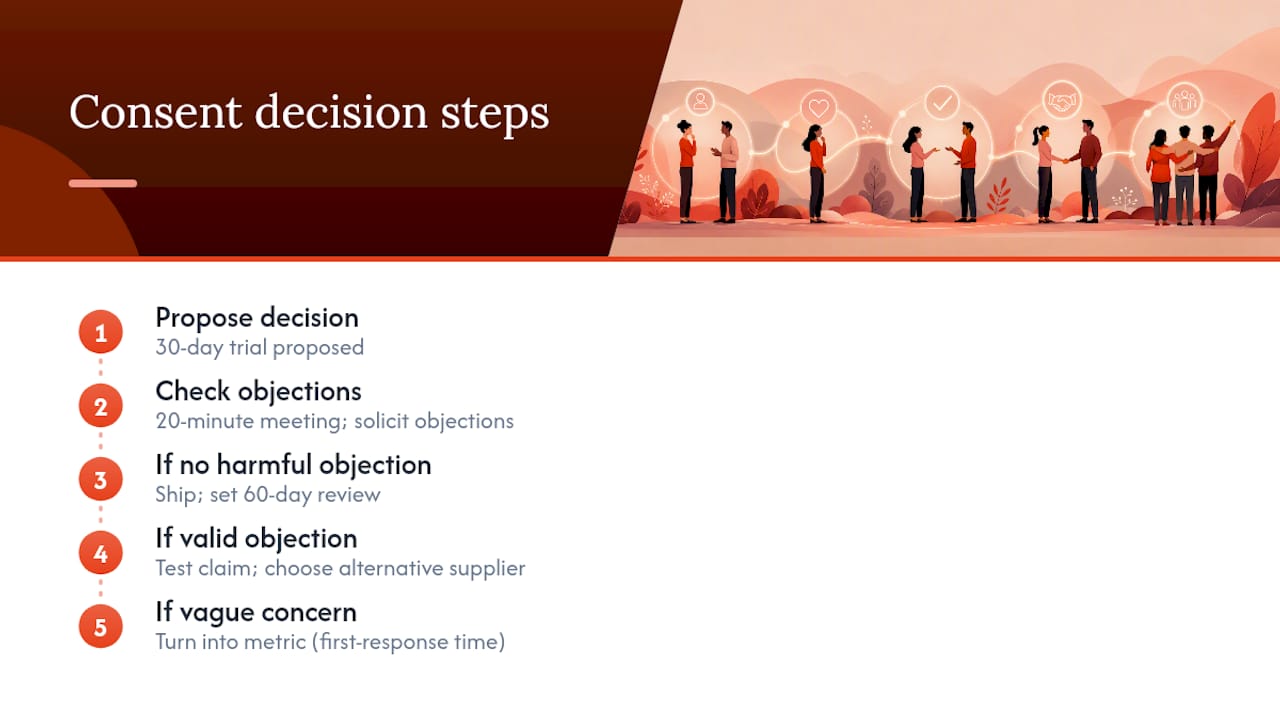
A product team deciding on a default setting for a new feature used consent to skip weeks of back-and-forth: they proposed a 30-day trial window, checked for objections, found none that showed real harm, shipped it, and set a 60-day review to check activation data. Total decision time: one 20-minute meeting.
A worker-owned co-op considering a new supplier ran the same process and hit a real objection: a member pointed out the supplier's sourcing conflicted with the co-op's stated mission. That objection wasn't a preference, it was a documented risk to the group's aim, so the group tested it, agreed it was valid, and picked a different supplier that fit both the budget and the mission.
A third example: a team raised a concern (not an objection) that a new support-ticket rule "felt risky." Rather than blocking the decision, the facilitator turned that vague worry into a concrete rollback metric, first-response time, and built it into the 30-day review, which is exactly the kind of reasoned-argument equivalence sociocracy is built around: a hunch becomes useful once it's tied to something measurable.
Why Logging Every Objection Changed How I Think About This
The habit that actually moves the needle isn't the meeting format. It's the decision log. Teams that write down every objection, every resolution, and every review date build a record they can point to months later when someone asks "why did we decide this?" Teams that skip logging end up relitigating the same argument every quarter because nobody remembers who raised what or why it got resolved the way it did.
If you try exactly one thing from this piece, run a single consent session on a decision your team has been avoiding, and pick one concrete metric to check at the review date. That one habit, logging objections and tying them to a measurable check-in, does more for group trust than any amount of process polish.
— Cody
Where to Learn More About Consent-Based Governance
For the full canonical process and worked examples, Sociocracy For All and the Sociocracy 3.0 pattern library remain the primary references. Clearleft's practical writeup and the Agile Coop handbook offer grounded facilitation reasoning worth bookmarking.
Running consent sessions across a distributed team gets harder without a shared space to draft proposals, gather reactions, and keep the objection log visible to everyone in real time. Swarm-stack builds that structure directly into its collaborative planning sessions, letting teams combine input from human experts and AI specialists to argue out a proposal, track amendments by version, and export the final, decided plan straight into tools like GitHub or Jira once the objections are cleared.
Sources
- Consent decision making — Sociocracy For All
- Consent Decision-Making — Sociocracy 3.0 patterns
- Using consent over consensus for decision making — Clearleft
- Consent-based decision making — Agile Coop handbook