Decision Matrix Examples: Worked Templates You Can Use Today
Discover effective decision matrix examples to transform subjective choices into data-driven decisions. Use templates today!

A decision matrix turns a subjective choice into an evidence-backed ranked recommendation by scoring each option against the criteria that actually matter to you. Try it right now:
- Pick multiple criteria that matter most for your decision.
- Score every option 1 to 5 on each one.
- Multiply by importance and add up the totals. Highest score wins.
Here's what that looks like in practice: a hiring team scoring two finalists on skills, culture fit, and salary found their gut favorite actually lost by four points once salary got proper weight. The numbers changed the outcome, not just the discussion.
Key Takeaways
A decision matrix works because it forces teams to agree on weighted criteria before scoring, replacing gut-feel debate with a ranked, defensible recommendation.
| Point | Details |
|---|---|
| Pick the right matrix type | Use weighted matrices for multi-criteria choices, Pugh for baseline comparisons, Eisenhower for task triage. |
| Score before weighting influences you | Score each option independently first, then apply weights to avoid anchoring bias. |
| Watch for the additive trap | Filter out options that fail a must-have before scoring, so minor criteria can't outweigh a deal-breaker. |
| Run a sensitivity check | Shift one weight ±20% and see if the winner changes before you commit to the result. |
| Run the session collaboratively | Swarm-stack lets teams weight, score, and export a decision matrix together in one tracked, versioned session. |
Table of Contents
- What Is a Decision Matrix and When Should You Use One?
- Weighted Matrix, Pugh Matrix, or Eisenhower Matrix: Which One Fits?
- What Are the Real Benefits and Common Pitfalls?
- How to Build a Weighted Decision Matrix in 7 Steps
- Three Worked Decision Matrix Examples You Can Copy
- How Do You Weight Criteria Without Team Bias?
- Why This Simple Tool Changes How Teams Decide
- Run Your Next Decision Matrix as a Team, Not a Spreadsheet Email Chain
- Sources
What Is a Decision Matrix and When Should You Use One?
A decision matrix is a structured tool that scores multiple options against a shared set of criteria, then ranks them by weighted total. It works especially well when you're stuck comparing more than two choices with competing priorities.
Reach for one when you're facing:
- Hiring decisions between multiple qualified candidates
- Vendor or software selection with several credible bidders
- Feature prioritization across a crowded product backlog
- Project prioritization when resources are limited
- Major purchases with long-term consequences (equipment, real estate, contracts)
Skip it for binary yes/no calls, low-stakes choices that don't justify the setup time, or decisions where you genuinely lack any real evidence to score against.
Weighted Matrix, Pugh Matrix, or Eisenhower Matrix: Which One Fits?
Three formats get lumped together under "decision matrix," but they solve different problems.
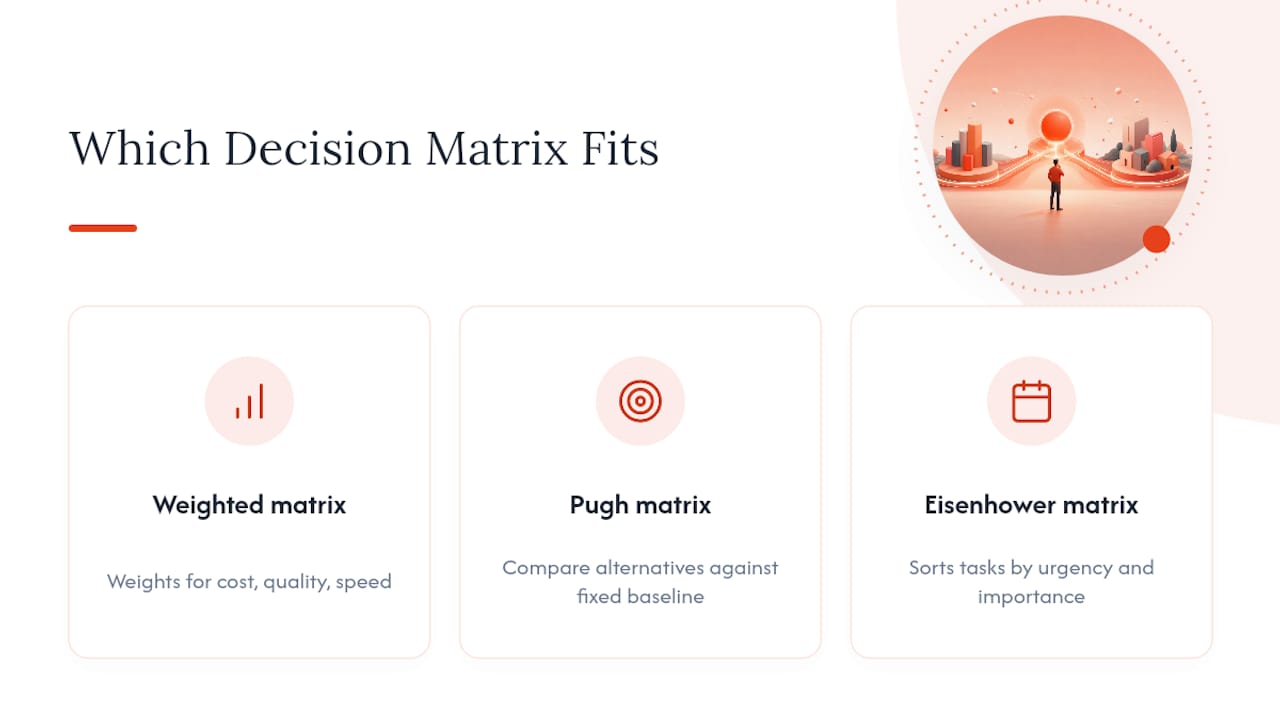
A weighted decision matrix handles the most common case: multiple criteria, each with different importance, scored across several options. Use it when cost, quality, and speed all matter but not equally. Example: choosing a marketing agency where experience counts more than price.
A Pugh matrix compares every alternative against a fixed baseline instead of scoring in isolation, which makes it a favorite in engineering and product design. Example: rating five packaging concepts against your current design to see which actually improves on it.
Pairwise or head-to-head comparisons go a level deeper, weighting criteria against each other using scales like 1, 3, and 9 to capture relative superiority between them, useful when your team can't agree on weights by gut feel alone.
The Eisenhower matrix is a different animal entirely. It sorts tasks by urgency and importance rather than ranking alternatives you're choosing between, so use it for triaging a to-do list, not comparing vendors.
What Are the Real Benefits and Common Pitfalls?
Done right, a decision matrix removes emotion from the room, makes trade-offs visible instead of implied, and leaves an audit trail you can point back to when someone asks "why did we pick this?" six months later.
Three mistakes undo that value fast:
- The additive trap: a pile of minor criteria mathematically outweighs one deal-breaker. Fix it by filtering out any option that fails a must-have before scoring begins.
- Reversed-scale criteria: "difficulty to implement" confuses scorers about which number is good. Rephrase everything so higher always means better, like "ease to implement."
- Inconsistent scoring habits: one person rates generously, another harshly. Separate the weighting conversation from the scoring conversation so bias doesn't compound.
How to Build a Weighted Decision Matrix in 7 Steps
Here's the process, spreadsheet-ready:
- Define the decision and list your real options. A few alternatives (around three to six) is the practical sweet spot. More than that and scoring turns into a chore nobody finishes.
- Select 4 to 8 criteria. Fewer than four oversimplifies; more than eight makes weighting nearly impossible to agree on.
- Assign weights that sum to 100 (or use decimals that sum to 1.0 if you prefer multipliers).
- Pick a consistent scoring scale. A 1 to 5 scale works for most teams; anything wider adds precision nobody can actually justify.
- Score each option separately, criterion by criterion, before looking at totals. This keeps early scores from anchoring later ones.
- Multiply score by weight for every cell, then sum each column. In Excel or Google Sheets, this is a SUMPRODUCT formula:
=SUMPRODUCT(scores_range, weights_range). - Interpret the results and run a sensitivity check by nudging one weight up or down 20% to see if the winner changes.
Here's a mini version showing the math on two criteria for one option:
That 3.4 gets compared against every other option's total, and whichever number is highest wins the recommendation. Building this template is straightforward, as the core structure only needs options, criteria, weights, and scores. Set it up once in a shared spreadsheet and every future decision just means swapping in new rows.
Three Worked Decision Matrix Examples You Can Copy
Hiring decision. Weighting functional experience above education is common in real hiring matrices, because past performance predicts future performance better than a degree does.

Candidate B wins by a narrow margin, largely on salary fit and culture, despite Candidate A's stronger raw experience score.
Vendor selection. If you're evaluating project management platforms, the same math applies whether you're comparing Asana alternatives or a shortlist you built yourself.
Vendor X wins even though Vendor Y is cheaper, because features and integration carry more combined weight.
Feature prioritization. Score technical complexity inversely (low complexity = high score) so higher always means "do this."
Feature 2 wins, mostly because it's easier to build without sacrificing much customer impact.
How Do You Weight Criteria Without Team Bias?
Have each participant weight criteria independently before any group discussion, then average the results. This one habit does more to reduce individual bias than any amount of debate. A facilitator-run consensus round works well for smaller teams; Delphi-style anonymous scoring rounds work better when a strong personality tends to dominate the room.
Before scoring starts, review your criteria list with a cross-functional group. Independent criteria review catches confirmation bias and flags criteria that overlap. If it does, that criterion deserves more discussion before you commit.
Pro Tip: Rewrite every criterion so a higher score is always better before scoring begins. "Cost" should become "affordability," and "difficulty to implement" should become "ease to implement." A reversed scale quietly wrecks totals, and nobody notices until the wrong option wins.
Why This Simple Tool Changes How Teams Decide
I've watched teams argue in circles for an hour over a vendor choice, then land on an answer in fifteen minutes once someone forced the criteria and weights onto paper. The math isn't the point. The point is that disagreements about weighting surface the real priority conflict before anyone signs a contract. Pick one of the three templates above and run it on your next real decision.
Run Your Next Decision Matrix as a Team, Not a Spreadsheet Email Chain
Building the matrix is the easy part. Getting five stakeholders to agree on weights without three rounds of email is where most teams stall out. Swarm-stack runs that whole conversation as a live, structured session, so your team scores criteria together, tracks every version of the decision, and exports a finished matrix instead of a half-finished spreadsheet nobody trusts.
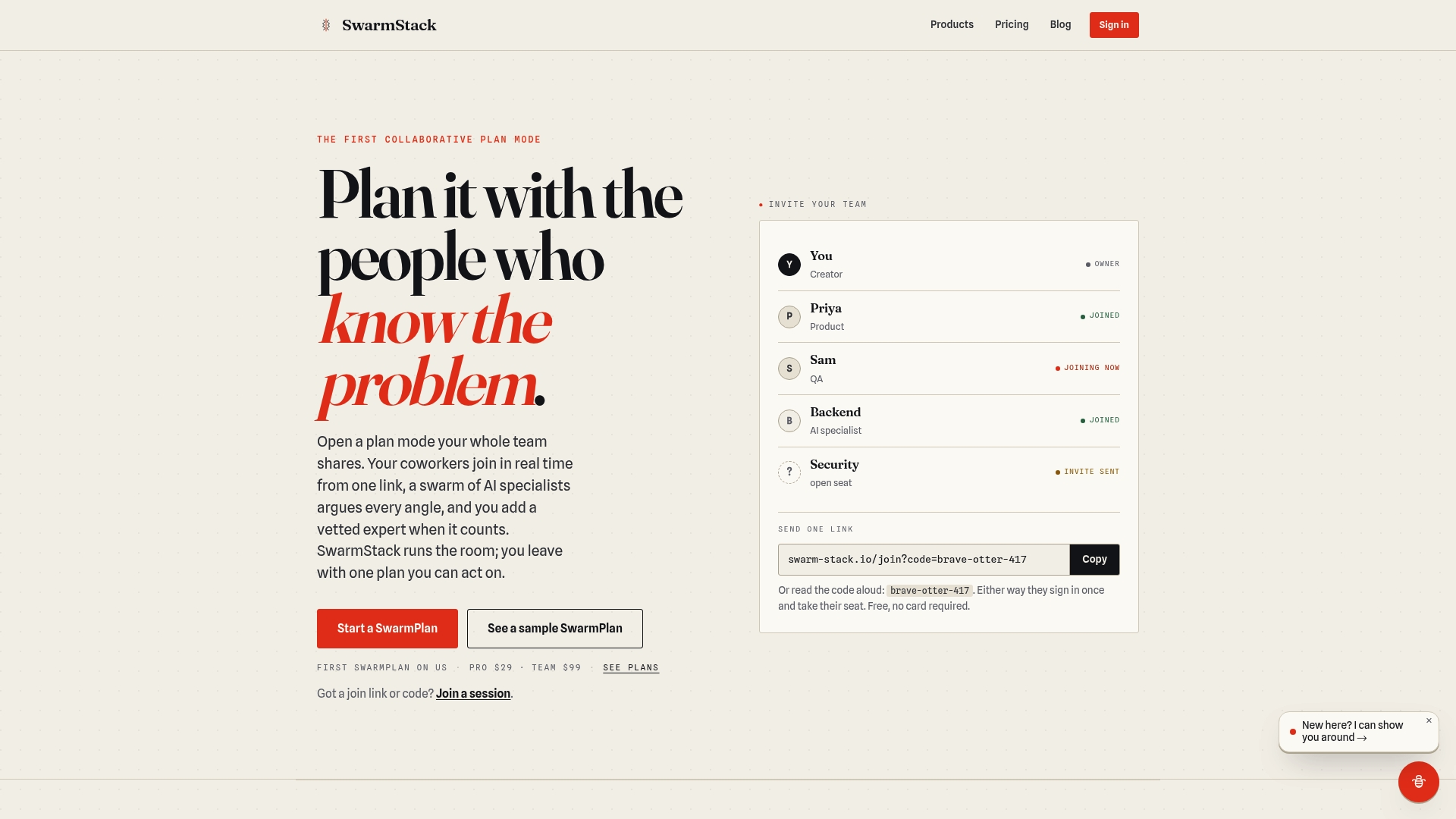
Every session keeps a record of who weighted what and why, which solves the audit-trail problem the moment it happens instead of after the fact. If your team is choosing between vendors, candidates, or features, start a SwarmStack session and get a scored, ranked recommendation your whole team actually signed off on.
Sources
- What is a Decision Matrix? Pugh, Problem, or Selection Grid | ASQ
- Decision Matrix Template – Project Management Formula
- Decision Matrix by McKinsey Alum | Free Templates
- Decision-matrix method — Wikipedia