Disagree and Commit: A Leader's Guide to Faster Decisions
Learn how to make faster decisions in your team with the "disagree and commit" strategy. Discover the benefits of clear execution.

"Disagree and commit" means arguing hard for your position before a decision gets made, then executing it fully once it does, even if you lost the argument. The payoff is speed: teams stop circling the same debate for weeks and start moving on a call everyone can act on. It works best when a leader needs a fast, accountable decision and the cost of delay outweighs the cost of imperfect consensus.
The mechanism has two distinct phases, and mixing them up is where most teams get it wrong.
- Disagree phase: raise objections early, back them with evidence, and stop when the decision owner has heard you.
- Commit phase: drop the internal campaign against the decision, communicate support publicly, and execute as if it were your idea.
- Who it's for: leaders and decision owners under time pressure, not every choice a team faces.
Table of Contents
- What Does Disagree and Commit Mean, and Where Did It Start?
- Why Disagree and Commit Speeds Up Team Decision Making
- How to Disagree Well Before the Decision Is Made
- How to Commit So the Decision Actually Sticks
- Where Disagree and Commit Goes Wrong
- Real Examples of Disagree and Commit in Practice
- Making Disagree and Commit Repeatable, Not Just Aspirational
- Sources
What Does Disagree and Commit Mean, and Where Did It Start?
The disagree and commit meaning traces back further than most people assume. Andy Grove, Intel's former CEO, is widely credited with popularizing the phrase inside Silicon Valley management culture, using it to push engineering teams past analysis paralysis. Business Insider's reporting on the phrase's history also credits Andy Grove at Intel with popularizing the underlying idea decades before it became a tech industry staple again.
Scott McNealy, co-founder of Sun Microsystems, used a similar formulation to keep engineering debates from stalling product releases. Jeff Bezos later brought it into the mainstream through Amazon, where it now sits inside a formal leadership principle: Have Backbone; Disagree and Commit, which explicitly tells leaders to challenge decisions they disagree with, respectfully, and then commit fully once a call is made.
- Grove used it to speed engineering trade offs under deadline pressure.
- McNealy applied it to product decisions at Sun.
- Amazon formalized it as a named leadership principle with explicit expectations.
The different origin stories matter because they shape how strictly a team interprets the rule. Intel's version leans hard on speed. Amazon's version leans on backbone first, meaning dissent is expected, not optional.
Why Disagree and Commit Speeds Up Team Decision Making
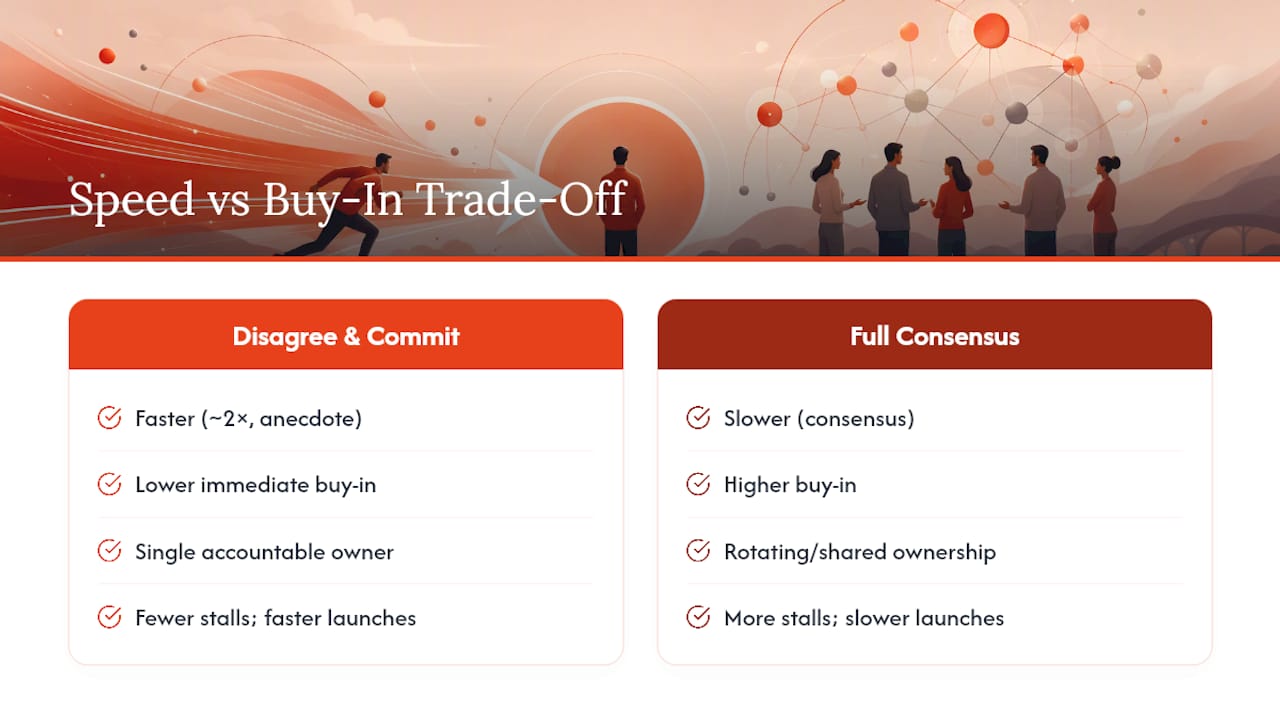
The clearest evidence for why this matters comes from Bezos himself. He's said publicly that the approach can help teams reach decisions in roughly half the time compared with consensus-driven models, largely because it eliminates the drawn-out cycle of rebuilding agreement every time a new voice joins the room.
Decision velocity, quantified: Bezos has framed the practice as significantly increasing team productivity on decisions, a claim rooted in his own shareholder letters and executive experience rather than a controlled study.
That distinction is worth sitting with. The "twice as fast" framing is an executive anecdote, not a peer-reviewed finding, so treat it as directional rather than a guarantee for your team. What it does capture accurately is the downstream effect: fewer initiatives stall in committee, experiments launch sooner, and ownership stays clear because one person, not a rotating consensus, is accountable for the outcome.
The trade-off is real. Speed helps most when the decision is reversible and the cost of delay is high. For safety-critical calls or choices that reshape company culture for years, full buy-in still beats velocity.
How to Disagree Well Before the Decision Is Made
A useful dissent looks nothing like a complaint. It has structure, evidence, and a clear stopping point.
- Speak early. Raise your objection before the decision owner has committed mentally, not after the meeting ends.
- Document, don't just talk. Write down your assumption, the failure mode you're worried about, and a measurable risk, ideally in one page or less.
- Skip the rehash. Send a short written summary ahead of the next meeting instead of re-litigating the same points live.
- Know who to loop in. If the disagreement touches budget, legal exposure, or customer safety, escalate to the decision owner or an executive sponsor directly, rather than debating peers indefinitely.
- Recognize the stop signal. Working Backwards guidance on the principle notes that knowing when a decision has actually been made is often harder than knowing when to speak up in the first place.
None of this works without psychological safety. If junior team members believe raising a risk will cost them politically, the disagree phase collapses into silence, and you lose the entire benefit of the model.
Pro Tip: Cap the disagree phase with a visible deadline, like "final input by Thursday 5pm," so debate has a natural end point instead of dragging until someone just gets tired of arguing.

How to Commit So the Decision Actually Sticks
Commitment isn't a feeling. It's a set of observable behaviors, and teams that skip them end up with quiet sabotage instead of alignment.
- Name the decision owner out loud, in writing, the moment the call is made. Ambiguity here is where execution quietly falls apart.
- Switch your public language from "I'm not sure this is right" to active advocacy. You don't have to pretend you agree, but you do have to stop campaigning against the choice.
- Set short-term checkpoints, weekly metrics or a 30-day review, so early warning signs surface fast without reopening the whole debate.
- Reserve the right to revisit the decision only when genuinely new data shows up, not because the old argument still feels unresolved.
Amazon's own leadership principles describe this exact posture: challenge before the decision, commit fully once it's made, even without total agreement.
Pro Tip: If you catch yourself explaining a decision to your team with "we're doing this, but I still think..." stop. That sentence is passive resistance wearing the costume of transparency.
Where Disagree and Commit Goes Wrong
The phrase has a dark pattern: it quietly becomes "disagree and commit, or leave." Critics have flagged exactly this shift, warning that power dynamics can turn a cultural norm into a coercive ultimatum when leaders use it to shut down debate rather than resolve it.
- Junior employees may stay quiet not because they agree, but because dissent feels career-risky, which defeats the entire purpose of the disagree phase.
- Leaders sometimes invoke the phrase the moment pushback appears, using it as a debate-ending weapon instead of a decision-closing one.
- Commitment gets confused with silent compliance. A team that stops objecting isn't necessarily executing well; it might just be checked out.
- When the same disagreement resurfaces every quarter, the real problem is often unclear decision rights, not a missing "commit" mindset. Fixing the org chart beats repeating the slogan.
Real Examples of Disagree and Commit in Practice
Seeing how specific organizations applied this shows the difference between the theory and the practice.
- Amazon Studios. Bezos has described greenlighting a project he personally doubted, using the phrase to signal trust in his team's judgment while still saving the time a longer internal fight would have cost. The move became one of the most cited examples of the principle in action outside Amazon's leadership documents.
- Intel under Andy Grove. The original use case centered on engineering trade-offs where deadlines made prolonged consensus building a real cost, not just an inconvenience.
- GitLab. The company's published values describe a similar norm: debate hard during the disagree window, then execute as a unified team once the decision is locked, a structure that works especially well for distributed teams that can't rely on hallway conversations to rebuild alignment.
Making Disagree and Commit Repeatable, Not Just Aspirational
Most teams fail at this not because they lack conviction but because they lack a record. Verbal disagreement evaporates the moment the meeting ends, and nobody remembers exactly what was decided or why.
- Structured sessions that capture dissent in writing, alongside supporting evidence, create the paper trail that separates real disagreement from venting.
- A visible decision record, naming the owner and the reasoning, is what makes "commit" checkable instead of aspirational.
- Deliverables like a decision log, a next-action list, or an implementation checklist give a team something concrete to execute against.
A decision without a written record is just an opinion that everyone quietly reinterprets a month later.
Swarm-stack runs on exactly this logic: real-time structured sessions pull in AI specialists and human experts to argue a plan from multiple angles, then lock the outcome into a versioned decision record anyone on the team can check later. It's one practical way to operationalize both halves of the model without relying on memory or goodwill.
A rule of thumb, when consensus still wins, and one move for your next meeting
Cody's take: disagree and commit works best as a default for reversible, time-pressured calls, not as a universal leadership philosophy. When a decision is safety-critical or shapes team culture for years, slow down and build real consensus instead of rushing to commit. The one thing worth trying in your next meeting: write down the dissent before you vote, not after someone loses.
— Cody
Turning the Principle Into a Repeatable Process
There are other ways to run this: a shared doc, a meeting note template, a Slack thread you promise to revisit. Those work until the team scales past a handful of people or the decision touches multiple departments, at which point the paper trail usually falls apart quietly. Swarm-stack exists for exactly that gap. It runs structured, real-time sessions where AI specialists and human experts argue a plan from every angle before anyone commits, then locks the outcome into a versioned decision record that survives past the meeting. Teams join with a single invite link, no lengthy onboarding, and walk away with a deliverable ready to hand to engineering or procurement. If your last major decision got re-argued three weeks later because nobody remembers who actually said what, start a session on Swarm-stack and see what a documented commit phase actually looks like.
Disagree and commit works when dissent is documented before the decision and ownership is named clearly after it.
| Point | Details |
|---|---|
| Disagree phase needs evidence | Written assumptions, failure modes, and measurable risks beat verbal pushback in meetings. |
| Commit phase needs a named owner | Say who owns the decision out loud, then switch language from doubt to public advocacy. |
| Speed has a real trade-off | Bezos has cited decisions moving in roughly half the time, but reversible calls benefit most, not safety-critical ones. |
| Watch for coercive misuse | If dissent disappears the moment someone invokes the phrase, the culture, not the model, is broken. |
| Swarm-stack operationalizes the record | Structured sessions and versioned decision logs turn the principle into a checkable process instead of a slogan. |
Sources
- Amazon
- Disagree and commit: when to speak up and support decisions - Working Backwards
- 'Disagree and commit': The famous Jeff Bezos phrase that's making a comeback - Business Insider