Human in the Loop AI: A Practical Guide for Practitioners
Discover how human in the loop AI enhances accuracy and safety in decision-making, especially in high-stakes scenarios. Learn more now!

Human-in-the-loop (HITL) AI is the practice of embedding human judgment directly into an AI or machine learning workflow, whether at the labeling stage, during model evaluation, or at runtime before a decision takes effect. The goal is to improve accuracy, safety, and alignment in situations where the model alone is not reliable enough to act without oversight.
When do you actually need it? A quick decision rule:
- High-stakes decisions where an error has serious consequences (medical diagnosis, loan denial, content removal)
- Low-confidence predictions where the model's output falls below a defined certainty threshold
- Regulatory mandates that require a human to authorize or audit AI-driven actions
- Agentic AI actions where the system is about to take an irreversible external step (sending a message, executing a transaction, modifying a record)
- Novel or out-of-distribution inputs the model has not seen enough of to generalize reliably
Regulatory frameworks increasingly formalize this. EU AI Act Article 14 requires that high-risk AI systems include human-machine interfaces enabling natural persons to oversee and intervene in AI decisions. Even if your organization operates primarily under U.S. law, sector-specific rules in healthcare (FDA guidance on AI/ML-based software), finance (OCC model risk management), and defense procurement are pushing in the same direction. HITL is no longer just a quality practice. For many teams, it is becoming a compliance requirement.
Table of Contents
- How does human-in-the-loop AI actually work?
- Why HITL matters: performance, safety, and trust
- Where HITL shows up in practice
- What methods and techniques power HITL workflows?
- What are the real challenges of running HITL at scale?
- How do you build a production HITL program?
- What types of tools support HITL workflows?
- Ethics, governance, and U.S. regulatory considerations
- What does the latest research say about human-AI teaming?
- Key Takeaways
- The case for treating HITL as a first-class design decision
- Swarm-stack brings human oversight into your AI workflows
- Useful sources and further reading
How does human-in-the-loop AI actually work?
HITL is a design pattern, not a single checkpoint. Humans can enter the loop at multiple stages of an ML lifecycle, and the mechanics differ considerably depending on where they appear.
The main stages where humans participate
Data labeling is the most familiar entry point. Annotators assign ground-truth labels to raw data before training. The quality of those labels directly shapes what the model learns, which is why reviewer selection matters as much as reviewer volume.

Model evaluation brings humans in after training to assess outputs on held-out examples, flag failure modes, and validate that the model behaves as intended before deployment.
Active learning sampling is where HITL gets more surgical. Instead of labeling everything, the system identifies the examples it is least certain about and routes only those to human reviewers. This concentrates human effort where it adds the most signal.
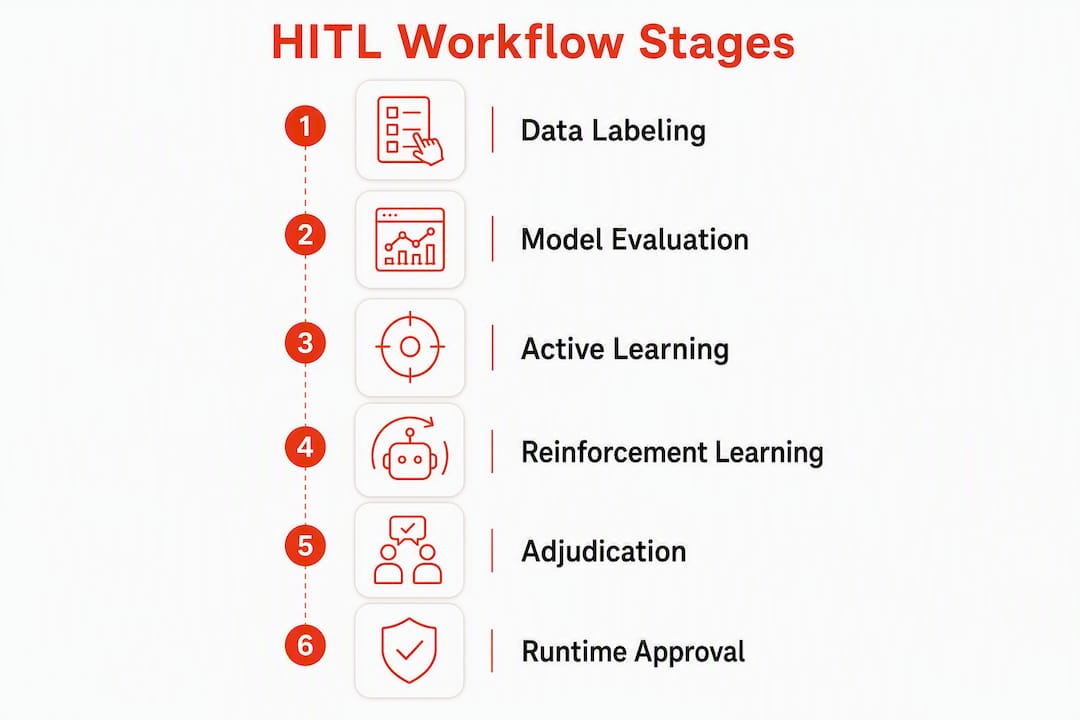
Reinforcement learning from human feedback (RLHF) uses human preference ratings to train a reward model, which then guides the policy model toward outputs humans prefer. This is the mechanism behind alignment work on large language models.
Adjudication resolves disagreements between multiple annotators. When two reviewers label the same item differently, a senior reviewer or consensus rule determines the final label.
Runtime escalation and approval is the synchronous form of HITL. The system pauses before acting, presents the decision to a human, and waits for approval or override. This is common in agentic workflows and high-stakes automated decisions.
Synchronous vs. asynchronous interaction
The distinction matters for system design:
- Synchronous (pause-for-approval): The AI halts and waits. Adds latency but provides hard safety guarantees. Used when the cost of an error is high.
- Asynchronous (background feedback): The AI acts, humans review outputs after the fact, and corrections feed back into retraining. Higher throughput, but errors can propagate before correction.
How feedback flows through the system
A typical production HITL loop follows this sequence:
- Model generates an output with a confidence score or risk flag.
- A routing rule evaluates whether the item meets the threshold for autonomous action or requires human review.
- Items below the threshold enter a review queue.
- A human reviewer examines the item, confirms, corrects, or escalates.
- The human's decision is logged as labeled data.
- Labeled corrections are versioned and fed into the next retraining cycle or used to update a policy.
- The updated model is evaluated, and thresholds are recalibrated.
Confidence thresholds and risk scores are the primary routing mechanism. A model that is 95% confident on a routine transaction routes it automatically; the same model at 60% confidence on a medical imaging result sends it to a radiologist. Setting those thresholds correctly is one of the most consequential design decisions in any HITL program.
Why HITL matters: performance, safety, and trust
The case for embedding humans is not just philosophical. There are concrete performance, safety, and governance reasons that justify the added complexity.
Accuracy on edge cases. Models trained on historical data struggle with novel inputs, rare categories, and distribution shifts. Targeted human feedback on exactly those cases improves generalization without requiring a full retraining cycle on large datasets.
Safety and risk reduction. For high-impact decisions in healthcare, finance, or agentic systems, a human checkpoint is a circuit breaker. It catches errors before they become incidents. This is especially relevant as AI systems take on more autonomous actions where a mistake is difficult or impossible to reverse.

Explainability and audit trails. When a human reviews and approves a decision, that action is logged. The result is a decision provenance record that compliance teams, auditors, and regulators can inspect. Without HITL, many AI decisions are effectively black boxes with no accountable actor attached.
Bias mitigation. Human reviewers can catch systematic errors that aggregate metrics miss. A model might perform well on average while failing consistently on a specific demographic or input type. Reviewers who understand the domain notice these patterns; aggregate accuracy scores often do not.
Trust and user acceptance. Research on calibrated trust shows that users over- or under-estimate AI capabilities over time, and that transparency about limitations is necessary for reliable reliance. Knowing a human reviewed a decision increases user confidence in the outcome, particularly in sensitive domains.
A critical nuance on performance: A meta-analysis published in Nature Human Behaviour found that human-AI combinations often provide human augmentation but do not always produce synergy. When AI outperforms humans on a task, adding humans to the loop may reduce overall system performance. The implication is direct: HITL is not universally beneficial. It adds value when humans are genuinely better than the model on the items being reviewed, or when governance requires it regardless of performance.
Where HITL shows up in practice
These are not hypothetical scenarios. Each represents a real deployment pattern with a defined human role.
-
Medical imaging. A radiology AI flags potential anomalies in CT scans. A radiologist reviews flagged cases before any diagnosis is recorded. The AI handles volume; the physician handles liability and edge-case judgment. Risk profile: very high. Human role: final decision authority.
-
Content moderation. A classifier scores user-generated content for policy violations. High-confidence benign and high-confidence violating content is handled automatically. The middle band, where the model is uncertain, goes to a human reviewer before any action is taken. Risk profile: medium-high (reputational and legal). Human role: adjudicator on ambiguous cases.
-
Speech-to-text in regulated contexts. Legal and medical transcription services route low-confidence segments to human editors before the transcript is finalized. Errors in a legal deposition or clinical note carry real consequences. Human role: correction and quality assurance.
-
Customer support routing. A support AI handles routine queries autonomously. When intent classification confidence drops below a threshold, or when the query touches a sensitive topic (billing dispute, account security), it escalates to a human agent. Human role: handler of complex or high-value interactions.
-
Agentic AI actions. An AI agent is tasked with drafting and sending a vendor contract. Before the email is sent, a human reviews and approves the final document. Agentic systems increase the need for pause-and-approve checkpoints because the actions they take are external, consequential, and sometimes irreversible. Human role: approval authority before external action.
-
Financial fraud detection. A fraud model flags transactions above a risk score. Human analysts review flagged cases before accounts are frozen. Automated freezes based solely on model output create false-positive customer harm. Human role: verification before consequential action.
Across all of these, the pattern is consistent: the AI handles volume and speed, the human handles judgment, accountability, and the cases where the cost of error is unacceptable.
What methods and techniques power HITL workflows?
The choice of method depends on your scale, the expertise required, and how much labeling budget you have. These are not interchangeable.
Active learning and sampling strategies
Active learning minimizes labeling cost by selecting only the most informative examples for human review. The three main sampling approaches:
- Uncertainty sampling: Route items where the model's confidence is lowest. Simple and effective for binary or multiclass problems.
- Query by committee: Multiple models vote on an item; high disagreement signals the item is worth labeling.
- Stratified sampling: Ensure coverage across rare categories or demographic groups that would be underrepresented in pure uncertainty sampling.
RLHF and reward-model workflows
Reinforcement learning from human feedback trains a reward model on human preference comparisons, then uses that reward model to fine-tune the policy. The human's job is not to label correct answers but to rank or compare outputs. This scales better than direct correction for generative tasks, but it introduces its own risks: the reward model can be gamed, and human raters bring their own biases into the preference data.
Crowd-sourced vs. domain-expert annotation
| Dimension | Crowd-sourced annotation | Domain-expert annotation |
|---|---|---|
| Cost per label | Low | High |
| Throughput | High | Low |
| Label quality (routine tasks) | Acceptable | High |
| Label quality (specialized tasks) | Poor | High |
| Bias risk | High (inconsistent standards) | Lower (but expert blind spots exist) |
| Best fit | High-volume, well-defined tasks | High-stakes, ambiguous, or regulated tasks |
Selecting the right reviewer skill level directly affects label quality, bias introduction risk, and cost. For medical imaging or legal document review, crowd workers are not a viable substitute for credentialed experts regardless of volume.
Adjudication and consensus
When multiple reviewers label the same item, disagreement is expected. Adjudication resolves it through majority vote, weighted voting (senior reviewer overrides), or escalation to a tie-breaker. Inter-rater reliability (IRR) metrics like Cohen's kappa measure how consistently reviewers agree. Low IRR is a signal that the labeling guidelines are ambiguous, not that the reviewers are incompetent.
Governing feedback as operational data
Human corrections are only valuable if they are captured, versioned, and used. Operationalizing human feedback as training data multiplies HITL's value over time. This means storing corrections with metadata (reviewer ID, timestamp, confidence score at routing, final label), versioning label sets alongside model versions, and building automated retraining triggers when correction volume crosses a threshold.
What are the real challenges of running HITL at scale?
HITL is not free, and the costs are not always obvious upfront.
Cost and throughput limits. Human review is expensive per item and does not scale linearly. Subject-matter experts are scarce and cannot be hired on demand. As model volume grows, the review queue can become a bottleneck that negates the speed advantage of automation.
Latency in synchronous workflows. Pause-for-approval adds real time to a process. In customer-facing applications, that latency degrades user experience. The tradeoff between safety and speed must be explicit in the system design, not discovered after deployment.
Annotation drift and human error. Reviewers are not consistent over time. Fatigue, changing interpretations of guidelines, and turnover introduce label noise. A model trained on drifting annotations learns the drift, not the intended signal.
Bias introduction. Human reviewers bring their own cognitive biases. If the reviewer pool is not diverse, or if guidelines are ambiguous, the model can learn systematic biases that were not present in the original data. This is a particular risk when crowd workers are used for tasks requiring cultural or contextual judgment.
Privacy and data handling under U.S. law. When reviewers see real user data, HIPAA (healthcare), GLBA (financial services), and CCPA/state privacy laws may apply. Annotation workflows must be designed with data minimization, access controls, and reviewer agreements that comply with the relevant regulatory framework. Sending sensitive data to external crowd-sourcing platforms without proper data processing agreements is a compliance risk many teams underestimate.
Labor ethics. Content moderation and annotation work can expose reviewers to harmful material. U.S. organizations have faced legal and reputational consequences for inadequate worker protections in annotation pipelines. Duty-of-care obligations extend to the humans in your loop.
Calibrated trust over time. Trust declines when user expectations misalign with system capabilities, and this applies to reviewers as well as end users. Reviewers who over-trust the model stop catching errors; those who under-trust it override correct predictions unnecessarily. Neither is the behavior you want.
Pro Tip: Reserve HITL for genuinely ambiguous or high-stakes items. Routing high-volume, well-defined, low-risk tasks to human review wastes budget and creates reviewer fatigue that degrades quality on the cases that actually need attention. Use confidence thresholds and risk scores to keep the review queue focused.
How do you build a production HITL program?
A HITL program that works in production requires deliberate design across four areas: thresholds and roles, metrics, reviewer onboarding, and feedback pipelines.
Design checklist
- Define risk thresholds. Determine which confidence scores and risk categories trigger human review. Document the rationale. Revisit thresholds quarterly or after significant model updates.
- Designate reviewer roles. Specify who reviews what. Separate routine adjudication from high-stakes escalation. Assign subject-matter experts to cases that require domain knowledge.
- Instrument audit logs. Every review action must be logged with reviewer identity, timestamp, original model output, and final decision. This is non-negotiable for compliance and for feedback quality.
- Set SLAs for review queues. Define maximum time-to-decision for each risk tier. A synchronous approval that takes 48 hours is not a safety mechanism; it is a bottleneck.
- Build a feedback ingestion pipeline. Corrections must flow from the review tool into a versioned label store. Manual exports to spreadsheets do not scale and introduce data integrity risks.
- Plan for retraining cadence. Decide in advance how often corrected labels trigger a retraining run, and what volume of corrections justifies the compute cost.
Metrics to track
- Human review rate: What percentage of model outputs are routed to humans? If it is too high, your thresholds are too conservative. If it is near zero, you may be under-reviewing.
- Reviewer disagreement rate: High disagreement signals guideline ambiguity or reviewer drift.
- False positive and false negative change: Track whether human review is actually improving model decisions over time.
- Time-to-decision: Average and 95th-percentile latency for human review. Spikes indicate queue management problems.
- Cost per reviewed decision: Tracks ROI and helps justify threshold adjustments.
Onboarding reviewers
- Provide a calibration set of pre-labeled examples with known correct answers before reviewers handle live data.
- Measure inter-rater reliability on the calibration set before a reviewer goes live.
- Run periodic recalibration checks, not just at onboarding. Reviewer performance drifts.
- Shared mental models between humans and AI require that reviewers understand what the model can and cannot do. Train reviewers on model limitations, not just labeling guidelines.
When to move from HITL to human-on-the-loop (HOTL)
As a model matures and error rates fall, full pause-for-approval on every uncertain item becomes unnecessary. Human-on-the-loop (HOTL) shifts the human role from pre-approval to monitoring and exception handling. The model acts autonomously; humans review samples and intervene when anomalies appear. This transition should be data-driven: move to HOTL when false-negative rates on previously reviewed categories fall below an agreed threshold and stay there across multiple evaluation cycles. Conflating HITL and HOTL causes either excessive bottlenecks or insufficient safety oversight, depending on which direction the confusion goes.
For teams designing AI project management workflows, the HITL-to-HOTL transition is one of the most consequential architectural decisions in the program lifecycle.
What types of tools support HITL workflows?
No single platform covers the full HITL stack. Teams typically assemble from several categories:
-
Annotation and labeling platforms: Purpose-built tools for managing labeling tasks, reviewer queues, and label versioning. They handle task assignment, inter-rater reliability measurement, and export to training pipelines. Selection criteria include support for your data modality (image, text, audio, video), built-in sampling strategies, and API integration with your MLOps stack.
-
Review and approval workflow tools: These manage the routing logic, SLA tracking, and audit logging for runtime HITL. They sit between the model inference layer and the action layer, intercepting outputs that meet escalation criteria.
-
Agent control and approval UIs: Specifically designed for agentic AI systems, these tools present proposed actions to human approvers with enough context to make an informed decision quickly. The UI design here is critical: a reviewer who cannot understand the context of a proposed action in under 30 seconds will either rubber-stamp or over-reject.
-
Label management and MLOps integration tools: These connect the review output to the training pipeline. They handle label versioning, dataset lineage, and retraining triggers. Without this layer, human corrections sit in a review tool and never improve the model.
Platform selection considerations: Data governance requirements (can reviewer data leave your cloud environment?), API latency for synchronous workflows, built-in sampling strategies, and the ability to record reviewer identity and decision rationale for audit purposes. For teams with regulatory obligations, the audit trail capabilities of the platform are often the deciding factor.
When scoping a HITL platform purchase, a structured AI RFP process helps teams specify governance, latency, and integration requirements before vendor conversations begin, which prevents scope creep and misaligned expectations later.
Ethics, governance, and U.S. regulatory considerations
HITL creates accountability, but only if the governance around it is deliberate.
Documentation and auditability. Every human decision in the loop must be logged with enough context to reconstruct the decision later: the model's output, the confidence score, the reviewer's identity and role, the final decision, and the timestamp. This is the minimum viable audit trail. For regulated industries, it is a legal requirement.
Informed consent for annotators. Reviewers who handle sensitive data must be informed about what they are reviewing and why. This is both an ethical obligation and, in some contexts, a legal one. Annotation agreements should specify data handling obligations, confidentiality requirements, and the purpose of the labeling work.
Privacy-preserving annotation practices. Where possible, de-identify or anonymize data before it reaches reviewers. Techniques like differential privacy, data masking, and synthetic data substitution reduce exposure without eliminating the signal reviewers need. Under HIPAA, PHI must be handled with appropriate safeguards even in internal annotation workflows.
Worker protections. Content moderation and annotation work can be psychologically harmful. U.S. organizations should implement exposure limits, provide mental health resources, and design review interfaces that minimize unnecessary exposure to harmful content. This is not optional for organizations that take duty-of-care seriously.
U.S. regulatory touchpoints. Sector-specific rules shape HITL requirements directly:
- Healthcare: FDA guidance on AI/ML-based software as a medical device (SaMD) requires predetermined change control plans and, in many cases, human oversight of AI-generated clinical recommendations.
- Financial services: OCC model risk management guidance (SR 11-7) requires human review and validation of model outputs used in credit, fraud, and compliance decisions.
- Defense and federal procurement: NIST AI Risk Management Framework (AI RMF) provides a voluntary but widely adopted structure for human oversight requirements in federal AI deployments.
Interface design for competent oversight. A human reviewer who cannot understand the context of a decision in the time available is not providing meaningful oversight. Interface design must surface the model's reasoning, the relevant context, and the consequences of each option. Reviewers need enough information to exercise genuine judgment, not just click a button.
What does the latest research say about human-AI teaming?
The research picture is more nuanced than the marketing around AI collaboration usually admits.
The Nature Human Behaviour meta-analysis is the most important finding to internalize: human-AI combinations often augment human performance but do not reliably produce synergy. The direction of the effect depends on which actor is stronger on the specific task. This means HITL design must start with an honest assessment of where humans actually add value, not an assumption that adding humans always helps.
Socio-technical research on human-AI teaming identifies four dimensions that determine whether a team succeeds: team formulation (who is on the team and in what role), coordination protocols (how decisions are handed off), social dynamics (trust, communication, conflict resolution), and continuous knowledge creation (how the team learns and updates shared understanding over time). Treating HITL as a purely technical problem, a routing rule and a review queue, misses the social and organizational dimensions that determine whether reviewers actually improve outcomes.
Stanford HAI frames HITL as keeping humans in charge of decision-making while treating AI as a capable teammate rather than a replacement. That framing matters for organizational culture: teams that treat AI as an oracle to be rubber-stamped get the worst of both worlds.
Agentic AI raises the stakes considerably. As AI systems pursue multi-step goals and take external actions, the consequences of a missed escalation grow. Agentic systems require deliberate pause-and-approve checkpoints and clear escalation paths, not just confidence thresholds on individual predictions. The design question shifts from "when should a human review this output?" to "at which points in this multi-step process must a human authorize continuation?"
Frontiers in AI research argues that effective human-AI teams require blending computer science with psychology, specifically designing for shared mental models where both the human and the AI system have a compatible understanding of the task, the constraints, and each other's capabilities. Building that shared model requires training reviewers on model limitations and designing model outputs that surface uncertainty and reasoning in ways humans can actually use.
Practical recommendations for organizations preparing for more agentic AI:
- Map every agentic workflow to identify which steps are reversible and which are not. Irreversible steps require synchronous human approval regardless of confidence.
- Build escalation paths before deployment, not after an incident.
- Treat reviewer calibration as an ongoing program, not a one-time onboarding task.
- Instrument for trust drift: measure whether reviewers are becoming more or less accurate over time and intervene when drift appears.
- Design for the complementarity framework described in recent PMC research: identify the specific conditions under which your human-AI team outperforms either actor alone, and design the workflow to maximize time spent in those conditions.
Key Takeaways
Human-in-the-loop AI adds the most value when it is risk-based, well-governed, and treated as an ongoing program rather than a one-time integration.
| Point | Details |
|---|---|
| Use HITL where it earns its cost | Route only high-stakes or low-confidence items to humans; blanket review wastes budget and degrades reviewer quality. |
| Human feedback is product data | Capture, version, and feed corrections back into retraining pipelines or they have no lasting effect on model performance. |
| Reviewer reliability must be measured | Track inter-rater reliability and recalibrate reviewers periodically; annotation drift silently corrupts training data. |
| HITL and HOTL are distinct patterns | Conflating pause-for-approval with monitoring-and-exception-handling creates either bottlenecks or safety gaps. |
| Swarm-stack supports HITL governance | Swarm-stack's versioned deliverables, audit trails, and integrated expert marketplace map directly to production HITL program needs. |
The case for treating HITL as a first-class design decision
The conversation around human-in-the-loop AI tends to split into two camps: teams that treat it as a temporary patch until the model gets good enough to go fully autonomous, and teams that treat it as bureaucratic overhead imposed by compliance. Both framings are wrong, and both lead to poor outcomes.
The meta-analytic evidence is clear that human-AI combinations do not automatically outperform either actor alone. What determines the outcome is whether the workflow is designed to put humans in the positions where they genuinely add signal. That requires knowing your model's failure modes in detail, not in aggregate. A model with 97% accuracy can still fail catastrophically on the 3% of cases that happen to be the highest-stakes ones. HITL, designed well, is the mechanism that catches those cases. Designed poorly, it is theater.
The governance dimension is equally underappreciated. As agentic AI systems take on more consequential actions, the audit trail that HITL produces is not just a compliance artifact. It is the evidence base that lets organizations learn from near-misses, defend decisions to regulators, and build the kind of institutional trust that allows AI systems to take on more responsibility over time. Organizations that skip the governance work now will face much harder retrofits when regulators or incidents force the issue.
The practical recommendation is to start with the risk assessment, not the tooling. Map your AI workflows by consequence severity and model confidence. Design HITL checkpoints for the high-consequence, low-confidence intersection. Instrument everything. Treat reviewer feedback as operational data from day one. And plan explicitly for the transition from HITL to HOTL as the model matures, because that transition is where most programs either stall or create safety gaps.
Swarm-stack brings human oversight into your AI workflows
Most teams building HITL programs run into the same friction: the collaboration between human reviewers and AI outputs happens across disconnected tools, with no shared record of who decided what and why. That gap is where governance breaks down.
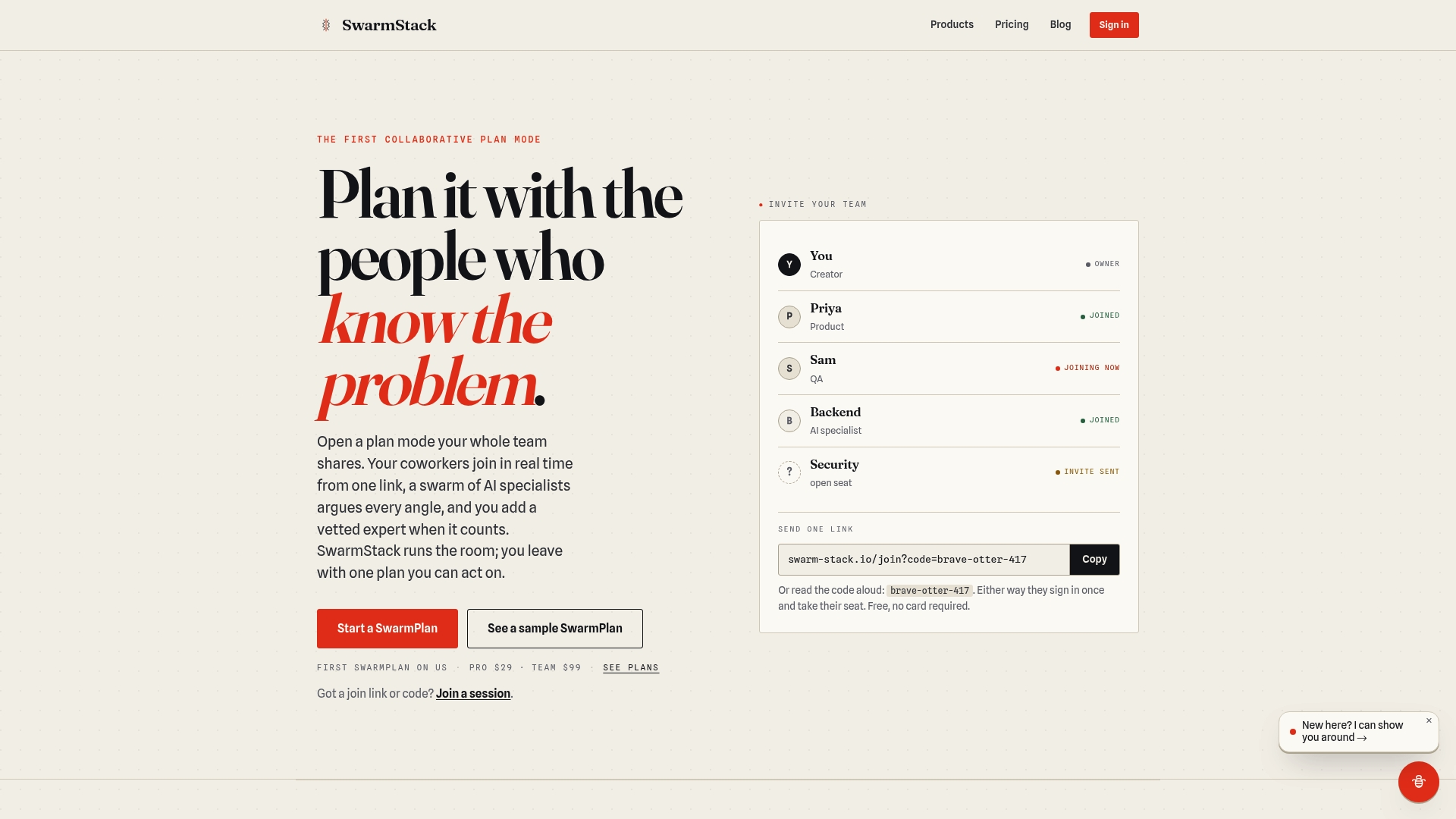
Swarm-stack is built for exactly this kind of structured human-AI collaboration. Teams run real-time sessions that combine AI specialists and human experts, with every decision versioned and tracked from the first draft to the final deliverable. Reviewers join via a single invite link, structured interviews surface every relevant angle, and the output is a documented, ready-to-implement plan with a full decision trail. The integrated expert marketplace means you can bring in vetted domain experts for the high-stakes review tasks that crowd workers cannot handle. For teams that need to demonstrate competent human oversight to auditors or stakeholders, that audit trail is not an afterthought. It is built into how the platform works. Start a session on Swarm-stack and see how versioned human-AI collaboration changes what your team can produce.
Useful sources and further reading
The sources below are organized by the article sections they support most directly.
-
Toward a science of human-AI teaming for decision making | PMC — Complementarity framework for structuring human-AI teams. Supports the research and implementation sections.
-
Human-AI Teaming: State-of-the-Art and Research Needs | National Academies — Authoritative review of the research landscape, with a focus on high-consequence environments. Supports the research and governance sections.
-
Human-AI teaming frameworks | arXiv — Socio-technical dimensions of teaming: formulation, coordination, social dynamics, and knowledge creation. Supports the research and implementation sections.
-
Stanford HAI: What is human-in-the-loop? — Accessible definition and framing from a leading AI research institution. Supports the BLUF and importance sections.
-
Frontiers in AI: human-AI teaming research — Socio-technical design requirements for effective human-AI teams. Supports the research section.
-
Data Science and Engineering With Human in the Loop | Harvard Data Science Review — Academic treatment of HITL in data science workflows. Supports the methods and implementation sections.