Red Team Review: A Practical Guide for RFP Teams
Unlock the power of a red team review for your RFPs. Learn practical steps to elevate your proposals with unbiased feedback and actionable insights.

A red team review for proposals and RFPs is an independent, outsider-perspective critique that applies the sponsor's own evaluation criteria to your near-complete submission before it goes out the door. The immediate next step: schedule a 60–90 minute session, assign a Red Team lead, and send reviewers the solicitation, scoring criteria, and a compliance matrix at least 48 hours in advance. Two things make the difference between a review that sticks and one that gets ignored: rubric-based scoring to reduce bias, and assigned follow-up tasks with named owners and deadlines.
- Schedule the session 1–2 weeks before submission
- Send materials early: proposal draft, solicitation, compliance matrix
- Use a scoring rubric (not open-ended comments)
- Assign every finding to a named owner with a deadline
Table of Contents
- What does "red team review" mean here, and how does it differ from cybersecurity red teaming?
- When should you schedule a Red Team review?
- Who belongs on the Red Team and what does each role do?
- A repeatable Red Team process you can run in 60–180 minutes
- What the Red Team must produce and how to make feedback stick
- Copyable checklist and rubric you can reuse
- Common mistakes teams make during Red Team reviews
- How long Red Team reviews take and what resources they consume
- Running Red Team reviews inside Swarm-stack
- Key Takeaways
- Why structured Red Team reviews pay off more than teams expect
- Swarm-stack turns Red Team findings into tracked deliverables
- Useful sources and templates
What does "red team review" mean here, and how does it differ from cybersecurity red teaming?
The term gets used in two very different worlds. Here, the focus is the proposal/RFP context: an independent outsider review that simulates how a sponsor's evaluator reads your submission cold, under time pressure, applying the stated criteria. The goal is to surface clarity gaps, weak win themes, and unpersuasive sections before the real evaluator does.
Cybersecurity red teaming is a different posture entirely: offensive emulation of adversary behavior to test technical defenses. Both share the same core value — an adversarial, independent perspective that finds what internal teams miss — but the actions and outputs diverge sharply.
| Dimension | Proposal Red Team | Cybersecurity Red Team |
|---|---|---|
| Goal | Improve persuasiveness and responsiveness to evaluation criteria | Identify exploitable vulnerabilities in systems and defenses |
| Posture | Client-emulation (reviewer perspective) | Adversary emulation (attacker perspective) |
| Output | Scored findings, suggested edits, compliance crosswalk | Penetration report, attack paths, remediation list |
| Timing | Late-stage, near-complete proposal | Ongoing or scheduled security exercises |
| Team profile | Independent reviewers, SMEs, proposal professionals | Ethical hackers, penetration testers, security engineers |
Typical goals for a proposal Red Team: confirm the win themes are clear, verify the narrative responds to every evaluation factor, identify sections that read as vague or unpersuasive, and flag compliance gaps before submission.
When should you schedule a Red Team review?
Timing is everything. A Red Team run too early reviews an incomplete draft; run too late, there is no time to act on findings. The standard window is 1–2 weeks before the submission deadline, when the proposal is substantively complete: narrative sections drafted, budget roughed in, biosketches attached, and key graphics in place.
Triggers that should force a Red Team regardless of schedule:
- High-stakes or must-win opportunities
- Major changes to your technical approach since the last draft
- Shifts in evaluation criteria from a prior solicitation version
- New team members or subcontractors who haven't been reviewed before
When the schedule is tight, CapturePlanning documents three practical modes: a full evaluating-and-recommending-fixes Red Team, a customer-evaluation simulation, and a running Red Team for compressed timelines. A running Red Team uses one or two independent reviewers who score sections as they are completed rather than waiting for a full draft. It preserves the independent perspective and rubric discipline even when a full panel session isn't possible.
Practical rule of thumb: "Substantively complete" means every major section has prose, not placeholders. A budget table with TBD cells and a methods section that says "to be written" is not ready for Red Team.
Who belongs on the Red Team and what does each role do?
| Role | Responsibility | Independence Requirement |
|---|---|---|
| Red Team lead/manager | Facilitates session, enforces rubric, consolidates findings | Must not be a proposal author |
| Independent reviewers (2–4) | Score and comment blind against rubric | No direct involvement in proposal writing |
| Subject-matter experts (consult) | Answer technical questions during debrief only | Partial; advise, don't score |
| Proposal manager | Observes, takes notes, does not defend the proposal | Observer role only |
| Decision owner | Receives findings, approves prioritization, assigns owners | Accountable for follow-up |

A minimum viable panel is three independent reviewers plus a Red Team lead. The ideal mix includes at least one person with no prior knowledge of the project — someone who reads the proposal the way a real evaluator would, cold. Reviewers unfamiliar with the project expose clarity and persuasion gaps that insiders have long stopped seeing.
Conflict-of-interest rules matter. Anyone who wrote a section, contributed data, or has a financial stake in the award should not score that section. Rotate reviewers across proposals to prevent familiarity creep.
Time commitment: plan for 2–3 hours of reading and scoring per reviewer, plus 30–60 minutes for the debrief. Brief them on the rubric and solicitation before the session, not during it.
A repeatable Red Team process you can run in 60–180 minutes
Step 1 — Open with the objective (5 minutes). State the session goal and walk reviewers through the sponsor's scoring criteria. Every reviewer should know the evaluation factors and their weights before reading a single page.
Step 2 — Read-and-score phase (30–90 minutes). Reviewers read independently and score each section against the rubric. No discussion during this phase. Pre-distributed materials — the proposal, solicitation, and a Proposal Scoring Form — keep reviewers focused on substantive weaknesses rather than editorial preferences.
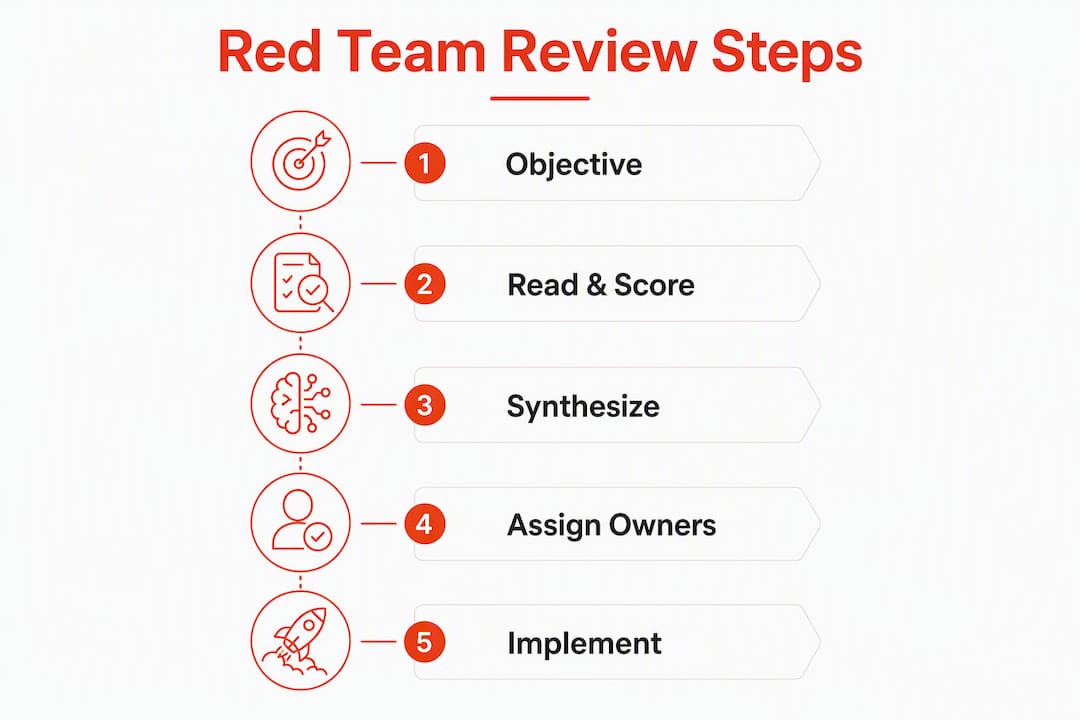
Step 3 — Scoring synthesis (15–30 minutes). Consolidate scores, identify the top 5–10 findings, and classify each by severity (critical, significant, minor) and fixability (can fix before deadline, needs strategy change, informational only). Co-locating reviewers during synthesis — or running a tightly facilitated remote session — reduces conflicting recommendations and produces cleaner outputs.
Step 4 — Debrief and assignment (15–30 minutes). Present findings to the proposal team. Assign each finding to a named owner with a deadline. No owner, no fix.
Sample schedules:
- 60-minute session: 5 min open, 30 min read/score, 15 min synthesis, 10 min debrief
- 90-minute session: 5 min open, 45 min read/score, 20 min synthesis, 20 min debrief
- 180-minute session: 10 min open, 90 min read/score, 40 min synthesis, 40 min debrief
Compact rubric template:
| Criterion | 1 (Weak) | 2 (Partial) | 3 (Adequate) | 4 (Strong) |
|---|---|---|---|---|
| Clarity | Hard to follow | Some unclear sections | Mostly clear | Easy to read throughout |
| Responsiveness | Misses evaluation factors | Addresses some factors | Addresses most factors | Fully mapped to criteria |
| Persuasiveness | No win themes | Weak benefit statements | Some compelling points | Clear, consistent win themes |
| Discriminators | None visible | Vague differentiators | Some specific advantages | Clear, provable differentiators |
| Risk | Major gaps or red flags | Some unaddressed risks | Minor risks only | No significant risks |
Pro Tip: Distribute the rubric and solicitation 48 hours before the session. Reviewers who arrive prepared spend their time scoring, not orienting — and the findings are sharper for it.
What the Red Team must produce and how to make feedback stick
A Red Team that ends with verbal comments and no written record is a wasted session. Formal presentation of findings plus assigned follow-ups is what separates reviews that change proposals from reviews that get filed and forgotten.
Standard deliverables:
- Executive scorecard (section-by-section rubric scores)
- Prioritized findings list (severity + fixability)
- Suggested edits or rewrite guidance per finding
- Compliance matrix crosswalk (evaluation factor vs. proposal section)
- Presentation slides for the debrief
Finding template:
| Field | Example |
|---|---|
| Title | Win theme absent from Section 3 |
| Excerpt | "Our team will deliver..." (no benefit statement) |
| Rubric score | Persuasiveness: 1/4 |
| Recommended fix | Add a benefit statement tied to sponsor priority |
| Owner | J. Smith |
| Deadline | 5 days before submission |
| Verification | Proposal manager confirms revision in next draft |
Versioning matters here. Every revision triggered by a Red Team finding should be logged so the decision owner can verify closure. Without version tracking, teams often discover on submission day that a critical fix was discussed but never made.
Copyable checklist and rubric you can reuse
Pre-session checklist:
- Proposal draft (near-complete)
- Solicitation and all amendments
- Compliance matrix
- Scoring rubric and Proposal Deficiency Form
- Reviewer briefing note (session agenda, criteria weights, conflict-of-interest declaration)
- Session schedule with timeboxes
In-session checklist:
- Confirm all reviewers have read materials
- State evaluation criteria and weights at open
- Enforce silent read-and-score phase
- Collect scores before group discussion
- Facilitate synthesis without letting one voice dominate
Post-session checklist:
- Distribute written findings within 24 hours
- Assign every finding to a named owner with a deadline
- Schedule a verification checkpoint before final submission
- Log all revisions in a versioned document
Common mistakes teams make during Red Team reviews
Running the review too late. If findings come back 48 hours before submission, there is no time to rewrite. Fix: set a hard internal Red Team deadline at least 10 days before the due date.
Using reviewers who lack independence. A panel of proposal authors reviewing each other's sections produces confirmation, not critique. Rotate reviewers across proposals and bring in at least one person with no prior project exposure.
Generic comments with no rubric. "This section needs work" is not a finding. Rubric-based scoring forces reviewers to be specific and gives the proposal team a clear target.
No assigned owners. Findings without owners get deprioritized when deadline pressure hits. Every finding needs a name, a deadline, and a verification step. The accountability mechanics are what convert Red Team output into actual proposal improvements.
Isolated, asynchronous reviews. When reviewers score independently and never synthesize together, conflicting recommendations pile up and the proposal team has to arbitrate instead of fix. A facilitated synthesis session, even a 20-minute one, resolves most conflicts before they reach the authors.
How long Red Team reviews take and what resources they consume
| Review type | Duration | Reviewers | Prep time per reviewer |
|---|---|---|---|
| Running Red Team (tight schedule) | 30–60 min | 1–2 | 1–2 hours |
| Standard Red Team | 60–180 min | 3–5 | 2–3 hours |
| Full multi-section review | Multiple sessions | 4 | 3–5 hours per session |
Resource factors that drive effort:
- Proposal length and complexity (more sections = more reading time)
- Number of independent reviewers needed
- Whether external SMEs must be sourced and briefed
- Quality of pre-distributed materials (poor prep doubles session time)
Sample calendar milestones for a 30-day proposal cycle:
- Day 1: Proposal kickoff, assign Red Team lead
- Day 15: Pink Team (compliance check)
- Day 20: Red Team materials distributed to reviewers
- Day 22: Red Team session
- Day 23: Findings distributed, owners assigned
- Day 28: Verification checkpoint
- Day 30: Submission
External SME costs vary by domain and engagement model. For teams using an assessment management platform or structured review workflow, the overhead of coordinating reviewers and tracking findings drops considerably.
Running Red Team reviews inside Swarm-stack
Swarm-stack maps directly to the Red Team workflow without requiring a separate project management layer.
| Red Team step | Swarm-stack feature |
|---|---|
| Invite independent reviewers | Single session invite link — no account setup required |
| Distribute materials | Upload proposal draft, solicitation, and rubric to the session |
| Score and synthesize | AI summarization consolidates reviewer scores and surfaces top findings |
| Assign follow-ups | Decision-tracking assigns findings to named owners with deadlines |
| Version revisions | Deliverable versioning logs every change triggered by a finding |
| Export to workflow | Direct export to GitHub or Jira for technical teams |
Quickstart:
- Create a new session in Swarm-stack and upload the proposal draft, solicitation, and rubric
- Share the invite link with independent reviewers (no account required)
- Run the read-and-score phase; AI summarization surfaces consensus findings
- Assign each finding to an owner in the decision-tracking view
- Export the findings list to GitHub or Jira for follow-up tracking
For confidential RFP material, Swarm-stack's data privacy controls and platform security measures cover access management and data handling. Before running a Red Team on sensitive procurement material, confirm reviewer access is scoped to the session only and that no proposal content is retained beyond the review window.
Pro Tip: Use Swarm-stack's AI summarization after the read-and-score phase to generate a draft findings list before the group synthesis. Reviewers spend the synthesis time refining priorities rather than building the list from scratch, which cuts synthesis time roughly in half.
Confidential review checklist for Swarm-stack sessions:
- Scope reviewer access to the session only
- Confirm data retention settings before uploading sensitive material
- Use versioned deliverables so every revision is logged
- Export findings to a tracked system (GitHub/Jira) before closing the session
Key Takeaways
A Red Team review works when independent reviewers apply the sponsor's scoring criteria to a near-complete proposal, findings are assigned to named owners, and every revision is tracked to closure.
| Point | Details |
|---|---|
| Timing window | Run the Red Team 1–2 weeks before submission, when the proposal is substantively complete. |
| Independent reviewers | Include at least one reviewer with no prior project exposure to mirror a real evaluator reading cold. |
| Rubric-based scoring | Score against explicit criteria (clarity, responsiveness, persuasiveness, discriminators) to replace vague comments with specific, fixable findings. |
| Accountability mechanics | Assign every finding to a named owner with a deadline and a verification step — unassigned findings rarely get fixed. |
| Swarm-stack workflow | Use Swarm-stack's invite links, AI summarization, decision-tracking, and versioning to run auditable Red Team sessions and convert findings into tracked follow-ups. |
Why structured Red Team reviews pay off more than teams expect
The resistance I see most often is time. Teams treat the Red Team as optional when the schedule compresses, which is exactly backwards. The proposals that benefit most from a Red Team are the ones where the team has been heads-down for weeks and can no longer see what an evaluator sees on page one.
The second pattern worth naming: organizations that run Red Teams ad hoc get ad hoc results. The teams that see consistent score improvements treat the Red Team as a fixed process step, not a favor someone does when they have a free afternoon. That means a standing rubric, a standing roster of independent reviewers, and a standing calendar slot. The first time you run it as a repeatable practice rather than a scramble, the difference in finding quality is obvious.
The accountability piece is where most teams leave value on the table. A finding without an owner is a suggestion. A finding with a named owner, a deadline, and a verification checkpoint is a commitment. That distinction, more than any rubric refinement, determines whether the Red Team changes the proposal.
Swarm-stack turns Red Team findings into tracked deliverables
Running a Red Team session is one thing. Converting findings into verified proposal improvements before the submission deadline is where most teams lose ground. Swarm-stack gives your team a single session where independent reviewers score against your rubric, AI summarization surfaces the top findings in minutes, and every follow-up is assigned, versioned, and exportable to GitHub or Jira. No separate project management tool, no emailed comment threads, no findings that fall through the cracks.
For teams handling sensitive RFP material, Swarm-stack's trust and security documentation covers access controls and data handling in plain language. If you want to see how the session model maps to your next proposal cycle, start a session on SwarmStack and run your first Red Team review with your existing team today.
Useful sources and templates
- CASRAI: Pink, Red & Gold Team Proposal Reviews — Explains the staged review sequence and how Red Team fits between compliance and submission-readiness checks.
- NCSU Research Development Office: The Importance of Red Team Reviews — Covers the value of independent reviewers and how they expose clarity gaps.
- FedMarket: Red Team Review Guidelines — Practitioner checklist for evaluating proposals from the client's perspective.
- CapturePlanning: Using Red Teams Effectively — Documents Red Team modes, pre-distributed materials, and co-location best practices.
- Course Hero: Red Team Review Checklist — Sample artifacts including Proposal Deficiency Form and Proposal Scoring Form.
- SentinelOne: Red Team vs. Blue Team — Defines cybersecurity red teaming for teams needing to distinguish it from proposal reviews.
- NIST CSRC: Red Team/Blue Team Approach Glossary — Authoritative definition of the cybersecurity red team/blue team construct.
- Swarm-stack Trust & Privacy — Platform data-privacy and confidentiality controls for teams running sensitive reviews.
- Swarm-stack Security — Platform security measures for managing reviewer access and sensitive proposal material.
- Swarm-stack RFP Excel Template Toolkit — Downloadable templates including compliance matrices teams can adapt for Red Team prep.
- iSET+: Information Security Emerging Technology — Resource on independent technical review and the role of third-party contributors in quality assurance.