10 RFP Question Categories Procurement Teams Use to Score Vendors
Copy ready RFP questions and a weighted scorecard for procurement teams, plus collaborative AI tips to turn vendor answers into a defensible choice.

Every strong RFP rests on ten question categories: internal alignment, company background, solution fit, pricing, implementation, security and compliance, references, technical team, support and governance, and a scoring framework that turns answers into a decision. Below you'll find a copy-ready question bank organized by evaluation impact, a scorecard structure with weighting guidance, and the common mistakes that turn a solid RFP into a stack of vague, unusable responses.
TL;DR:
- Clear internal goals and scope must be established before drafting RFP questions to ensure vendor proposals target the right problems and solutions.
- Response timelines should be at least three weeks to prevent generic answers and enable thorough evaluation of complex RFPs.
- RFP questions should be categorized and mapped to evaluation criteria, with specific requirements for evidence such as certifications or references.
- Effective scoring relies on standardized rubrics, independent evaluation, and transparent weighting to make defensible, unbiased decisions.
- Collaborative, AI-assisted RFP development accelerates drafting, aligns stakeholder priorities, and produces a ready-to-score document before vendor engagement.
Table of Contents
- Questions to Ask Internally Before You Write the RFP
- Must-Ask RFP Questions for Vendors, Organized by Category
- How to Score RFP Responses Without the Process Falling Apart
- A Copy-Ready RFP Question Bank
- Common RFP Mistakes and How to Fix Them
- Questions to Clarify Legal and Contractual Terms
- Questions to Assess Vendor Sustainability and Corporate Responsibility
- Questions to Understand Post-Implementation Training and Documentation
- Why Collaborative, AI-Assisted RFP Design Beats the Solo Draft
- Build Your RFP Faster With a Structured, Collaborative Session
- Sources
Questions to Ask Internally Before You Write the RFP
The best RFP questions to ask vendors mean nothing if your own team hasn't agreed on what "good" looks like first. Skip this step and you'll get comparable-sounding proposals that solve three different problems, because three different stakeholders quietly wrote the requirements in their heads.
Start with goals, not features. What does success look like in six months, and how will you measure it? A vague goal like "improve efficiency" produces vague vendor answers. A goal like "cut invoice processing time from 9 days to 3" gives every vendor a number to respond to, and gives your evaluators a weight to assign later.
From there, lock down scope before scope creep locks you into a bad contract:
- Define deliverables, timeline, and hard constraints (budget ceiling, integration requirements, compliance mandates).
- Separate must-haves from nice-to-haves so vendors don't pad proposals with irrelevant features.
- Decide whether you need an RFI first to narrow a long vendor list, or whether you're ready to go straight to a full RFP.
Guidance from procurement specialists is consistent here: structured RFP questions start with internal alignment regarding goals, scope, budget, and evaluation method before a single vendor question gets drafted.
Two more decisions matter more than teams expect:
- Response format. Decide whether you want a narrative, a scored short-answer template, required attachments, or some combination. Vendors respond better when the format is spelled out, not left to guesswork.
- Evaluators and rules. Name who scores responses, disclose conflicts of interest before proposals arrive, and set confidentiality expectations for anyone with access to competing bids.
Give vendors real response time. Complex RFPs deserve at least three weeks between release and deadline, since rushed timelines correlate with weaker, more generic proposals.
Must-Ask RFP Questions for Vendors, Organized by Category
This is the core of any RFP evaluation questions framework: the categorized list that determines whether you're comparing apples to apples or guessing based on whichever proposal reads the smoothest.
Company background and stability
You're not just buying a product. You're buying a company's ability to still exist in three years.
- Who owns the company, and has ownership changed in the last five years?
- What's your current financial standing (audited statements, credit rating, or bank references)?
- Do you carry professional liability and cyber insurance, and at what coverage limits?
- Will any part of this engagement be subcontracted, and to whom?
- Are there any pending conflicts of interest, litigation, or contract disputes we should know about?
Solution architecture and fit
- What is the core architecture (cloud native, hybrid, on premises), and what happens if our infrastructure changes?
- Which systems does this integrate with natively, and which require custom middleware?
- Where are the customization limits? What can't be configured without a code change?
- What does your product roadmap look like for the next 18 to 24 months, and how do customers influence it?
- What's the average lifecycle of a major feature before it's deprecated or replaced?
Pricing and total cost of ownership
Pricing questions for RFP submissions catch more vendors off guard than any other category, mostly because line-item pricing hides more than it reveals.
- What is your pricing model (per seat, per usage, flat fee, tiered), and what triggers a tier change?
- What is the total cost of ownership over three years, including training, support, and any required add-ons?
- Are there fees not included in the base quote (data migration, API access, priority support)?
- What are the terms for change orders during implementation?
- What happens to pricing at renewal, and is there a cap on annual increases?
Implementation and rollout
- What's the realistic timeline from signed contract to full deployment?
- What do you need from our team, and when, to hit that timeline?
- How do you handle data migration, and what's your track record on migration accuracy?
- What are the rollout milestones, and how do we sign off on each one?
- What defines "acceptance" of the final deliverable, in writing?
Security and compliance
For technology procurements, this category tends to be the one where a weak answer eliminates a vendor outright. Security and compliance questions covering certifications and incident response are treated as close to non-negotiable in most current question banks, and for good reason: a breach downstream of a vendor relationship is still your breach in the eyes of your customers.
- Do you hold current SOC 2 Type II or ISO 27001 certification? Can you provide the audit report?
- Where is data stored and processed, and does that meet our data residency requirements?
- What encryption standards apply to data at rest and in transit?
- What's your documented incident response plan, and what's your average time to notify a client after a breach?
- Who conducts your third-party security audits, and how often?
If security review is the make-or-break category for your procurement, Swarm-stack's guide to cybersecurity RFP questions goes deeper into the specific certifications and audit language to demand.
References and measurable outcomes
Anyone can list a client logo. Fewer vendors can produce a client willing to talk about actual results.
- Can you provide three references from clients with a similar scope and industry to ours?
- What measurable outcome did those clients see (cost reduction, time saved, error rate drop)?
- May we speak directly with a reference without the vendor present on the call?
Verified references and hard before-and-after metrics give evaluators something concrete to score instead of marketing language.
Technical team and continuity
- Who specifically will be assigned to our account, and can we see resumes or bios?
- What is your team's turnover rate on accounts of similar size?
- If our assigned lead leaves mid-project, what's the transition plan?
- How do you document institutional knowledge so a new hire can pick up the account without a learning curve?
Support, SLAs, and governance
- What are your guaranteed response and resolution times by severity level?
- What's the escalation path when the first-tier support doesn't resolve an issue?
- How do you handle change control after go-live, and who approves scope changes?
- What's the cadence for governance meetings, and who from your side attends?
Vendors offering SaaS platforms should also expect questions about uptime history and failover design. A useful outside reference on this is how SaaS providers design for scale, which covers the operational questions worth raising before you commit to a platform you can't easily leave.
How to Score RFP Responses Without the Process Falling Apart
A stack of thorough vendor answers is useless without a scoring method that turns them into a defensible decision. This is where most procurement teams either build a rigorous evaluation scorecard or default to gut feel dressed up as consensus.
The scorecard itself typically has three parts: a technical proposal score, a value or price proposal score, and an overall summary tab that cross-walks each RFP question back to a specific evaluation criterion. If a question doesn't map to a criterion, it probably didn't need to be asked.
Weighting is where teams reveal their real priorities. Highly specialized software leans harder on technical weight. Interchangeable services lean harder on price.
Rubrics prevent five evaluators from scoring the same answer five different ways. Spell out what separates a 9 from a 5, not just in points but in language: a 9 might mean "the vendor provided a documented process with metrics," while a 5 means "the vendor described intent without evidence." Defined criteria, weights, and rubric anchors are what separate a fair evaluation from one that just reflects whoever wrote the smoothest paragraph.
The evaluation sequence itself matters as much as the scorecard:
- Each evaluator scores independently, without discussion, using the rubric.
- Scores are compiled into a summary before any group conversation happens.
- The committee discusses the highest and lowest scoring proposals specifically, not every proposal equally.
- Evaluators are permitted to revise scores after discussion, but only within a limited window.
- Final scores are recorded along with a brief rationale for any changes.
This structure, backed by proposal evaluation guidance on facilitated discussion, keeps one dominant voice in the room from steering the outcome before quieter evaluators get heard.
If you're adding interviews, demos, or work samples, slot them after the written scoring round, reserved for your top two or three finalists. Score demos against the same rubric categories you used for written responses, not a separate impression scale, or you'll end up comparing polish instead of substance.
Pro Tip: Give each evaluator a one-page rubric cheat sheet before they open a single proposal. Scoring drift almost always comes from evaluators inventing their own definition of "excellent" halfway through the stack.
A Copy-Ready RFP Question Bank
Below is a compact set of essential RFP questions organized by category. Each is written to produce a scoreable answer, not a paragraph of marketing copy. Questions marked with an attachment note should require a document, not just a text box.
Company (maps to risk criteria)
- Describe your ownership structure and any changes in the last five years.
- Provide proof of insurance coverage (attachment required).
- List any active litigation or disputes involving your company.
Solution (maps to technical fit) 4. Describe your architecture and hosting model. 5. List all native integrations with our current stack (attachment: integration matrix). 6. What can and cannot be customized without custom development? 7. Share your product roadmap for the next 18 months.
Pricing (maps to value criteria) 8. Provide a full pricing breakdown by year for three years (attachment required). 9. List all fees not included in the base price. 10. What is your renewal pricing policy?
Implementation (maps to delivery risk) 11. Provide a proposed implementation timeline with milestones (attachment: Gantt chart or equivalent). 12. What client resources are required, and when? 13. Describe your data migration methodology and error rate history.
Security and compliance (pass/fail criteria) 14. Yes/No: Do you hold current SOC 2 Type II or ISO 27001 certification? Attach proof. 15. Describe your data residency and encryption practices. 16. Describe your incident response plan and notification timeline.
References (maps to evidence criteria) 17. Provide three references with similar scope (attachment: contact list). 18. What measurable results did each reference achieve?
Technical team (maps to continuity risk) 19. Provide resumes for the proposed account team (attachment required). 20. What is your account team turnover rate over the last two years?
Support and governance (maps to operational risk) 21. List SLA response and resolution times by severity. 22. Describe your escalation path and change control process.
Add narrative depth questions for finalists only, since scored short answers keep the first-round comparison manageable across a full vendor list.
Common RFP Mistakes and How to Fix Them
Generic RFPs get generic answers. If your document doesn't name your actual constraints and give a real example of the problem you're solving, vendors will hand back a repurposed template they've sent to twenty other buyers.
Unclear evaluation criteria cause disputes after the fact, especially with public or heavily governed procurements. Publish your weighting categories in the RFP itself when your process allows it.
Unrealistic timelines lower response quality across the board. A vendor rushing a proposal in five days writes a worse proposal than one given three weeks, every time.
Failing to require evidence up front (certifications, references, samples) turns verification into a slow, expensive chase after the fact.
- Tighten scope and include a real example of your current problem.
- Publish rubric weights where policy permits it.
- Give complex RFPs a minimum three-week response window.
- Require attachments for every claim that needs proof, not just a checkbox.
Pro Tip: If a vendor's proposal reads like it could be sent to any company in your industry with the name swapped out, that's a signal your RFP was too generic, not that the vendor is lazy.
Questions to Clarify Legal and Contractual Terms
Legal terms buried in an appendix are still legal terms, and they deserve direct questions in the RFP itself rather than a surprise during contract redlines.
Ask about termination rights explicitly: What notice period applies if either side wants out, and are there penalties for early termination? Vendors sometimes bury auto-renewal clauses that convert a one-year pilot into a three-year commitment without a clear off-ramp.
Liability and indemnification deserve their own line of questions. What are the liability caps in your standard contract, and are they negotiable? Who indemnifies whom in the event of a third-party claim tied to the vendor's product?
Intellectual property ownership matters more than most procurement teams ask about upfront, especially for custom development work. Who owns code, data, or configurations built specifically for us during the engagement?
Data ownership and portability questions protect you at the end of the relationship, not just the beginning: If we terminate, how quickly can we export our data, and in what format? Are there fees attached to that export?
Finally, ask directly about dispute resolution: Does your standard contract require arbitration, and in which jurisdiction? A vendor based in a different state or country can turn a minor dispute into a costly, drawn-out process if the governing law clause wasn't reviewed before signing.
Questions to Assess Vendor Sustainability and Corporate Responsibility
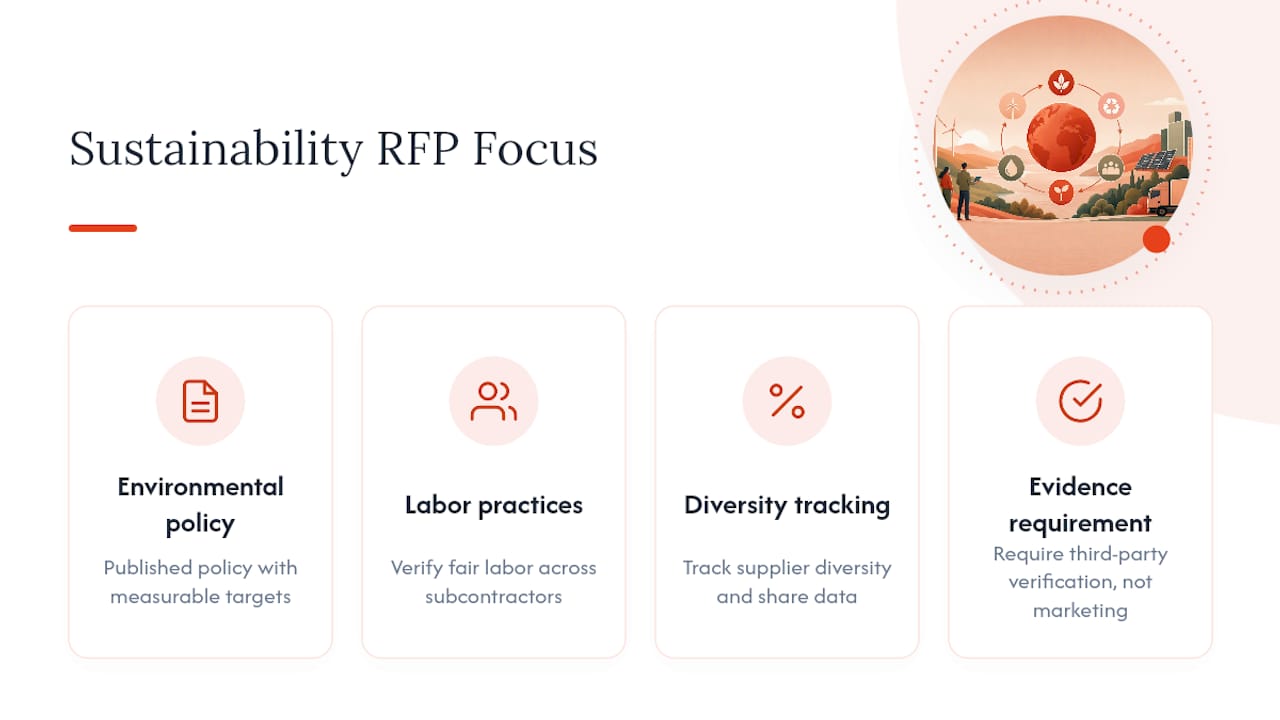
Sustainability and corporate responsibility questions have moved from a "nice to ask" afterthought to a real line item in many RFP evaluation questions, particularly for organizations with public sustainability commitments or supply chain reporting obligations.
Start with concrete policy questions rather than open-ended ones. Do you have a published environmental policy, and does it include measurable targets? A vendor with a one-line sustainability statement on their website and no supporting data is answering differently than one with an actual reduction plan.
Ask about labor practices directly, especially if the vendor relies on subcontractors: How do you verify fair labor practices across your own supply chain and any subcontracted work? This matters more the further removed the vendor's production or service delivery is from your direct oversight.
Diversity and inclusion in vendor operations is worth a direct question too: Do you track supplier diversity, and can you share your current data? Some procurement processes, particularly in the public sector, weight this as a scored criterion rather than a background note.
Ask for evidence over statements wherever the RFP allows it. A vendor claiming carbon-neutral operations should be able to point to a third-party verification or a specific methodology, not just a marketing page. Treat unverifiable sustainability claims the same way you'd treat an unverifiable security claim: as a gap, not a pass.
Questions to Understand Post-Implementation Training and Documentation
The RFP process too often stops at go-live, when the real test of a vendor relationship starts the week after launch, once your team is using the product without the vendor's implementation specialists hovering nearby.
Ask specifically what training is included versus what costs extra: Does your proposal include end-user training, and how many sessions or hours are covered before additional fees apply? A vendor that includes two hours of training for a system your whole department will use daily hasn't scoped the engagement realistically.
Documentation quality varies enormously between vendors, so ask for a sample. Can you provide a sample of your standard user documentation or admin guide before we sign? Reading an actual guide tells you more than any promise about documentation quality.
Ask how knowledge gets transferred beyond the initial rollout: What happens when we onboard a new employee six months after go-live? Is there a self-serve training library, or does every new hire require a paid session with your team?
Finally, ask about documentation ownership and updates: How often is documentation updated when the product changes, and will we be notified when a workflow we depend on shifts? A vendor with a stale help center is telling you something about how they treat existing customers once the contract is signed.
Why Collaborative, AI-Assisted RFP Design Beats the Solo Draft
Most RFPs get written by one overworked procurement lead stitching together fragments from stakeholders who never actually talked to each other. That's how you end up with contradictory requirements buried in section 4 and section 9.
Real-time collaborative sessions surface those conflicts before the document goes out, not after vendors respond. A structured session that pairs human expertise with AI specialists typically produces a versioned RFP draft, pre-mapped evaluation weights, and an exportable template in a fraction of the back-and-forth email cycle. Choose a workshop format when stakeholders disagree on priorities; a single author can still handle a narrow, low-stakes RFP alone.
— Cody
Build Your RFP Faster With a Structured, Collaborative Session
A collaborative platform replaces the week of scattered email threads and conflicting stakeholder edits with one live, structured session. Instead of one person guessing at requirements, your team and AI specialists work through the RFP together in real time, arguing out the tradeoffs on scope, pricing questions, and evaluation weights before a single vendor sees the document.
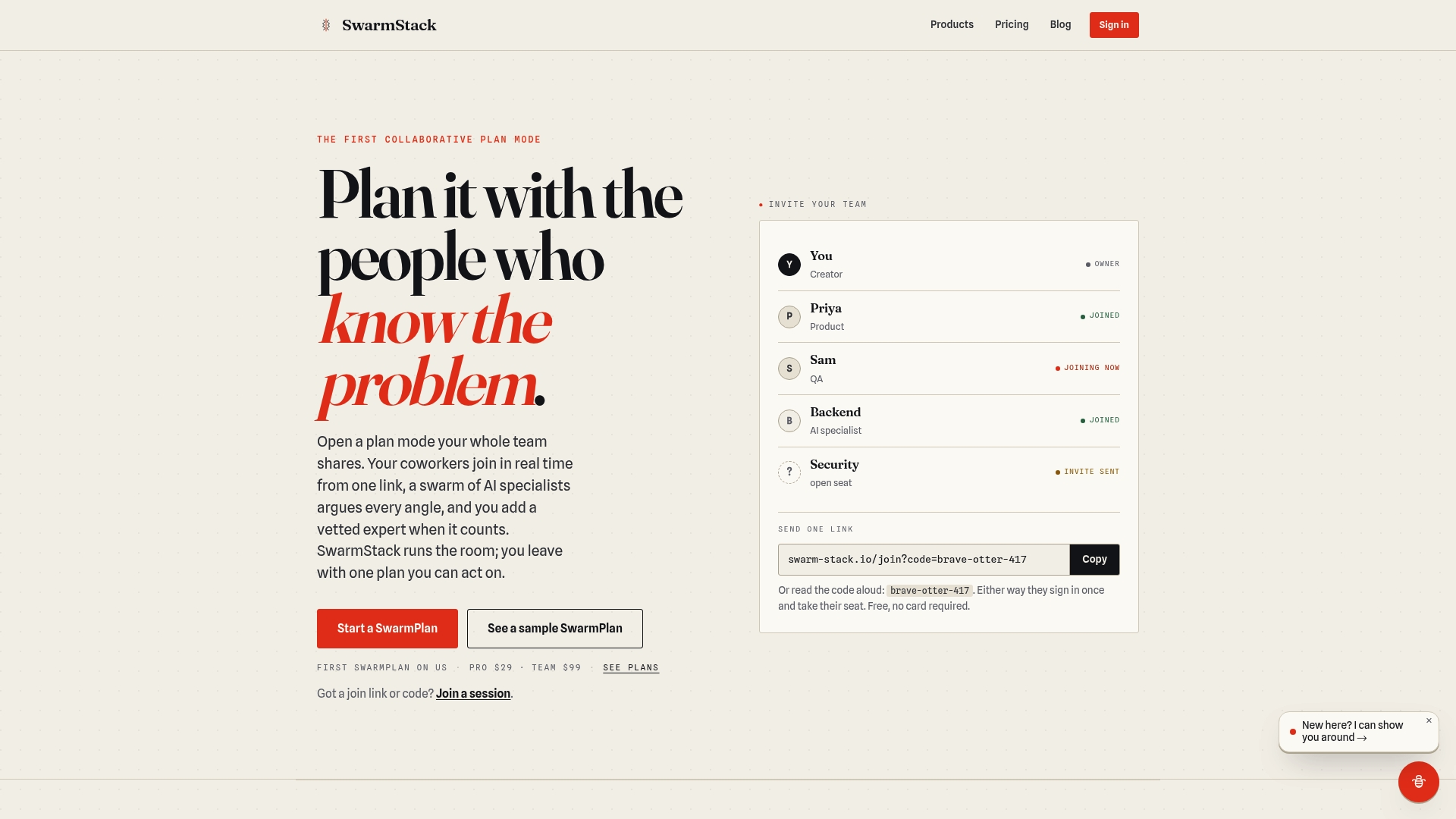
The output isn't a rough draft. It's a versioned RFP ready for export, with the evaluation weights already mapped to your questions, so the scorecard work from this article is half done before you send anything to vendors. Teams that want the scoring side built out further can pair a session with the Vendor Evaluation Scorecard guide for a ready-made rubric structure.
Invite your team with a single link, run the session, and export a deliverable your evaluators can start scoring the same week. Start a session on Swarm-stack and see how much of this question bank you can turn into a finished RFP before the next status meeting.
Sources
This article draws on procurement scorecard guidance from Partners for Public Good, vendor question banks from Zip and SiftHub, and staged RFI/RFP guidance from Guidant Global. For software-specific question examples, see Swarm-stack's RFP for software development guide.
- 33 Request For Proposal (RFP) questions to ask vendors
- Proposal Evaluation Tips & Tricks: How to Select the Best Vendor for the Job (Evaluation Scorecards)
- What are the top 25 questions to ask in your RFIs and RFPs?