RFP Scope of Work: Template & Checklist for Teams
Master the RFP scope of work with our detailed template and checklist. Ensure clarity on deliverables, timelines, and success criteria.

An RFP scope of work is the section of a request for proposal that tells vendors exactly what to deliver, when each piece is due, and how success will be measured. Get it right, and vendors price accurately and propose confidently. Get it wrong, and you spend the next six months arguing about what "complete" means.
TL;DR checklist — the must-haves before you send or respond:
- Deliverables: Named, specific outputs with format and quantity stated
- Acceptance criteria: Measurable conditions that define "done" for each deliverable
- Timeline and milestones: Dates tied to specific outputs, not just a project end date
- Roles and responsibilities: Who owns what, on both the issuer and vendor side (RACI)
- Inclusions and exclusions: What is explicitly in scope and what is not
- Assumptions and constraints: Budget ceilings, technology constraints, regulatory requirements
- Change-control process: How scope changes are requested, assessed, approved, and repriced
When a project is complex enough to warrant a full contract exhibit, this checklist becomes the skeleton of a post-award Statement of Work. For most RFPs, the section above is enough to get competitive, comparable proposals.
Table of Contents
- What is the RFP scope of work, and how does it differ from a post-award SOW?
- The 10 core elements every RFP scope of work must include
- How do you write a clear RFP scope of work step by step?
- How should vendors analyze and respond to an RFP scope of work?
- Practical copy-paste scope of work template and checklist
- Best practices and common drafting mistakes
- Why collaborative drafting reduces scope risk
- Key Takeaways
- The tradeoffs procurement teams and vendors rarely talk about
- Swarm-stack makes collaborative SOW drafting faster
- Useful sources and further reading
What is the RFP scope of work, and how does it differ from a post-award SOW?
The scope of work inside an RFP describes what the issuer needs done. Its job is to give competing vendors enough detail to price the work, propose a credible approach, and understand what winning looks like. It is not a contract. It is an invitation to bid, written clearly enough that every respondent is answering the same question.
A post-award Statement of Work is a different document, even though the two share a name and many of the same sections. According to procurement consultants at Hinz Consulting, an RFP is issued at the start of procurement to solicit proposals, while a Statement of Work is generally developed or refined after contract award to guide execution. The RFP version is intentionally broader; the post-award version locks in the negotiated specifics.
Other RFP sections that often get confused with the scope of work:
- Requirements section: Lists technical or functional specifications the vendor must meet. The scope of work describes what gets delivered; the requirements section describes how it must be built or configured.
- Evaluation criteria: Explains how the issuer will score proposals. Separate from scope, but a well-written scope makes evaluation criteria easier to apply.
- Terms and conditions: Legal language governing the contract. The scope of work feeds into the contract but is not itself a legal instrument until incorporated by reference.
| Dimension | RFP scope of work | Post-award SOW |
|---|---|---|
| Purpose | Communicate needs to competing vendors | Guide execution with the selected vendor |
| Timing | Before award | After award, during contract negotiation |
| Audience | All bidders | Winning vendor and project team |
| Level of detail | Sufficient for accurate pricing and proposal | Fully negotiated, legally binding specifics |
| Typical contents | Deliverables, milestones, acceptance criteria, exclusions | All of the above plus payment schedules, SLAs, escalation paths |
The practical implication: if your RFP scope of work is vague, every vendor fills the gaps differently, and you end up comparing proposals that are not actually comparable. Specificity at the RFP stage saves weeks of negotiation after award.
The 10 core elements every RFP scope of work must include
A comprehensive scope of work should cover ten core elements: project overview and objectives, deliverables with acceptance criteria, timeline with milestones, resource requirements and responsibilities, scope boundaries, assumptions and constraints, change management, reporting and communication, final acceptance and sign-off, and supporting appendices. Here is what each one actually requires in practice.

| Element | What to include |
|---|---|
| Project overview and objectives | One-paragraph context; measurable business goal the project must achieve |
| Deliverables with acceptance criteria | Named outputs; format, quantity, and measurable "done" condition for each |
| Timeline and milestones | Specific dates; milestone tied to a deliverable, not just a phase name |
| Resource requirements and responsibilities | Named roles; RACI matrix or equivalent; vendor vs. client ownership |
| Scope boundaries (inclusions/exclusions) | Explicit list of what is in scope; explicit list of what is out |
| Assumptions and constraints | Budget ceiling, technology stack, regulatory requirements, third-party dependencies |
| Change management process | How changes are requested, assessed, approved, documented, and repriced |
| Reporting and communication | Frequency, format, and audience for status reports; escalation path |
| Final acceptance and sign-off | Who signs, what triggers sign-off, and what happens if acceptance is disputed |
| Supporting appendices and glossary | Diagrams, data dictionaries, reference documents, defined terms |
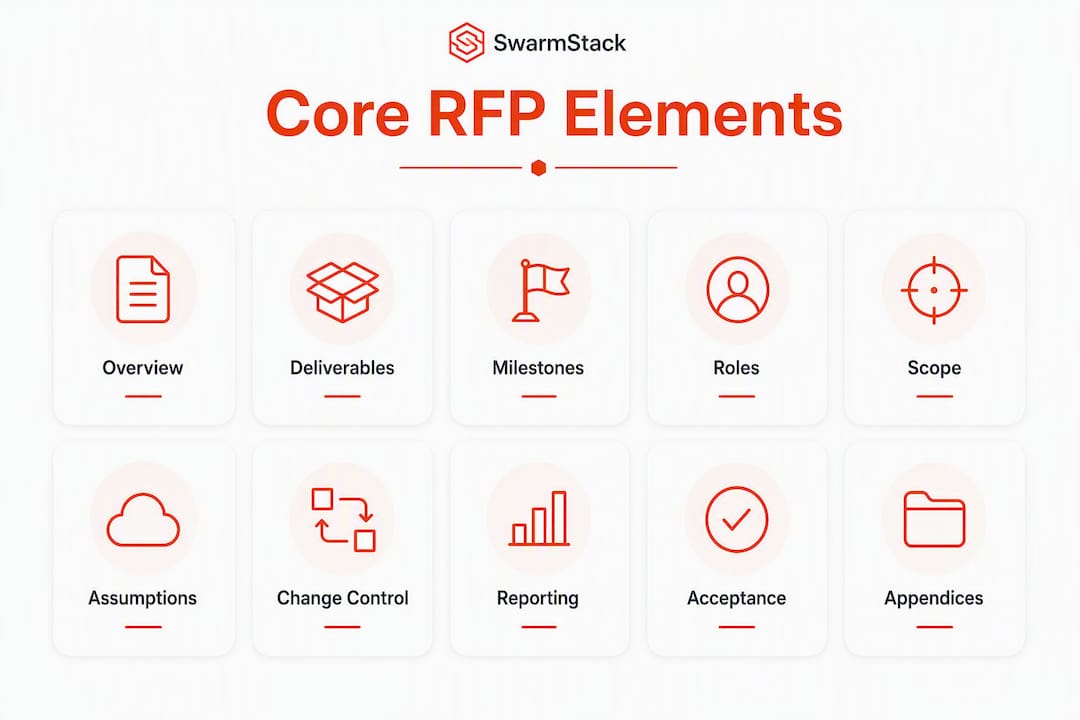
Acceptance criteria deserve extra attention. Vague criteria ("the system should perform well") create disputes; measurable criteria ("the system must return search results in under 2 seconds for 95% of queries under a 500-concurrent-user load") do not. NYU's procurement guidance specifically emphasizes including milestones, acceptance criteria, and sign-off steps to make deliverables enforceable and measurable.
Three short examples of well-written acceptance criteria:
- "Deliver a data migration report in PDF format, covering 100% of records migrated, with a reconciliation table showing source vs. destination counts, submitted within five business days of go-live."
- "Provide 12 SEO-optimized blog posts, 800–1,000 words each, with a Flesch reading score above 60, delivered in Google Docs format by the 15th of each month."
- "Complete user-acceptance testing with zero critical defects open and no more than three minor defects deferred, signed off by the client's QA lead before production deployment."
Each follows the same logic: verb + object + measurable condition. That structure makes pricing, scheduling, and acceptance straightforward.
Pro Tip: Add a "definition of done" row to your deliverables table. One sentence per deliverable, written in the client's language, that a non-technical stakeholder can read and confirm. If you cannot write that sentence, the deliverable is not yet defined well enough to go into an RFP.
How do you write a clear RFP scope of work step by step?
The five-step sequence: define the objective, enumerate deliverables with acceptance criteria, map milestones to payment triggers, state exclusions and constraints, then add change-control and sign-off mechanics.

Step 1: Define the objective in the client's language. One sentence, no jargon. Template: "The purpose of this project is to [verb] [specific outcome] so that [measurable business result] by [target date]." Example: "The purpose of this project is to migrate 14,000 customer records from Salesforce Classic to Salesforce Lightning so that the sales team can access unified account histories by March 31, 2027."
Step 2: Enumerate deliverables and acceptance criteria. List every output the vendor must produce. Use verb + object + metric format for each line. "Deliver" is cleaner than "provide," "develop," or "support" because it implies a handoff. Attach an acceptance criterion to every deliverable before you move on.
Step 3: Translate deliverables into milestones and tie them to payment triggers. A milestone without a deliverable attached is just a date. A deliverable without a milestone is a wish. Connect them: "Milestone 2: Delivery of completed data-mapping document (Deliverable 1.2) — due April 15, 2027 — triggers 20% payment." This alignment keeps both parties honest about progress.
Step 4: State exclusions, assumptions, and constraints explicitly. University of Oregon's procurement guidance frames the scope of work as the component that describes needs and desired outcomes, and explicitly notes that stating what is not included reduces supplier confusion as much as stating what is. Write "Out of scope: ongoing system maintenance after go-live" rather than leaving vendors to guess.
Step 5: Add change-control and sign-off mechanics. A clear change-control process — request, impact assessment, approval, and re-baselining — prevents open-ended obligations and keeps payment triggers aligned with actual delivery. Name the person on each side who has authority to approve a change. Without that, every scope conversation stalls waiting for someone to find the right approver.
Pro Tip: Watch for these language traps: "appropriate," "reasonable," "industry-standard," and "as needed." Each one is a dispute waiting to happen. Replace every subjective adjective with a number, a named standard, or a specific condition. "Industry-standard security" means nothing; "AES-256 encryption at rest and TLS 1.3 in transit" means something.
How should vendors analyze and respond to an RFP scope of work?
Before writing a single word of your proposal, triage the SOW. A fast read-through against five signals tells you whether this bid is worth pursuing.
Go/no-go triage checklist:
- Deliverables are named and specific, not described in vague outcome language
- Each deliverable has a measurable acceptance criterion or a clear definition of done
- The timeline is realistic given the scope and your current capacity
- A named decision-maker or authority is identified on the client side
- Payment triggers are tied to deliverable acceptance, not just calendar dates
If two or more of those signals are missing, you have a choice: ask clarifying questions or walk away. Responding to an RFP without those signals means you are pricing a guess.
Red flags that warrant a clarifying question or a no-go decision:
- Deliverables described only as outcomes ("improve customer satisfaction") with no output specified
- Acceptance criteria that reference client "approval" with no objective standard attached
- Dependencies on third parties the client has not confirmed are available
- Change-control language that says "as mutually agreed" with no process defined
- Milestones that require vendor work to begin before the contract is signed
- Budget ranges that do not cover the scope as described, even at minimum effort
Sample clarifying questions vendors should submit:
- "Section 2.3 references integration with the existing CRM. Will the client provide API documentation and a sandbox environment before kickoff? If so, by what date?"
- "The acceptance criteria for Deliverable 4 state 'client approval.' What objective criteria will the client use to evaluate the deliverable, and what is the review timeline?"
- "The timeline shows a four-week development phase. Does this assume the client's data-mapping document is complete before development begins?"
- "Is the $150,000 budget inclusive of travel and expenses, or are those reimbursed separately?"
- "Who on the client side has authority to approve scope changes, and what is the turnaround time for change-order approvals?"
When you document assumptions and exceptions in your proposal, put them in a dedicated section, not buried in narrative. A table works well:
Assumption: Client will provide access to the production database environment no later than five business days after contract execution. Impact if not met: Development timeline extends by one day for each day of delayed access. Exception: If the environment is unavailable at kickoff, vendor reserves the right to re-baseline the project schedule at no additional cost.
That format survives contract negotiation because it is specific, quantified, and tied to a consequence. Vague assumptions ("we assume client cooperation") do not.
Practical copy-paste scope of work template and checklist
The template below works for fixed-price, time-and-materials, retainer, and outcome-based engagements. Adapt the payment-trigger language in Section 3 to match your contract structure: fixed-price ties payments to milestone acceptance; time-and-materials ties them to approved hours; retainer ties them to a monthly cycle; outcome-based ties them to a verified metric.
Adapting by contract type:
- Fixed-price: Lock acceptance criteria tightly before signing. Every ambiguous criterion becomes a cost dispute.
- Time-and-materials: Add a not-to-exceed cap per milestone and require weekly time reporting.
- Retainer: Define a monthly deliverables list and a rollover policy for unused hours.
- Outcome-based: Specify the measurement method, the data source, and the audit process before the contract starts.
SCOPE OF WORK TEMPLATE
Section 1: Project Overview Project name: [Name] Issuing organization: [Name] Project objective: The purpose of this project is to [verb] [specific outcome] so that [measurable business result] by [target date]. Background: [Two to three sentences of context a vendor needs to understand the project.]
Section 2: Deliverables and Acceptance Criteria
| # | Deliverable | Format | Quantity | Acceptance criteria | Due date |
|---|---|---|---|---|---|
| 1 | [Name] | [Format] | [Qty] | [Measurable condition] | [Date] |
| 2 | [Name] | [Format] | [Qty] | [Measurable condition] | [Date] |
Section 3: Timeline and Milestones
| Milestone | Deliverable(s) | Due date | Payment trigger |
|---|---|---|---|
| Kickoff complete | Signed project charter | [Date] | [%] |
| [Phase name] | [Deliverable #] | [Date] | [%] |
| Final acceptance | All deliverables accepted | [Date] | [%] |
Section 4: Roles and Responsibilities
| Role | Name/Title | Responsible | Accountable | Consulted | Informed |
|---|---|---|---|---|---|
| Project sponsor | [Client] | ✓ | |||
| Project manager | [Vendor] | ✓ | |||
| Subject matter expert | [Client] | ✓ |
Section 5: Scope Boundaries In scope: [Bulleted list] Out of scope: [Bulleted list — be explicit]
Section 6: Assumptions and Constraints Assumptions: [List each; include impact if assumption proves false] Constraints: [Budget ceiling, technology requirements, regulatory requirements]
Section 7: Change-Control Process Changes are initiated via a written Change Request form submitted to [named approver]. The vendor will provide an impact assessment within [X] business days. Approved changes are documented in a Change Order and re-baselined into the project schedule before work begins.
Section 8: Reporting and Communication Status reports: [Frequency, format, distribution list] Escalation path: [Named contacts and response SLA] Review meetings: [Frequency and attendees]
Section 9: Final Acceptance and Sign-Off Final acceptance requires written sign-off from [named client authority] confirming all deliverables meet their stated acceptance criteria. Disputes are resolved via [process].
Section 10: Appendices Appendix A: Glossary of defined terms Appendix B: Reference documents and data sources Appendix C: [Diagrams, wireframes, Gantt chart]
One-page checklist for issuers and vendors:
| Check | Issuer confirms | Vendor confirms |
|---|---|---|
| Project objective is one sentence with a measurable outcome | ✓ | Read and understood |
| Every deliverable has a format, quantity, and acceptance criterion | ✓ | Priced and scheduled |
| Every milestone is tied to a named deliverable | ✓ | Dependencies flagged |
| Exclusions are listed explicitly | ✓ | No hidden assumptions |
| Assumptions are listed with impact statements | ✓ | Exceptions documented |
| Change-control process names an approver and a turnaround time | ✓ | Process accepted or exception noted |
| Sign-off authority is named | ✓ | Confirmed in proposal |
| Version number and date appear on the document | ✓ | Responding to correct version |
A standardized SOW template aligns parties on deliverables, timeline, costs, and acceptance criteria and helps avoid scope creep, particularly in construction and technical projects. For software projects specifically, the RFP for software development guide covers additional technical acceptance criteria worth incorporating.
Versioning note: Every draft of the SOW should carry a version number and a date in the header. During negotiation, track changes in a dedicated log rather than overwriting the baseline. When both parties sign, freeze that version as the contract baseline. Any subsequent change goes through the change-control process, not an informal email.
Best practices and common drafting mistakes
The eight practices that separate clean SOWs from disputed ones:
- Use a single canonical name for each deliverable throughout the document. Calling the same output a "report," a "summary," and a "deliverable" in different sections creates genuine ambiguity about whether they are the same thing.
- Write acceptance criteria before you write the deliverable description. If you cannot define done, you cannot define the deliverable.
- Tie every milestone to a payment trigger. Milestones without financial consequences are advisory; milestones with payment triggers are enforceable.
- Name a single point of contact on each side with authority to make decisions. Committees slow everything down; named individuals do not.
- Define dependencies explicitly. If Deliverable 3 cannot start until the client provides data from System X, say so in the SOW, not in a kickoff meeting six weeks later.
- Include a visual timeline. Gantt charts, flowcharts, and wireframes materially improve clarity for reviewers and reduce time spent clarifying requirements.
- Keep language action-oriented. Every deliverable description starts with a verb: "deliver," "develop," "train," "document." Never "support," "assist," or "help with."
- Review the SOW against the evaluation criteria before publishing the RFP. If evaluators cannot score a criterion because the SOW does not define it, fix the SOW first.
Common mistakes and quick fixes:
Vague deliverable: "Provide consulting services related to the implementation." Fix: "Deliver a written implementation plan, covering system configuration, data migration, and user training, in PDF format, within 10 business days of contract execution."
Subjective acceptance criterion: "The final report should be professional and complete." Fix: "The final report must include all sections listed in Appendix A, pass a spell-check with zero errors, and be reviewed and approved by the client's project manager within five business days of submission."
Pro Tip: Run a "who decides?" test on every acceptance criterion. If the answer is "it depends" or "we'll know it when we see it," rewrite the criterion until a third party with no context could make the call. That test catches 80% of the disputes before they happen.
Why collaborative drafting reduces scope risk
Involving key stakeholders during drafting and securing signatories is essential for enforceability and operational clarity. That is not a process formality. When each stakeholder reviews the draft, they flag assumptions and dependencies the primary author missed, and those flags caught early cost nothing to fix. Caught after award, they cost rework, change orders, and sometimes the relationship.
A practical collaborative drafting workflow:
- Kickoff interview: The SOW author interviews the project sponsor, the technical lead, and the end-user representative. Each person answers: What does success look like? What would make this project fail? What are you assuming the vendor will handle?
- First draft review: Share the draft with all stakeholders simultaneously, not sequentially. Sequential review lets early reviewers' comments shape what later reviewers see, which introduces bias and misses independent perspectives.
- Consolidated comment cycle: Collect all comments in one document. Resolve conflicts in a single meeting rather than through email chains. Document every decision and the reasoning behind it.
- Sign-off gate: No SOW goes into an RFP without written sign-off from the project sponsor and the legal or contracts team. That gate forces a final read and catches errors that survived the review cycle.
- Version baseline: Once signed, the document is frozen. The version number, date, and signatories appear in the header. All subsequent changes go through change control.
Standard SOW components and a shared checklist help teams maintain consistent drafting across projects and reviewers. Tools that combine live collaboration with versioning fit naturally into steps 2 and 3 of this workflow: multiple reviewers can comment on the same draft simultaneously, decisions are logged against the version they affected, and the baseline is preserved automatically when sign-off is recorded.
Key Takeaways
A well-written RFP scope of work requires named deliverables with measurable acceptance criteria, explicit exclusions, a change-control process with a named approver, and stakeholder sign-off before the document goes to vendors.
| Point | Details |
|---|---|
| Deliverables need acceptance criteria | Every output must have a measurable "done" condition, not just a description. |
| Milestones should trigger payments | Tying milestone acceptance to payment keeps both parties accountable to the schedule. |
| Exclusions prevent disputes | Listing what is out of scope is as important as listing what is in scope. |
| Collaborative drafting catches gaps | Simultaneous stakeholder review surfaces assumptions and dependencies before award. |
| Swarm-stack supports the full workflow | Swarm-stack's real-time collaborative sessions, versioned baselines, and export to GitHub or Jira fit directly into the kickoff-to-sign-off drafting process. |
The tradeoffs procurement teams and vendors rarely talk about
Procurement teams often limit detail in RFPs deliberately. The reasoning is sound: a tightly specified SOW can constrain vendor creativity and push respondents toward a single solution the issuer already has in mind. When the goal is genuine innovation, leaving some room in the scope invites vendors to propose approaches the issuer has not considered. The tradeoff is that looser scopes produce less comparable proposals and harder post-award negotiations.
The practical answer is to be specific about outcomes and flexible about methods. Define what success looks like in measurable terms, then let vendors propose how to get there. That structure gives you comparable proposals on the outcome dimension while preserving space for creative approaches on the method dimension.
From the vendor side, the risk runs the other direction. A loosely written SOW looks like an opportunity until the contract is signed and the client's definition of "done" turns out to be different from yours. The protection is not to refuse ambiguous SOWs but to document your assumptions explicitly in the proposal and flag the specific criteria you are using to interpret each vague requirement. A vendor who says "we interpret Deliverable 3 to mean X; if the client means Y, the timeline extends by four weeks" is in a far stronger negotiating position than one who assumed and said nothing.
The negotiated compromise that works in practice: the vendor proposes a phased acceptance process. Phase one delivers a prototype or pilot against a narrow set of acceptance criteria. Both parties review, align on any interpretation gaps, and then the vendor proceeds to full delivery. That structure costs a little time upfront and saves a lot of time at the end.
Swarm-stack makes collaborative SOW drafting faster
Writing a clean RFP scope of work is harder than it looks, mostly because the people who know what success looks like are rarely the same people writing the document. Swarm-stack closes that gap by bringing your team, your subject-matter experts, and AI specialists into a single real-time session where every assumption gets argued before it becomes a contract problem.
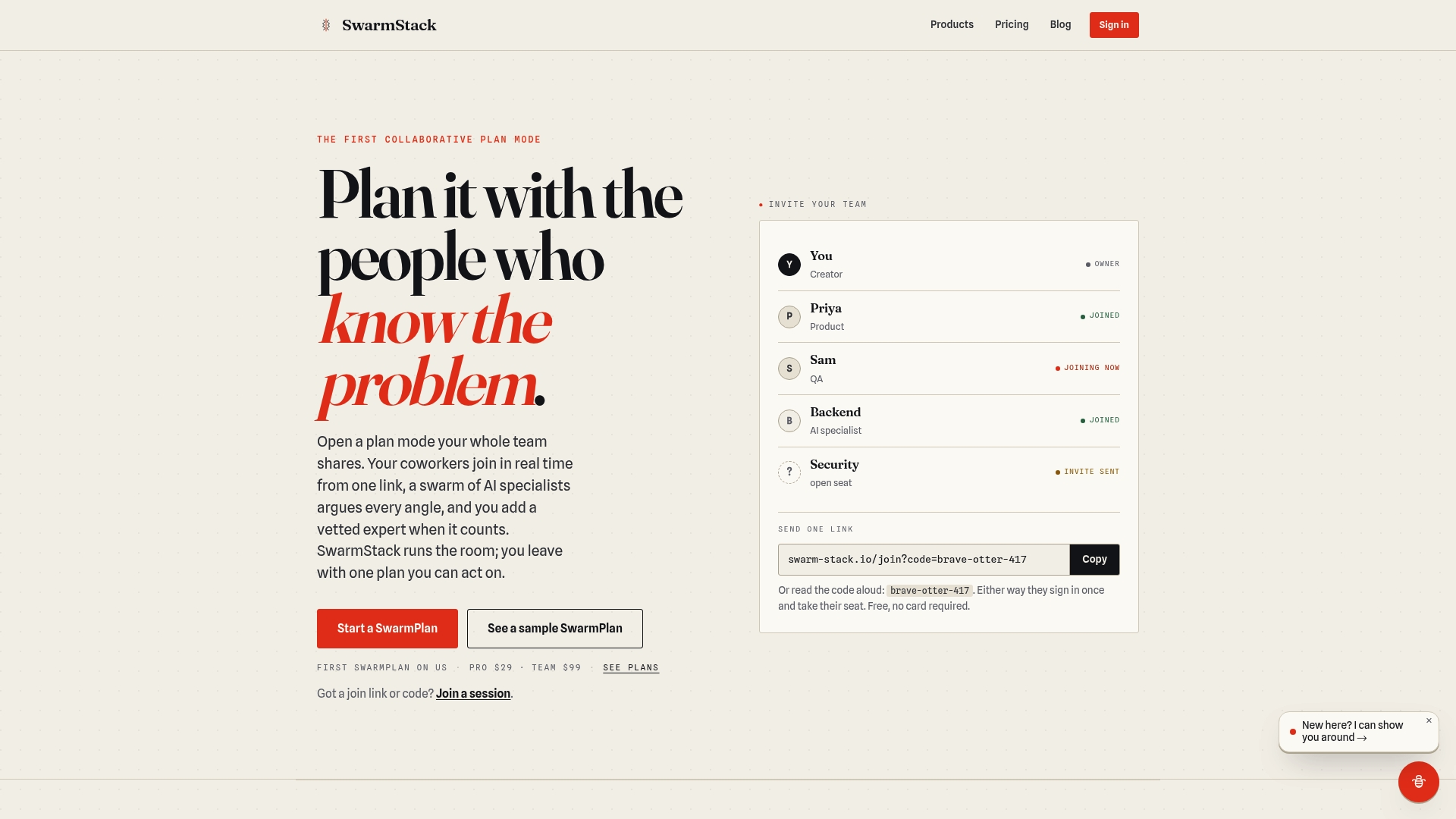
The practical benefits for procurement and proposal teams: structured sessions produce versioned SOW drafts with a full decision log, so you always know why a requirement was written the way it was. Reviewers join via a single invite link, comment on the live draft, and sign off without a separate email chain. When the SOW is ready, it exports directly to GitHub or Jira so the project team starts from the same baseline the contract team approved. For teams that need outside expertise, the integrated marketplace connects you with vetted human specialists for a single session, no long-term commitment required.
Start a collaborative SOW session on Swarm-stack, or review pricing and plan options to find the right fit for your team's volume.
Useful sources and further reading
The sources below informed this guide and are worth bookmarking for your own SOW drafting work.
| Source | Why it's useful |
|---|---|
| NYU Guidelines for Writing a Scope of Work | University procurement guidance covering acceptance criteria, milestones, and sign-off language; useful for legal-sounding SOW wording |
| University of Oregon: Creating a Scope of Procurement | Public procurement framing of inclusions, exclusions, and desired outcomes; practical for government and institutional RFPs |
| Hinz Consulting: RFP vs. SOW | Clear explanation of timing and role differences between an RFP scope of work and a post-award SOW |
| Ironclad: Scope of Work Blueprint | Covers all 10 core SOW elements with practical examples; primary reference for the component checklist |
| SafetyCulture: Free Scope of Work Template | Ready-to-use template with checklist; strong for construction and technical projects |
| ClickUp: How to Write a Scope of Work | Practical phrasing examples using verb + object + metric format; good for drafting deliverables language |
| Atlassian Confluence: Scope of Work Guide | Covers collaborative drafting, versioning, and standard SOW components; useful for team-based workflows |
| Mercy Corps SOW Checklist | Sector-specific checklist for commissioning evaluations; strong model for outcome-focused SOWs |
| Tulane University: Guide to Writing an RFP | Concise RFP cheat sheet covering scope of work, deliverables, and vendor requirements |