Cybersecurity RFP: A Practical Guide for Teams
Create a winning cybersecurity RFP with clear guidelines. Learn to avoid hidden fees and ensure complete vendor alignment. Read more!

Publish a segmented cybersecurity RFP that mandates NIST CSF 2.0 alignment, 24/7 human-led SOC response, and all-inclusive pricing covering software, deployment, and licensing. That single requirement eliminates the two most common failure modes: proposals that can't be compared side-by-side and hidden fees that surface after award.
Before you open a blank document, complete these four steps in the next 48 hours:
- Decide which service groups are mandatory (EDR, SIEM/SOAR, MDR) and which are optional.
- Confirm evaluation weights with your security and procurement leads.
- Set the submission format (PDF, separate cost attachment) and a hard deadline with no exceptions.
- Identify the single point of contact for vendor questions and block out a Q&A window.
Swarm-stack's collaborative sessions are built for exactly this alignment step — invite your stakeholders via a single link and capture every trade-off in one versioned record before the RFP goes live.
Table of Contents
- What does a cybersecurity RFP need to include?
- How should you segment service requirements for better bids?
- How do you score vendor proposals objectively?
- What submission rules protect procurement integrity?
- What background should you give vendors?
- What timeline and pricing structure should you require?
- What red flags should you watch for in vendor proposals?
- What files should you publish alongside the RFP?
- Key Takeaways
- Why collaborative AI sessions produce better RFPs
- Swarm-stack helps teams draft and finalize a cybersecurity RFP faster
- Authoritative sources for cybersecurity procurement language
What does a cybersecurity RFP need to include?
A well-structured request for proposal produces comparable bids. A vague one produces marketing decks. Every cybersecurity RFP should contain these sections:
Core RFP sections:
- Overview and objectives: current security posture, why you're going to market, and the outcome you expect from the vendor relationship.
- Scope of work: which environments are in scope (endpoints, cloud workloads, identities, OT/IoT if applicable) and which are explicitly excluded.
- Service groups: separate sections for EDR/endpoint, SIEM + SOAR, and MDR/managed response so vendors can price each domain cleanly.
- SOC expectations: continuous 24/7/365 monitoring staffed by live analysts who validate alerts before escalation. Automated-only triage is not acceptable.
- Compliance and certifications: require SOC 2 Type II, ISO 27001 where applicable, and FedRAMP authorization for any cloud-hosted tooling serving federal data.
- NIST CSF 2.0 mapping worksheet: vendors must map their proposed work to the framework's six functions.
- Pricing bid sheet: one table covering all costs, no exceptions.
Response format requirements:
- PDF submission only, with a redacted copy (remove pricing) and an unredacted copy.
- Separate, clearly labeled cost proposal attachment.
- Subject-line template specified in the RFP (e.g., "RFP-2026-CYBERSEC | [Vendor Name] | Proposal").
- Strict no-late-submission policy with no waivers.
Required vendor attachments:
- Technical design and architecture diagram.
- Implementation and onboarding timeline.
- Staffing plan with SOC shift schedules and analyst-to-client ratios.
- SLA language with defined response and escalation times.
- References (minimum three) and copies of current certifications.
- AI usage disclosure: whether models are internally developed or external, and how customer data is handled.
How should you segment service requirements for better bids?
The Group model is the clearest way to get pricing you can actually compare. Structure it like this:
- Group 1 — EDR/Endpoint: agent deployment, behavioral detection, automated containment, and managed response for all endpoints.
- Group 2 — SIEM + SOAR: log ingestion, correlation rule management, playbook automation, and analyst-driven investigation.
- Group 3 — Identity and cloud workload monitoring: identity threat detection and response (ITDR), cloud posture management, and privileged access monitoring.
Allow vendors to bid on individual groups or submit an integrated managed offering that covers all three. Hawaii's HIePRO solicitation used exactly this structure, separating EDR and SIEM/SOAR into discrete groups so evaluators could score each domain independently and still compare integrated bids against point-solution combinations.
Segmentation does three things: it forces vendors to price each capability explicitly, it lets you swap one group without renegotiating the whole contract, and it exposes proposals that bundle capabilities to hide weak coverage in one area.

Pro Tip: Before publishing, run a 60-minute Swarm-stack session with your CISO, IT lead, and procurement officer. Use the session to lock in which groups are mandatory, which are optional, and what the minimum acceptable SLA looks like for each. The session record becomes your internal decision log — traceable if the award is ever challenged.
How do you score vendor proposals objectively?
Technical capability and SOC operations quality should carry the most weight. Price alone is a poor proxy for security outcomes.
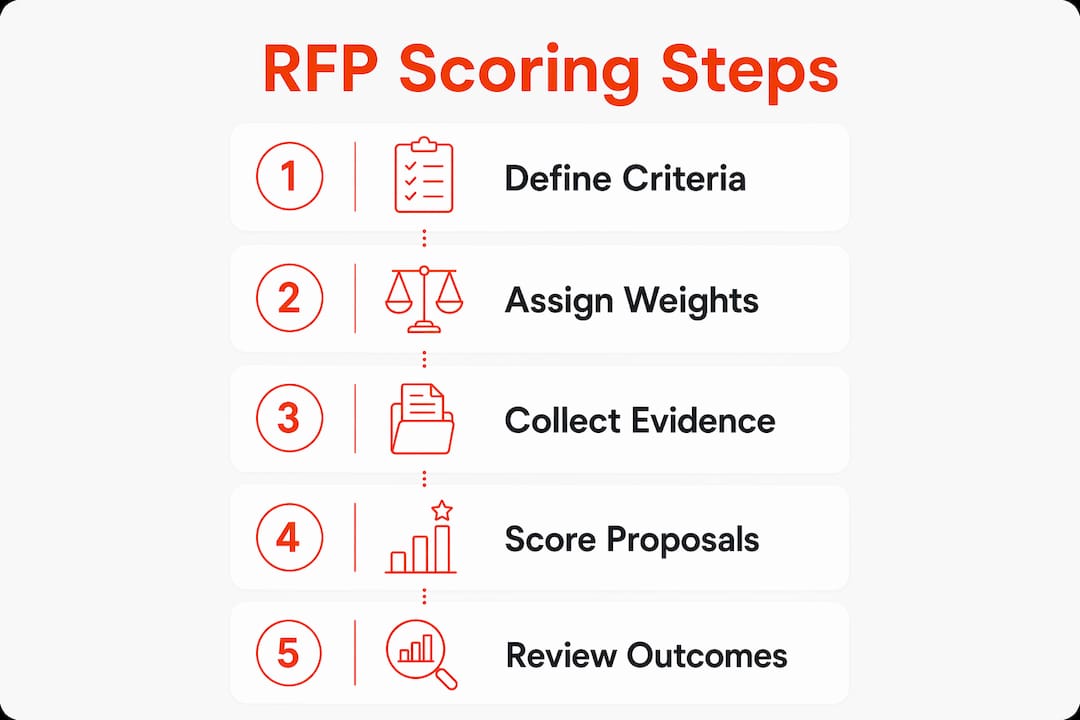
Recommended scoring weights:
| Criterion | Weight | What to evaluate |
|---|---|---|
| Technical capability | 30% | Detection coverage, tool integrations, EDR/SIEM feature depth |
| SOC operations and staffing | 30% | Analyst ratios, shift schedules, escalation SLAs |
| Implementation approach and timeline | 15% | Onboarding plan, migration risk, milestone clarity |
| Cost and total cost of ownership | 15% | All-in pricing, renewal rates, per-unit costs |
| Compliance and certifications | 10% | SOC 2 Type II, NIST mapping, supply-chain controls |
| References and past performance | 5% | Comparable clients, incident response examples |
Sample scoring rows for your evaluation spreadsheet:
| Evaluation item | Evidence required | Max points |
|---|---|---|
| EDR capability checklist | Vendor demo + feature matrix | — |
| SIEM ingest capacity (GB/day) | Architecture diagram + SLA | — |
| SOC staffing plan | Shift schedule + analyst CVs | — |
| NIST CSF 2.0 mapping | Completed worksheet attachment | 10 |
| References verified | Three client contacts confirmed | 10 |
Score technical evidence, not marketing claims. If a vendor claims 15-minute mean time to respond, require a sample incident report that proves it. For AI-assisted RFP workflows, the scoring matrix is the one artifact worth locking before any AI draft goes out.
What submission rules protect procurement integrity?
Rigid rules prevent bid protests. PDF submissions, subject-line templates, and hard deadlines are not bureaucratic overhead — they're your legal defense if an unsuccessful vendor challenges the award.
Non-negotiable submission guardrails:
- PDF format only; no Word documents or compressed archives.
- Separate cost proposal attachment, clearly labeled, not embedded in the technical response.
- Redacted copy (pricing removed) for public record; unredacted copy for evaluators.
- Exact subject-line format specified in the RFP — deviations disqualify the submission.
- Hard deadline with no extensions; late submissions are returned unopened.
- Single point of contact for all vendor questions; no direct evaluator contact permitted.
- Q&A window of five to seven business days after issuance; all questions and answers published to all registered vendors simultaneously.
- Blackout period from Q&A close to award: zero vendor contact with evaluation team members.
Pro Tip: Require a signed statement of truth and a conflict-of-interest disclosure from every bidder. For claimed onshore SOC staffing, ask for evidence — shift schedules, facility addresses, and analyst employment verification. Offshore-only triage models that claim onshore coverage are a common misrepresentation in managed security proposals.
What background should you give vendors?
Providing clear telemetry context shifts proposals from generic product pitches to maturity-focused designs. Share enough for vendors to size their solution accurately, but keep sensitive architecture details in a controlled data room accessible only after NDA.
Minimum telemetry metrics to publish in the RFP:
| Metric | Example value |
|---|---|
| Managed endpoints | several thousand |
| Managed identities | several thousand |
| Average daily log ingest | a substantial volume per day |
| Critical SaaS integrations | Microsoft 365, Salesforce, Workday |
| Current identity provider | Microsoft Entra ID |
| Existing tools to integrate | CrowdStrike Falcon (partial), Splunk (legacy) |
Share anonymized telemetry samples (log volume trends, alert category breakdowns) in the data room. Vendors who ask smart questions about your environment during the Q&A window are usually the ones worth shortlisting. For guidance on handling sensitive background data and redaction, Swarm-stack's trust and data privacy documentation covers the principles directly.
What timeline and pricing structure should you require?
A realistic cybersecurity RFP runs four to six weeks from issuance to proposals due. Compress that and you get thin responses; extend it past eight weeks and vendors lose focus.
Milestone checklist:
- Week 1: RFP issued, vendor registration opens on procurement portal.
- Weeks 1–2: Q&A window open; all answers published to all registered vendors.
- Weeks 3–5: Proposal preparation period.
- Week 5–6: Proposals due; evaluation team convenes.
- Weeks 7–8: Scoring complete; shortlist invited for presentations.
- Week 9: Best-and-final offers (if needed); award decision.
- Week 10: Contract negotiations and kickoff scheduling.
For pricing, require a bid sheet that itemizes onboarding cost, per-endpoint EDR rate, per-identity ITDR rate, SIEM base fee plus per-GB ingest charge, 24/7 SOC flat fee, included incident response hours, and renewal pricing. Firm-fixed pricing for recurring services; time-and-materials only for defined project work like initial deployment. No line item labeled "TBD" or "to be negotiated post-award."
What red flags should you watch for in vendor proposals?
Disqualify immediately: proposals that describe automated-only alert triage with no human analyst validation, cost attachments that omit licensing or agent fees, and claimed certifications with no attached documentation. These are not clarification items — they signal the vendor either can't meet the requirement or is hoping you won't notice.
Watch for vague SOC staffing descriptions ("a team of analysts") with no shift schedules or analyst-to-client ratios. Ask every shortlisted vendor for a sample incident report, a SIEM parser maintenance commitment, and their escalation SLA with a real example. A vendor who can't produce those in 48 hours during evaluation almost certainly can't produce them at 2 AM during an incident.
For vendor pre-screening and evidence collection, a structured security questionnaire sent before the RFP closes can filter out unqualified bidders before your evaluation team spends time scoring them.
What files should you publish alongside the RFP?
A complete cybersecurity RFP package includes more than the main document. Publish these attachments:
- Scope of Work (Attachment A): detailed environment description, in-scope assets, and excluded systems.
- Bid Sheet template (Attachment B): pre-formatted pricing table with required line items.
- NIST CSF 2.0 mapping worksheet (Attachment C): vendors complete one column; your evaluators score the second.
- Redaction requirements (Attachment D): instructions for producing the public-record copy.
- Vendor qualification form: certifications checklist, references template, and AI usage disclosure questions.
Version every file with a date stamp and a revision number (e.g., "RFP-2026-CYBERSEC-v1.2-2026-03-14"). When you use an RFP drafting workflow that involves multiple reviewers and AI-assisted drafts, version control is what separates a defensible procurement record from a chaotic email chain.
Pro Tip: In Swarm-stack, each session produces a versioned deliverable with a decision log. Export the final RFP text directly to your document management system or GitHub so every change between the AI-assisted draft and the published version is traceable. Label each version with the session date and the names of approvers.
Key Takeaways
A well-segmented cybersecurity RFP with mandatory NIST CSF 2.0 alignment, human-led SOC requirements, and all-inclusive pricing produces vendor proposals that are genuinely comparable and defensible at award.
| Point | Details |
|---|---|
| Segment service groups | Separate EDR, SIEM/SOAR, and identity monitoring so vendors price each domain explicitly. |
| Require human-led SOC | Mandate 24/7 analyst-staffed monitoring; automated-only triage models do not meet the standard. |
| Weight technical capability first | Assign 30% to technical capability and 30% to SOC operations; price carries only 15%. |
| Enforce strict submission rules | PDF only, separate cost attachment, exact subject line, and a hard no-late-submission policy. |
| Swarm-stack for alignment | Run a structured collaborative session before publication to lock segmentation decisions and evaluation weights in a versioned record. |
Why collaborative AI sessions produce better RFPs
The conventional wisdom is that a good cybersecurity RFP comes from a thorough security architect. That's half right. The other half is stakeholder alignment — and that's where most RFPs quietly fail. A CISO writes requirements that procurement can't enforce. Legal adds clauses that conflict with the technical scope. IT has a tool preference that never makes it into the evaluation criteria. By the time the document goes out, it reflects one person's priorities, not the organization's.
A structured Swarm-stack session changes that dynamic. Bring your CISO, IT lead, procurement officer, and legal counsel into a single 90-minute session. The platform's argument-driven format forces each stakeholder to defend their requirements against the others — which is exactly how you discover that your "mandatory" SIEM ingest requirement is actually optional if the vendor provides equivalent visibility another way. Those trade-offs get recorded, versioned, and attached to the final document. If the award is ever challenged, you have a traceable record of every decision.
The session also catches the gaps that solo drafters miss: missing SLA definitions, undefined escalation paths, pricing line items that leave room for hidden fees. An AI-assisted RFP process doesn't replace procurement expertise — it surfaces the disagreements early enough to resolve them before vendors see the document.
Swarm-stack helps teams draft and finalize a cybersecurity RFP faster
Drafting a cybersecurity RFP across a distributed team typically means weeks of email threads, conflicting document versions, and a final document that no one fully owns. Swarm-stack cuts that cycle by combining human experts and AI specialists in structured sessions that produce a versioned, export-ready deliverable in hours, not weeks.
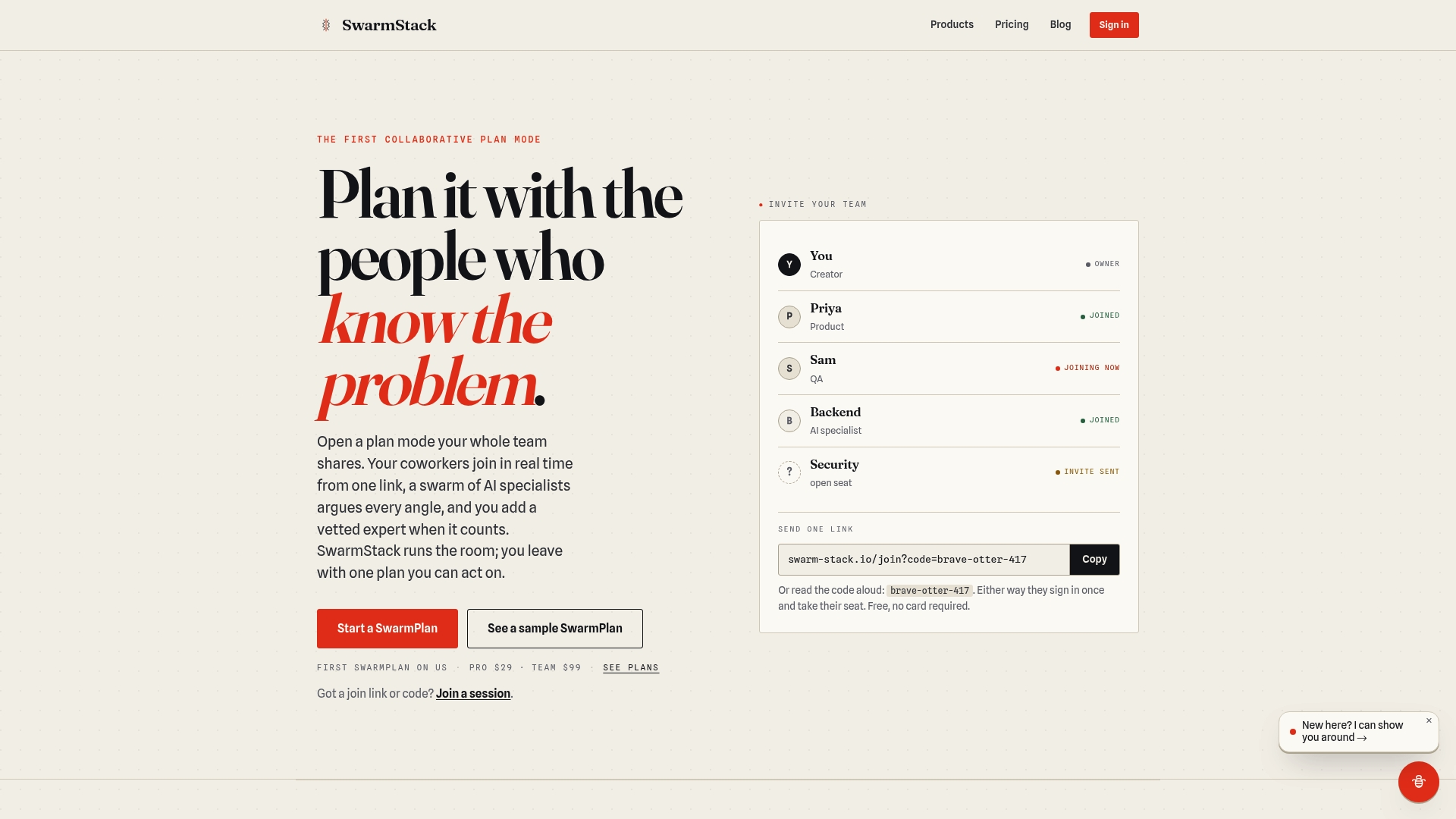
The platform maps directly to the RFP workflow: collaborative stakeholder alignment sessions to lock scope and evaluation weights, template versioning so every AI-assisted draft is traceable, and a marketplace of vetted human experts who can validate your procurement language before it goes to vendors. The final document exports to GitHub or Jira, so your team's existing tools stay in the loop.
If your team is ready to run a guided RFP session, start at SwarmStack and invite your stakeholders with a single link.
Authoritative sources for cybersecurity procurement language
These are the primary procurement documents and standards referenced throughout this guide. Download the originals to use as legal and technical references, or as input to your vendor Q&A.
- Westchester Cybersecurity RFP: strong examples of SOC staffing language, human-analyst requirements, and all-inclusive pricing bid sheet format.
- USAC RFP IT-26-073 — Enterprise Cybersecurity and Monitoring Services: federal-grade submission rules, firm-fixed and time-and-materials CLIN structure, and subject-line requirements.
- OPERS External IT Security Assessment RFP: NIST CSF 2.0 mapping requirements, AI usage disclosure questions, and background telemetry context guidance.
- Hawaii HIePRO RFP D26-007: Group model segmentation (EDR vs. SIEM/SOAR), procurement portal registration requirements, and timeline structure.