45 Stakeholder Interview Questions (Plus a Copy-Ready Guide)
Discover 45 essential stakeholder interview questions to uncover insights and drive project success. Get your copy-ready guide today!

Run a semi-structured interview: open with a fixed set of topic areas, then let open-ended questions branch wherever the stakeholder's answers lead. That structure beats a rigid script because it keeps the conversation comparable across stakeholders while still surfacing the constraints and politics a checklist misses.
Paste these into your next invite:
- What does success look like for you on this project, in concrete terms?
- What's the biggest constraint you're working around right now?
- Walk me through how this decision usually gets made.
- What's been tried before, and why didn't it stick?
- Who else's buy-in do I need before this moves forward?
- What would make this a failure in your eyes?
- What's the one thing you'd fix first if you could?
- Who else should I be talking to?
Timebox it at 30 minutes for most stakeholders; go to 45 for someone with veto power over the outcome, and drop to 15 for a quick async-style check-in.
Key Takeaways
A semi-structured guide of open-ended questions, grouped by topic and followed by real-time probing, surfaces the constraints and priorities a script or survey alone will miss.
| Point | Details |
|---|---|
| Use semi-structured, not scripted | Fixed topics with open branching beat a rigid question list for surfacing real constraints. |
| Prepare a hypothesis first | Walk in with one or two guesses to test, not a blank page, per Productboard's discovery framework. |
| Probe past the first answer | Follow-ups like "tell me more" or "why does that matter" turn polite answers into usable detail. |
| Confirm findings in writing | Send a summary within 24 hours and ask the stakeholder to correct it before you act on it. |
| Centralize multi-stakeholder sessions | Swarm-stack turns live interview notes and conflicting priorities into a versioned, exportable plan. |
Table of Contents
- Why Run Stakeholder Interview Questions Instead of a Survey?
- How Do You Prepare for a Stakeholder Interview?
- What Are the Best Stakeholder Interview Questions to Ask?
- How Do You Probe for Better Answers in a Stakeholder Interview?
- How Should You Open and Close a Stakeholder Interview?
- When Should You Use Email Instead of a Live Interview?
- What Mistakes Should You Avoid in Stakeholder Interviews?
- Ready-to-Copy Question Sets by Role
- How Do You Turn Interview Answers Into Decisions?
- What Does the Research Say About Getting Honest Answers?
- What's the Real Skill Behind Good Stakeholder Interviews?
- How Can You Scale Stakeholder Interviews Without Losing the Detail?
- Frequently Asked Questions
- Sources
Why Run Stakeholder Interview Questions Instead of a Survey?
Interviews deliver something a form can't: context. You get the reasoning behind a priority, not just the priority itself, and you catch the hesitation in someone's voice when a "yes" isn't really a yes. That's the gap between requirements gathering and requirements elicitation, the more rigorous discipline it belongs to, where the goal is uncovering what stakeholders actually need, not just what they say they want.
Interviews earn their time cost in specific situations:
- Kicking off a new initiative where nobody agrees yet on what "done" means
- Building a buyer-side RFP and you need real constraints, not boilerplate requirements
- Two departments want opposite things and someone has to reconcile it
- A decision is expensive enough that getting it wrong is costly
Reach for a stakeholder satisfaction survey instead when you need scale or trend data. SurveyMonkey recommends running one every 3 to 6 months to track sentiment over time. Use a workshop when the goal is consensus-building among people who already agree on the facts.
How Do You Prepare for a Stakeholder Interview?
Preparation determines whether you get a real answer or a polished one. Before you send the invite, do this:
- Write down the interview's single goal in one sentence.
- Draft one or two hypotheses you expect the conversation to confirm or kill.
- Pick your format: semi-structured beats a fixed script for almost every stakeholder conversation.
- Set your timebox: 15 minutes for a quick pulse-check, 30 for a standard discovery conversation, 45 for a high-influence stakeholder whose sign-off can stall the project.
- Assign a notetaker or set up a recording, and tell the stakeholder in advance.
Productboard's discovery framework treats those pre-interview hypotheses as essential. Walking in with a guess to test, rather than a blank page, keeps you from mistaking politeness for agreement.
Your checklist before the call:
- Research the stakeholder's role, recent decisions, and known priorities.
- Send an agenda with the purpose stated in one line, not a vague "quick sync."
- Confirm the tech: video link, recording consent, shared doc for live notes.
- Decide who takes notes so you can stay present in the conversation.
A workable agenda template: two minutes on purpose, five on context and role, fifteen on core questions, five on probing follow-ups, three on closing and referrals.
What Are the Best Stakeholder Interview Questions to Ask?
NN/g's stakeholder interview guide organizes questions around four core topics: success metrics, priorities, history and expertise, and process. That structure, expanded with a few extra categories that matter for RFP and planning work, gives you a full requirements elicitation interview in one conversation.
Success metrics
- What does success look like for you six months from now?
- How will you know if this project failed?
- What number or outcome would make you comfortable calling this done?
- If you could only measure one thing, what would it be?
Follow-up: "What would need to be true for that number to actually move?"
Priorities
- What's the single most important outcome for you here?
- If we could only solve one problem this quarter, which one?
- What's competing for your attention right now?
Short variant for a rushed exec: "What's your top priority this quarter?" Long variant for a product lead: "Walk me through how you'd rank these three priorities and why."
Constraints and history
- What's been tried before, and what happened?
- What can't change, no matter what we propose?
- What budget, timeline, or resource limits should I know about now?
- Who tried to fix this before, and why didn't it work?
Process and communication
- How do you prefer to get updates: async, weekly calls, dashboards?
- Who needs to be looped in before a decision is final?
- What's your ideal cadence for check-ins?
Decision-making and influence
- Who actually signs off on this, and who influences that person?
- What's your role in the final decision?
- Has a decision like this been reversed before, and why?
Conflicts and alignment
- Where do you think other stakeholders might disagree with you on this?
- What would you push back on if this launched today?
- Whose priorities conflict most with yours right now?
Closing and referrals
- What haven't I asked that I should have?
- Who else should I talk to before I finalize this?
- Can I follow up if something's unclear?
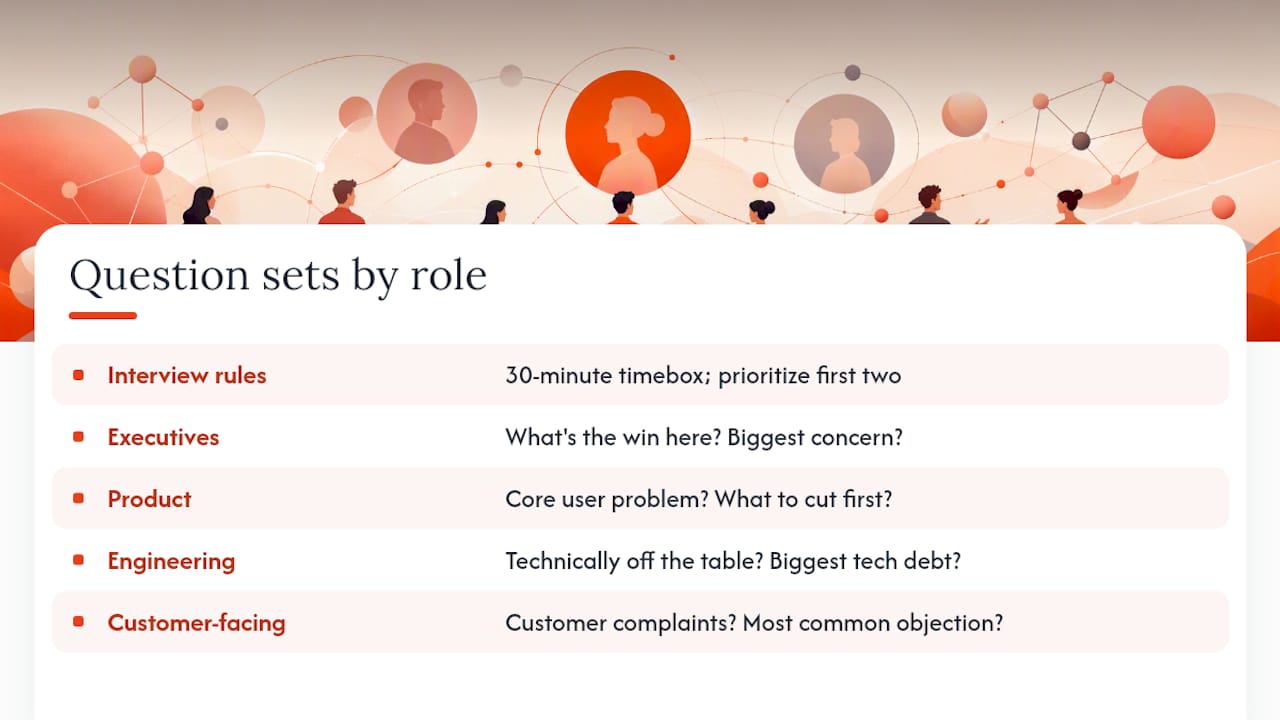
Adapt phrasing by role. Executives respond better to short, outcome-framed questions ("What's the win here?"). Engineers want specifics ("What's technically off the table?"). Product managers think in tradeoffs ("What would you cut first if scope shrank?"). Customer-facing roles surface the sharpest constraints when asked, "What do customers complain about that we're not fixing?"
Lean on "why," "how," and "tell me about" instead of "did you" or "is it." A yes/no question invites a one-word dead end.
Pro Tip: If a stakeholder answers with a vague adjective like "better" or "faster," ask them to define it numerically before you move to the next question. Vague answers early become expensive misunderstandings later.
How Do You Probe for Better Answers in a Stakeholder Interview?
Most first answers are safe answers. The real information shows up in the follow-up.
- "Tell me more about that."
- "Can you give me a specific example?"
- "Why does that matter to you?"
- "What would happen if we didn't fix that?"
- "What did that actually look like the last time it happened?"
Compare a weak exchange to a probed one:
Interviewer: "Is the current process working?" Stakeholder: "It's fine, mostly." Interviewer: "What does 'mostly' mean? Walk me through the last time it wasn't fine." Stakeholder: "Last month we missed a deadline because approvals sat in someone's inbox for four days."
That second answer is usable. The first one isn't. Adapt your follow-ups in the moment rather than reading from a script, and stay alert to leading phrasing. Asking "Don't you think X would help?" invites agreement, not honesty.
How Should You Open and Close a Stakeholder Interview?
Start with a short script: "Thanks for the time. I want to understand your priorities and constraints on this so we build the right thing. There's no wrong answer here. I'd rather hear a hard truth now than find out later."
Rapport comes from active listening more than small talk: reflect back what you heard ("So the main blocker is approval speed, not the tool itself?") and let silence sit after a hard question instead of rushing to fill it.
For notes, pick one method and stick with it: live notes typed during the call, a recording you transcribe afterward, or a dedicated notetaker who isn't also asking questions. Close every interview the same way: "Who else should I speak to, and is there anything you expected me to ask that I didn't?"
Pro Tip: Silence after a tough question almost always produces the most honest part of the interview. Resist the urge to rephrase or soften it.
When Should You Use Email Instead of a Live Interview?
Async questions work when the stakeholder is genuinely too busy for a call, the information is low-stakes, or you just need a quick confirmation on something already discussed.
- Send three to five prioritized open-ended questions, not ten.
- Frame the ask clearly: "This should take five minutes, and I only need your top priorities."
- Set a specific turnaround, like "by end of day Thursday," to keep momentum.
A short template: "What's your top priority for this project? What would make this a failure? Who else should weigh in before we finalize scope?" IdeaPlan's discovery template recommends this kind of short async approach specifically for stakeholders who are too senior or too booked for a live slot.
What Mistakes Should You Avoid in Stakeholder Interviews?
The most common failure is asking leading questions that hand the stakeholder your preferred answer. A close second: skipping the timebox and letting a 30-minute interview sprawl into an hour that derails the rest of your day.
Watch for these red flags in answers: vague KPIs with no number attached, ownership that keeps shifting to someone not in the room, and a flat "we tried that already" with no detail on what was actually tried. Push on all three before you build a decision around them.
Stay neutral by treating every stakeholder's input as data, not confirmation of what you already believe. Don't skip the quiet, less senior stakeholder just because the loudest one gave you a confident answer first.
Ready-to-Copy Question Sets by Role
Pick the set that matches who's across from you, timebox it at 30 minutes, and prioritize the first two questions if time runs short.
Executives: What's the win here? What's your biggest concern about this project? What would make this a failure? What's competing for budget right now? Who else needs to sign off? What's changed since the last time this came up? What's non-negotiable? How do you want updates delivered? What's the risk if we do nothing? Who else should I speak to?
Product: What's the core user problem we're solving? What would you cut first if scope shrank? How do you define success for this feature? What's been deprioritized to make room for this? What data supports this priority? What's the biggest assumption we're making? Who disagrees with this direction? What's the rollout risk? How will you measure adoption? Who else should I speak to?
Engineering: What's technically off the table? What's the biggest technical debt this touches? What would break if we moved fast here? What's the maintenance cost of this approach? What's already been tried and failed? What's your capacity concern? What's the security or compliance constraint? What's the timeline risk? What tradeoffs worry you most? Who else should I speak to?
Customer-facing: What do customers complain about that we're not fixing? What's the most common objection you hear? What would make customers happier tomorrow? What's the support burden today? What feature request comes up most? What's the churn risk here? What's working that we shouldn't touch? What's the biggest gap versus competitors? What would you tell customers is coming? Who else should I speak to?
How Do You Turn Interview Answers Into Decisions?
Send a short summary within 24 hours: three shared priorities, any conflicting priorities you noticed across stakeholders, and the next steps you're proposing. Ask the stakeholder to confirm or correct it. That single step catches misunderstandings before they turn into wasted work.
- Map every stated priority against effort or against certainty, so competing asks are visible side by side.
- Flag the two or three interviews that surfaced the same theme; that repetition is your signal to escalate it.
- Decide who to talk to next based on unresolved conflicts, not just who's easiest to schedule.
- Roll recurring, lower-stakes questions into a follow-up survey instead of scheduling another round of interviews.
If a theme keeps surfacing across five or six conversations, it's no longer a one-off opinion. That's when it belongs in your strategic planning documentation or your next RFP draft, not in another interview note.
What Does the Research Say About Getting Honest Answers?
Open-ended questions that start with "what," "why," or "how" consistently pull more usable detail than closed questions that invite a one-word answer. That's the single biggest lever available to any interviewer, and it costs nothing to apply.
Pairing that with pre-interview hypotheses gives you something concrete to test rather than a blank slate to fill, a practice 18F's guidance on stakeholder interviews frames around building genuine empathy for the people you're interviewing, not just extracting requirements from them.
If you're stuck with a stakeholder who gives short, guarded answers, try this: state your hypothesis out loud and ask them to correct it. "My guess is speed matters more to you than cost here. Is that right?" People who won't volunteer an opinion will often correct one.
- Prefer open questions over closed ones in nearly every exchange.
- Walk in with a hypothesis, not a blank page.
- Send a summary after every interview and ask for corrections.
What's the Real Skill Behind Good Stakeholder Interviews?
Most guides treat stakeholder interviews as a data-collection exercise: ask the questions, log the answers, move on. That undersells what's actually happening. A stakeholder interview is a negotiation over whose version of reality gets built into the final plan, and the interviewer who forgets that ends up with a document full of technically accurate answers that don't add up to a coherent project.
The skill that separates a useful interview from a wasted half hour isn't the question list. It's the willingness to sit in an uncomfortable silence after asking "why does that matter to you," and to push a second time when the first answer is a polite non-answer. Teams that skip this step usually don't fail because they asked the wrong questions. They fail because they accepted the first answer as the real one.
If there's one place teams consistently underinvest, it's the summary step. Sending a confirmation of what you heard feels like an extra task at the end of an already long process. Skip it, and you're building on assumptions nobody actually agreed to.
How Can You Scale Stakeholder Interviews Without Losing the Detail?
Running six interviews for one initiative is manageable with a shared doc and good notes. Running six interviews across four competing initiatives, with different stakeholders contradicting each other in real time, is where most teams lose the thread.

Swarm-stack is built for exactly that moment. Instead of a single notetaker trying to reconcile five separate conversations after the fact, your team runs structured, versioned sessions where interview notes, priorities, and conflicts get captured live and turned into a deliverable everyone can see, not a doc buried in someone's drive. You can pull in a vetted expert through the built-in marketplace when a technical or procurement question needs more than internal opinion, and export the final version straight to tools like GitHub or Jira once decisions are locked.
For teams inviting sensitive stakeholders, or planning to record and share notes across departments, the privacy and data handling details are worth a look before your first session. Start a session and turn your next round of stakeholder interviews into a plan you can act on the same week.
Frequently Asked Questions
How many stakeholder interview questions should I prepare for one session? Prepare 10 to 15 questions across your chosen categories, but expect to ask 6 to 8 in a 30-minute slot once follow-ups take their share of the time.
What's the difference between stakeholder interview questions and a stakeholder survey questions set? Interviews use open-ended, adaptive questions in real time to surface context and constraints. Surveys use fixed questions at scale to track sentiment over months, as SurveyMonkey recommends for periodic pulse checks.
Can I reuse the same stakeholder interview template for every role? Use the same core categories, but reword questions by role. An executive and an engineer need different phrasing to answer the same underlying question about priorities and constraints.
How long should a stakeholder feedback questions session run? Fifteen minutes for a quick check-in, 30 for a standard discovery conversation, and 45 for a high-influence stakeholder whose decision can stall the whole project.
What should go in a post-interview summary? List the stakeholder's stated priorities, any conflicts you noticed with other stakeholders, and the next steps you're proposing, then ask them to confirm or correct it before you move forward.
Sources
- Stakeholder Interviews 101 - NN/G
- Product Management Prompts: Stakeholder Discovery Interview | Productboard
- Stakeholder Survey Template & Questions | SurveyMonkey
- Stakeholder Interview Template for Discovery | IdeaPlan
Adapt every template to your own stakeholder mix; a set built for enterprise executives rarely fits a customer-facing team without rewording.