Workshop Facilitation: 3–5 Techniques and Ready Agendas for Team Leads
A practitioner toolkit: a 3–5 technique shortlist, runnable agendas, and session blueprints to run workshops that end with clear decisions.

Pick a small set of workshop facilitation techniques matched to your session's actual goal, build a clear open, diverge, converge, commit arc around them, and treat inclusion and energy as things you manage on purpose, not accidents you hope work out. Three to five methods, chosen for the phase they serve, will outperform a grab bag of icebreakers every time. The rest of this guide breaks those methods into runbooks, shows you how to design the arc around them, and gives you agenda templates and remote adaptations you can use today.
TL;DR:
- Using a small set of targeted techniques for each workshop phase improves engagement and outcomes, rather than relying on random icebreakers.
- Facilitators must actively protect process flow and neutrality, using structured methods like silent input or round-robin to manage dominant or disengaged participants.
- Design workshops starting with clear, measurable outcomes and assign roles beforehand to ensure focus, progress, and follow-through.
- Adapting techniques by group size and culture, especially for remote or hierarchical settings, ensures participation and comfort.
- Structured, real-time sessions produce more effective and actionable results than post-workshop notes or unstructured meetings.
Table of Contents
- What Are the Best Workshop Facilitation Techniques for Each Phase?
- What Facilitation Principles Actually Make These Techniques Work?
- How Do You Design a Workshop Session From Scratch?
- Which Tools and Templates Make Facilitation Repeatable?
- How Do You Practice and Improve Your Facilitation Skills?
- How Do You Handle Difficult Participants and Conflict in Workshops?
- How Should You Adapt Techniques for Group Size and Culture?
- Why Structured, Real-Time Sessions Beat Great Notes Afterward
- Try a Runnable Workshop Template Today
- Sources
What Are the Best Workshop Facilitation Techniques for Each Phase?
The techniques that work best are the ones matched to a specific job: generating raw material, making sense of it, deciding, or recharging a tired room. Below is a working bank organized by what each method is actually for, not by how trendy it sounds in a facilitation certification course.
For generating ideas (diverge phase):
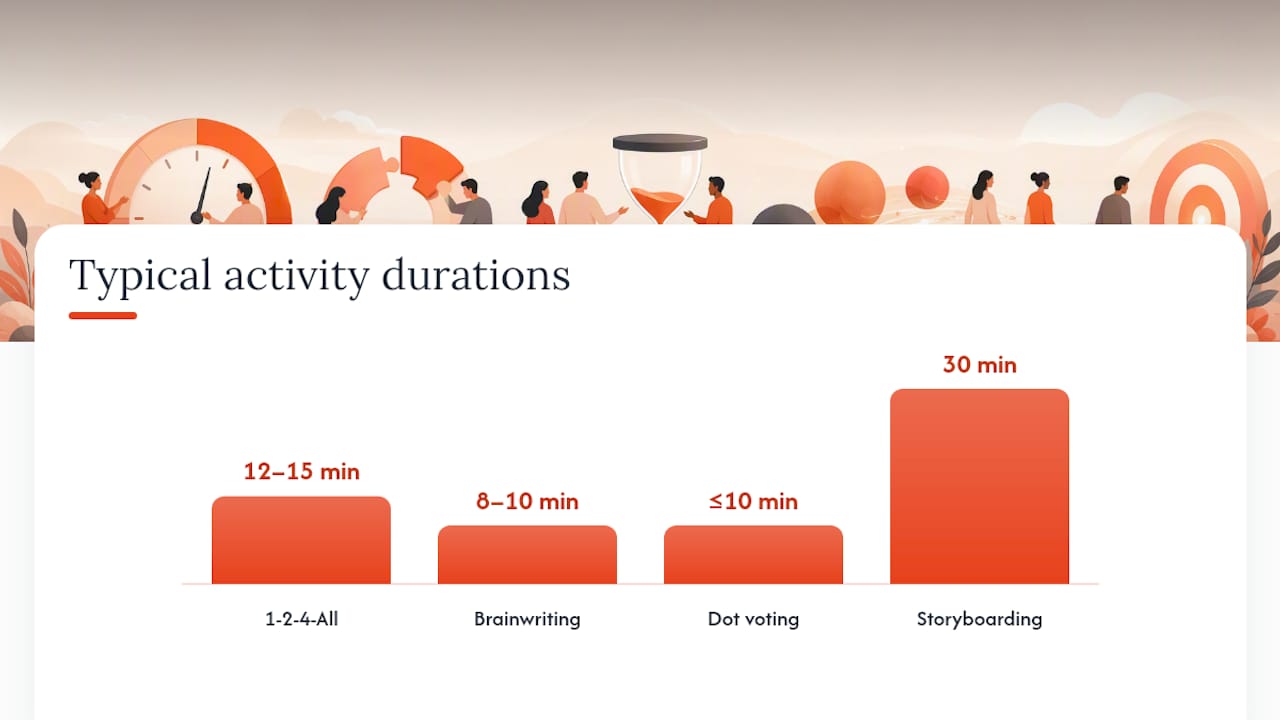
- 1-2-4-All. Individuals write silently for one minute, pair up for two minutes, form groups of four for four minutes, then share out. It surfaces ideas from people who never speak up in a full-group brainstorm and takes about 12 to 15 minutes for a group of 20.
- Brainwriting (silent brainstorming). Everyone writes ideas on sticky notes or a shared doc without talking, then passes work to a neighbor to build on it. Best for groups where a few loud voices tend to dominate; run it for 8 to 10 minutes before any verbal discussion starts.
- Storyboarding. Participants sketch a sequence of panels showing a process or user journey. Useful when the group needs to align on a flow rather than a list of features; budget 20 minutes plus 10 for gallery walk.
- Role play. Two or three volunteers act out a customer or stakeholder interaction while the group observes. Works well for surfacing friction points that a list of requirements would never capture.
For prioritization and decisions (converge phase):
- Dot voting. Give each participant three to five dot stickers (or digital equivalents) to place on the options they most want to pursue. Fast, transparent, and it takes under 10 minutes for 15 to 20 items.
- Impact/effort mapping. Plot ideas on a two-by-two grid of impact versus effort. This is the method to reach for when a group has generated 20+ ideas and needs a visual argument for what to do first.
- Forced ranking. Each participant ranks a shortlist top to bottom, and you tally scores. Better than dot voting when you need a strict order rather than a cluster of favorites.
For sensemaking and alignment:
- Affinity mapping. Cluster sticky notes or digital cards into themes after a brainstorm. Assign one person per cluster to name the theme out loud so the group can correct mislabeled groupings before you move on.
- World café. Small tables rotate through several rounds of conversation on related questions, with one person staying behind as the "table host" to brief new arrivals. Strong for 20 to 60 people; weak for anything under 12.
- Fishbowl. A small inner circle discusses while a larger outer circle listens, with empty chairs that outer members can fill to jump in. Good for contentious topics where a full-group debate would turn into cross talk.
- Playback. A facilitator or scribe reads back a summary of what the group just said, in the group's own words, and asks "did I get that right?" This single move catches misunderstandings before they harden into decisions.
For equity and participation:
- Silent brainstorming (again, doing double duty) and 1-2-4-All both force airtime toward quieter voices by structural design rather than by asking louder people to be quiet.
- Round-robin with a pass option. Go person by person, but let anyone say "pass" without pressure. It signals psychological safety while still giving everyone a turn.
For re-energizing:
- Stand-up stretch or two-truths-one-lie, kept under three minutes, resets a room after a heavy converge session.
- A five-minute silent synthesis, where everyone writes their own takeaway before anyone talks, often produces sharper contributions from quiet participants than another 20 minutes of open floor discussion, according to NN/g's facilitation research.
Pro Tip: Never run more than two diverge-phase techniques back to back. Groups generate diminishing returns after the second round of idea generation, and the room starts to feel like busywork instead of progress.
For remote and neurodivergent-friendly sessions, swap sticky notes for a shared digital board, always give a written option alongside verbal sharing, and turn on live captions where the tool supports it. A live captioning and accessibility guide built for event planners covers the mechanics in more depth if you're running hybrid or fully remote sessions regularly.
What Facilitation Principles Actually Make These Techniques Work?
Techniques fail all the time, not because the method was wrong, but because the person running it didn't hold the process. Holding the process means you protect the structure and the time box even when the conversation wants to wander, without inserting your own opinion into the content of the discussion. If a participant says "I think the roadmap should prioritize mobile first," a facilitator holding the process asks "what's the group's reaction to that?" instead of agreeing or disagreeing.
Neutrality is harder than it sounds, especially when you're facilitating your own team's workshop. NN/g's research on workshop facilitation frames facilitators as process experts whose job is enabling full participation and shared understanding, not steering content toward a preferred outcome. That distinction is the difference between a workshop and a meeting where one person already knows the answer.
Active listening in workshops looks different than active listening in a one-on-one conversation. It means:
- Letting silence sit for five to seven seconds after asking a question instead of filling it yourself.
- Paraphrasing what you heard before moving to the next agenda item, so the group can correct you.
- Tracking who has and hasn't spoken, and inviting quieter participants by name rather than waiting for them to volunteer.
- Linking one person's comment explicitly to another's ("that connects to what Priya said about timing") so the group feels like it's building something together, not taking turns talking at a wall.
A grounded-theory study of expert small-group teachers found that engagement in small groups comes from three things working together: a supportive environment, a personalized approach to the specific people in the room, and active, in-the-moment facilitation that observes, analyzes, and adjusts. That third piece, the observe-analyze-decide loop, is what separates facilitators who read the room from those who just run the agenda regardless of what's happening in it.
Energy management is a visible-timing problem as much as a psychological one. Keep visible timing for every activity, not just at the start. Groups manage their pace better when they can see the clock. Short, timed inputs (2 minute updates instead of open-ended status reports) protect energy far better than any energizer game, because they prevent the energy drain in the first place instead of trying to repair it afterward.
One more mental model worth carrying into every session: the curse of knowledge means you, as the facilitator or the most senior person in the room, will systematically overestimate how much the group already understands. Structures like playback and written silent input exist specifically to surface what people actually think, rather than what you assume they think.
How Do You Design a Workshop Session From Scratch?
Start with the outcome, not the agenda. A workshop designed backward from a measurable result avoids what Sessionplan's facilitation guide calls the trap of "beautiful outputs, no follow-through," where a session feels great in the room and changes nothing afterward.
- Write one sentence of purpose and one or two measurable outcomes. Not "align on strategy," but "leave with three prioritized Q3 initiatives and an owner for each." If you can't state what will exist after the session that didn't exist before it, the workshop isn't ready to be scheduled.
- Map the arc: open, diverge, explore, converge, commit. Assign one or two techniques to each phase. A two-hour session might open with framing (10 minutes), diverge with 1-2-4-All (20 minutes), explore with affinity mapping (25 minutes), converge with impact/effort mapping (20 minutes), and commit with a decision log (15 minutes), leaving the rest for breaks and buffer.
- Build in 15 to 20% time buffer. Every activity runs long. A schedule with zero slack guarantees you'll cut the commit phase, which is the one phase you can't afford to cut.
- Assign roles before the session, not during it. A facilitator holds the process, a timekeeper protects the clock so the facilitator doesn't have to watch two things at once, a note taker captures decisions verbatim, a tech lead handles the shared board and breakout rooms, and a sponsor stays present to answer scope questions without hijacking the room.
- Run pre-work. Short interviews with three to five participants beforehand surface landmines you don't want discovering live. Test your tech stack (shared board, video platform, polling tool) at least a day ahead, not ten minutes before the call starts.
- Close with a decision log, named owners, and a next-step deadline, then send a one-page summary promptly after the session. Sessions that share summaries quickly generally see better follow-through than those where notes are delayed, per Sessionplan's guidance on closing rituals.
- Run a two-minute retro before people leave, asking what worked and what to change next time. This is the cheapest feedback loop you'll ever build.
Pro Tip: Draft your agenda with times attached to every single activity, including transitions. "Discuss roadmap" with no time box will eat 40 minutes. "Discuss roadmap: 12 minutes" gets you 12 minutes, roughly.
For technical teams specifically, a requirements gathering workshop framework walks through method selection when the outcome is a spec rather than a strategic decision, since the diverge and converge techniques you'd use for a roadmap session don't map cleanly onto extracting technical requirements.
Which Tools and Templates Make Facilitation Repeatable?
You don't need custom material for every session. Three agenda skeletons cover most of what practitioners run:
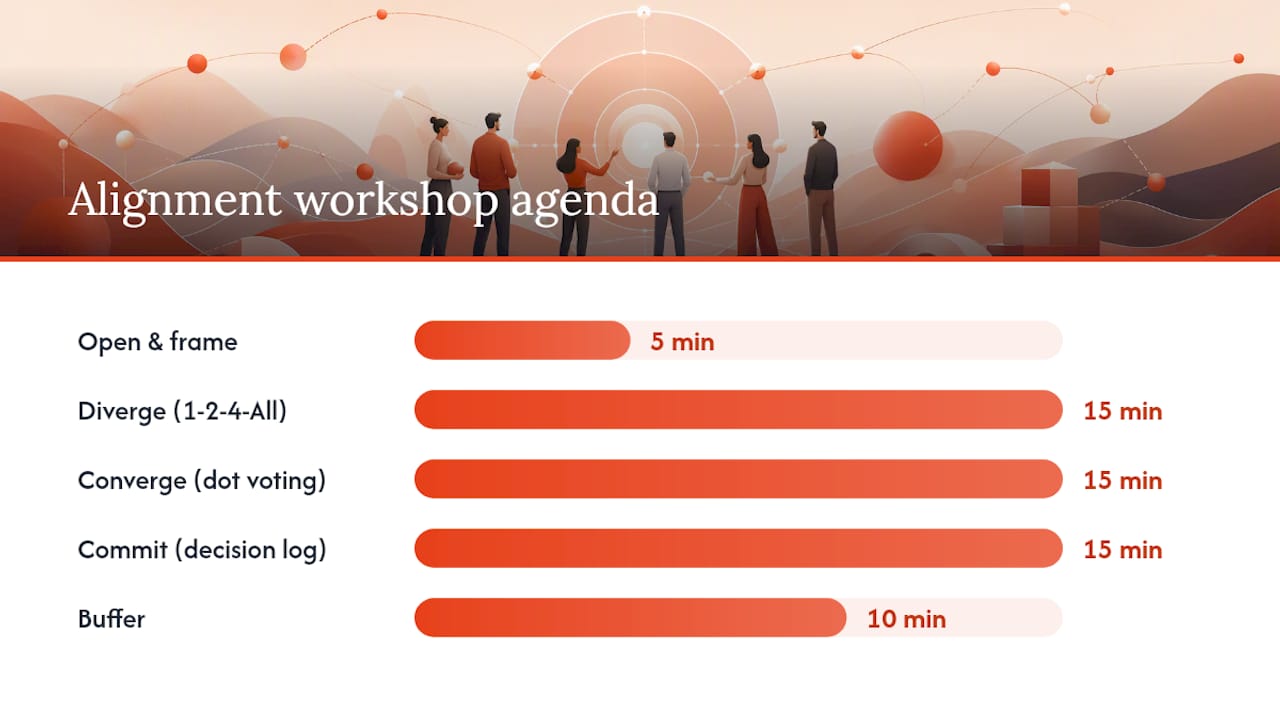
Quick alignment (60 minutes): Open and frame (5 min), diverge with 1-2-4-All (15 min), converge with dot voting (15 min), commit to a decision log with named owners (15 min), buffer (10 min).
Half-day design workshop (4 hours): Open and context-setting (20 min), diverge with brainwriting and storyboarding (60 min), explore with affinity mapping (45 min), break (15 min), converge with impact/effort mapping (45 min), commit with forced ranking and next steps (40 min), buffer (35 min).
Decision workshop (90 minutes): Open and frame the decision (10 min), explore options via fishbowl (30 min), converge with dot voting (20 min), commit with a documented decision and owner (20 min), buffer (10 min).
| Tool category | What it's for | When to use it |
|---|---|---|
| Collaboration board (digital sticky notes) | Brainwriting, affinity mapping, storyboarding | Any remote or hybrid session |
| Visible timer | Keeping activities on schedule | Every session, in-room or remote |
| Polling tool | Dot voting, forced ranking at scale | Groups over 15 people |
| Live caption or transcript tool | Accessibility, async review | Remote sessions, mixed-ability groups |
Remote facilitation adds its own hygiene rules on top of technique selection. Keep breakout rooms to four or five people so silent brainstorming actually surfaces voices instead of hiding them behind one dominant speaker. Use a shared artifact (one board everyone can see and edit) rather than individual screens, since a session where half the room is looking at their own notes isn't really a shared workshop anymore. Set a camera-on norm for small groups but relax it for large ones, and always post the visible timer inside the shared tool, not just on the facilitator's screen. A guide to remote collaboration best practices covers the meeting-cadence side of this if your team runs distributed workshops regularly, and a broader overview of remote collaboration tool categories is useful background if you're still choosing a stack.
For runnable starting points rather than blank templates, SwarmStack's alignment workshop agenda and structured planning workshop blueprint give you a filled-in skeleton to adapt instead of building one from scratch.
How Do You Practice and Improve Your Facilitation Skills?
Facilitation skills training works best as deliberate repetition of a few methods, not superficial exposure to dozens of them. Practitioners who go deep on 1-2-4-All, affinity mapping, and dot voting, running each one enough times to develop a feel for timing and failure modes, get better faster than those who try a new technique every week, according to NN/g's facilitation research.
A simple four-week plan:
- Week 1: Run a 60-minute session using only 1-2-4-All for idea generation. Note where timing broke down.
- Week 2: Add affinity mapping to sort what you generated. Practice naming clusters out loud and correcting them live.
- Week 3: Introduce dot voting or impact/effort mapping to converge on a decision. Time every phase.
- Week 4: Run a full open, diverge, converge, commit arc end to end, and close with a written decision log within 24 hours.
For structured starting material rather than building your own each week, SwarmStack's structured planning workshop template, alignment agenda, and requirements gathering workshop guide give you filled-in agendas to adapt rather than draft cold.
Measure progress with two questions after every session: "Did we leave with a clear decision and owner?" and "Did everyone get airtime?" Keep a running decision and completion log across sessions. If the same three people always dominate the log's "decided by" column, your technique selection needs to shift toward more silent and written methods.
How Do You Handle Difficult Participants and Conflict in Workshops?
The dominant talker, the silent skeptic, and the person who derails the agenda with a tangent are the three conflict patterns you'll meet most often, and each needs a different structural fix rather than a personal confrontation.
For a dominant talker, don't argue with them in the moment. Switch the activity to a written or silent format (brainwriting, 1-2-4-All) where airtime is structurally capped, and use a round-robin with a pass option for the next verbal round. This resolves the imbalance without singling anyone out.
For a silent skeptic who seems checked out, a direct but low-stakes invitation works better than a general "does anyone have thoughts?" Ask them by name about a specific point: "Marcus, you've done this kind of rollout before. What's your read on the timeline?" Most disengagement is a signal the person doesn't feel the format has room for them yet, not that they have nothing to say.
For agenda derailment, acknowledge the tangent out loud, capture it visibly on a "parking lot" list, and name when you'll return to it. This protects the derailing person's sense of being heard while protecting the group's time. If a real conflict flares between two participants, use a fishbowl structure: let the two people talk directly while everyone else listens silently, which tends to de-escalate faster than an open free-for-all where everyone piles on with an opinion.
How Should You Adapt Techniques for Group Size and Culture?
Group size changes which techniques even function. Under eight people, world café falls apart because there's no meaningful rotation, but fishbowl and round-robin work well. Between 8 and 20, most of the techniques in this guide scale cleanly. Above 30, you need methods with built-in structure, like 1-2-4-All or dot voting with digital polling, since open discussion collapses into a handful of voices dominating a room that size regardless of facilitator skill.
Cultural context changes how much silence, hierarchy, and direct disagreement a group can comfortably hold. In groups where deferring to seniority or title is a strong norm, silent brainwriting and written input matter even more than usual, since junior participants may never voice disagreement with a senior colleague out loud regardless of how many times you invite it. In groups with a strong preference for consensus over majority vote, forced ranking or dot voting can feel uncomfortably blunt; affinity mapping followed by a discussion-based converge often lands better. When you're facilitating a group whose norms you don't know well, default to more written, silent methods early in the session. You can always add verbal discussion later once you've read how the room behaves, but you can't easily undo a session that opened by putting people on the spot.
Why Structured, Real-Time Sessions Beat Great Notes Afterward
Most workshops fail after the room empties, not during it. A brilliant converge phase means nothing if the decision log sits in someone's notebook for a week. Some platforms build sessions where argument-driven refinement and decision recording happen in the same real-time flow, aiming for deliverables ready to implement immediately rather than reconstructed from memory. If you want to see what a structured, template-backed session actually produces, running one is faster than reading about it.
— Cody
Try a Runnable Workshop Template Today
Everything in this guide, the technique bank, the agenda skeletons, the closing rituals, works better with structure holding it together instead of a blank whiteboard and good intentions. That gap is addressed by platforms offering real-time sessions where human experts and AI specialists collaboratively refine plans or RFPs, inviting contributors via a single link to produce decided, versioned deliverables rather than mere notes.
If you're planning your next alignment session, planning workshop, or requirements gathering session, start with the SwarmStack platform to see how a structured session runs end to end, or check the pricing page to find the plan that fits your team's session volume. Teams evaluating a new collaborative tool for sensitive planning work can review SwarmStack's trust and data privacy details before inviting a full team in.
Sources
- Learning from the experts: Stimulating student engagement in small-group active learning
- Workshop facilitation 101
- How to run great workshops – facilitation guide
- The curse of knowledge (HBR)