Stop Overpaying: Workshop Facilitator Rates With a 3 Scenario Formula
Use a copyable cost layer formula to judge workshop facilitator rates. Build prices step by step, review three worked scenarios, and weigh facilitator ROI.

Expect to pay $50 to $150 per hour for entry-level facilitators, $150 to $350 per hour for experienced independents, and anywhere from $1,500 to over $15,000 per day for corporate engagements. The widespread range isn't arbitrary. Prep time, customization, and the depth of deliverables usually explain the gap between a $2,000 quote and a $20,000 one. If a quote seems out of line, ask what's included before assuming you're being overcharged.
TL;DR:
- Facilitator rates vary widely, with entry-level charging $50 to $100 per hour and senior corporate facilitators billing $10,000 to $30,000 per full-day engagement.
- Most preparation for complex sessions requires two to three hours of work per hour of facilitation, significantly impacting the overall cost.
- Additional expenses like travel, materials, and deliverables can increase the total fee and should be clearly itemized before agreement.
- Comparing quotes based solely on hourly rates can be misleading; evaluating scope, prep time, and deliverables provides a more accurate assessment.
- For recurring sessions or large projects, using marketplace models or structured frameworks can reduce costs and enhance consistency.
Table of Contents
- Workshop Facilitator Rates by Experience Level
- What Determines a Facilitator's Rate
- Building Your Own Fair-Rate Formula
- Rates by Format: Half-Day, Full-Day, Multi-Day, and Virtual
- How to Budget and Evaluate Facilitator ROI
- Why Facilitation Delivers Outsized Returns
- Deposits, Cancellations, and Payment Terms to Expect
- A Different Way to Get Facilitation Right
- A Final Word on Pricing Facilitation Fairly
- Sources
Workshop Facilitator Rates by Experience Level
The term "facilitator" covers everyone from a first-year trainer running icebreakers to a veteran who's designed strategy sessions for Fortune 500 boards, so the rate spread is enormous by design.
Entry-level facilitators, often people building a portfolio or working part-time alongside a training role, typically charge hourly rates on the lower end, with half-day and full-day sessions priced accordingly. Experienced independent facilitators, the ones with five or more years of dedicated practice, commonly charge $150 to $350 per hour, with day rates frequently falling between $3,000 and $5,000 depending on scope and industry.
At the top of the market, corporate engagements that include pre-event design work and post-event follow-up commonly run $10,000 to $30,000 for a full-day session with a senior facilitator. That range surprises a lot of first-time buyers, but it reflects weeks of hidden work, not eight hours in a room.
Salary data tells a different story than freelance pricing. ZipRecruiter reports an average hourly pay of $23.93 for employed workshop facilitator roles, a figure that reflects salaried staff positions, not independent consultants setting their own rates. If you're comparing quotes against a number you saw on a job board, you're comparing the wrong thing.
- Entry-level: $50 to $100/hour, $300 to $1,400 per half or full day
- Experienced independent: $150 to $350/hour, $3,000 to $5,000 per day
- Corporate/senior with design and follow-up: $10,000 to $30,000 per engagement
- Employed staff roles (not comparable to freelance quotes): roughly $23.93/hour average
What Determines a Facilitator's Rate
Two facilitators can quote wildly different numbers for what sounds like the same job, because "the same job" almost never means the same amount of work behind the scenes.
Prep and design time is the biggest hidden cost. A bespoke session often requires two to three hours of preparation for every hour of face time, and senior-designed corporate engagements can involve 8 to 20 hours of prep for a single full day with a client. Stakeholder interviews, custom slide decks, and pre-work surveys all add to that total before the facilitator says a word to the group.
Beyond prep, a handful of other factors move the number:
- Travel and lodging, billed separately from the facilitation fee in most contracts
- Group size, since larger groups often need co-facilitators or breakout support
- Deliverables like written reports, recorded sessions, or synthesis documents
- Specialty expertise, such as conflict resolution or executive-level strategy work
Pro Tip: Ask every prospective facilitator for an hourly prep-to-delivery ratio before comparing quotes. A facilitator quoting less per hour but budgeting only two hours of prep for a complex session may cost you more in redone work later.
Building Your Own Fair-Rate Formula
You don't need a pricing degree to sanity-check a quote. A workable formula builds the price from four cost layers, then adds a buffer and margin on top, an approach pricing guides for workshop-based businesses recommend:
- Calculate labor: (teaching time + prep time) × hourly rate
- Add materials: handouts, software licenses, printed workbooks
- Add venue and equipment costs, or subtract them for virtual formats
- Add coordination and admin time, plus a 5 to 10% buffer for the unexpected
- Add your margin, then divide by expected headcount for a per-person price
Operational fees matter too. Registration platforms and payment processors commonly add 4 to 6% plus small per-ticket charges, and skipping that step in your math quietly erodes your margin.
Here's how the formula plays out across three common scenarios:
Per-participant public workshops commonly land at $65 to $150 for a three-hour session, and $200 to $500 for a weekend intensive, which lines up closely with the worked math above.
Rates by Format: Half-Day, Full-Day, Multi-Day, and Virtual
The delivery format changes both the price and what's driving it, so it's worth pricing each type separately rather than assuming a full day just costs "double" a half day.
Half-day sessions (three to four hours) typically run from moderate to upper fees for independents and senior corporate facilitators. Full-day engagements vary widely, especially when custom design and stakeholder alignment are required. Multi-day intensives rarely scale linearly. A three-day strategy offsite often costs less per day than a single standalone session because prep work amortizes across all three days.
Virtual workshops shift the cost structure rather than simply cutting it.
Common add-ons worth budgeting separately:
- Pre-work stakeholder interviews: $200 to $800 depending on depth and number of interviews
- Custom materials and branded workbooks: $150 to $600
- Post-session synthesis reports: $300 to $1,500 depending on length and detail
How to Budget and Evaluate Facilitator ROI
Comparing quotes on price alone is how buyers end up with the wrong facilitator. Compare them on scope instead, using a short list of discovery workshop questions in your RFP or interview:
- What's included in prep, and how many hours does that represent?
- Are travel, materials, and venue billed separately or included?
- Will I receive a written report, recording, or synthesis document?
- What happens if we need a follow-up session?
- Have you facilitated groups of this size and industry before?
- What's your cancellation and rescheduling policy?
- Do you work solo or bring a co-facilitator for this group size?
- Can you share a sample agenda from a similar engagement?
The ROI math is simpler than it looks. If ten senior leaders sit through an unproductive two-hour meeting, that's roughly 20 hours of high-value time spent with nothing to show for it. Compared against that, a facilitator's fee often functions more like insurance than an expense.
Pro Tip: Before hiring, calculate the fully loaded hourly cost of everyone who'll be in the room. If that number exceeds the facilitator's day rate, the math already favors hiring one.
Why Facilitation Delivers Outsized Returns
Facilitation earns its cost when it prevents the alternative: a room full of expensive people leaving with no decisions made. That's the case Swarm-stack makes for structured planning sessions generally, and it holds whether the facilitator is human, AI-assisted, or both.
The real cost of a bad workshop isn't the facilitator's invoice. It's the follow-up meeting you need because the first one didn't produce a decision.
Paying more for a senior facilitator makes sense when stakes are high: reorganizations, budget fights, or sessions where disagreement is likely. A lower-cost or junior facilitator works fine for straightforward training or well-scoped requirements gathering sessions where the agenda is already clear. Match the facilitator's experience to how much judgment the room will actually require, not just to your budget line.
Deposits, Cancellations, and Payment Terms to Expect
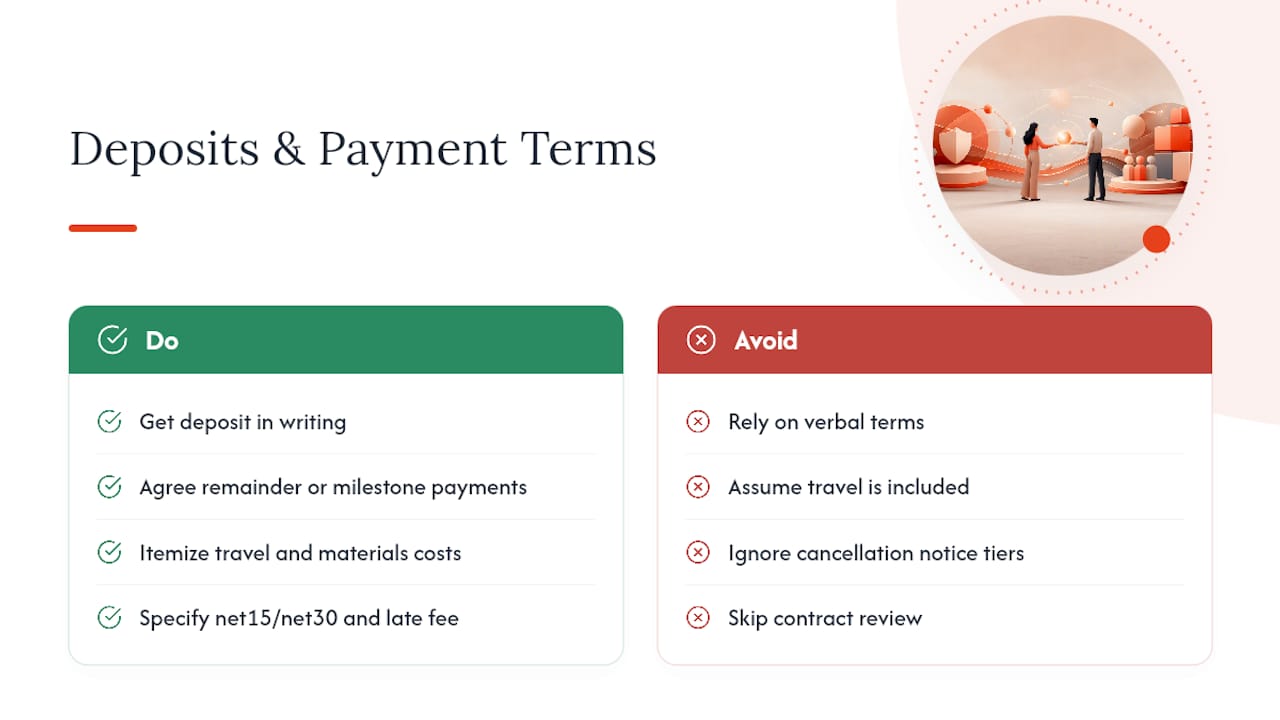
Most independent facilitators and agencies require a deposit before locking in your date, typically 25 to 50% of the total fee, due at contract signing. The remainder is usually invoiced on or shortly after the delivery date, though some facilitators split payment into thirds tied to design, delivery, and follow-up milestones for larger engagements.
Cancellation policies scale with how much notice you give. Rescheduling terms are typically more forgiving than outright cancellation, often allowing one free date change if you give at least a week's notice.
Travel and materials costs are usually billed as reimbursable expenses separate from the facilitation fee, and it's worth getting that itemized in the contract rather than assumed. Late payment terms matter too: most professional facilitators specify net 15 or net 30 terms, with a modest late fee after that window closes.
Before signing anything, get the deposit amount, cancellation tiers, and expense policy in writing. Verbal agreements on these terms are the single most common source of disputes after a workshop wraps, not the facilitation quality itself.
A Different Way to Get Facilitation Right
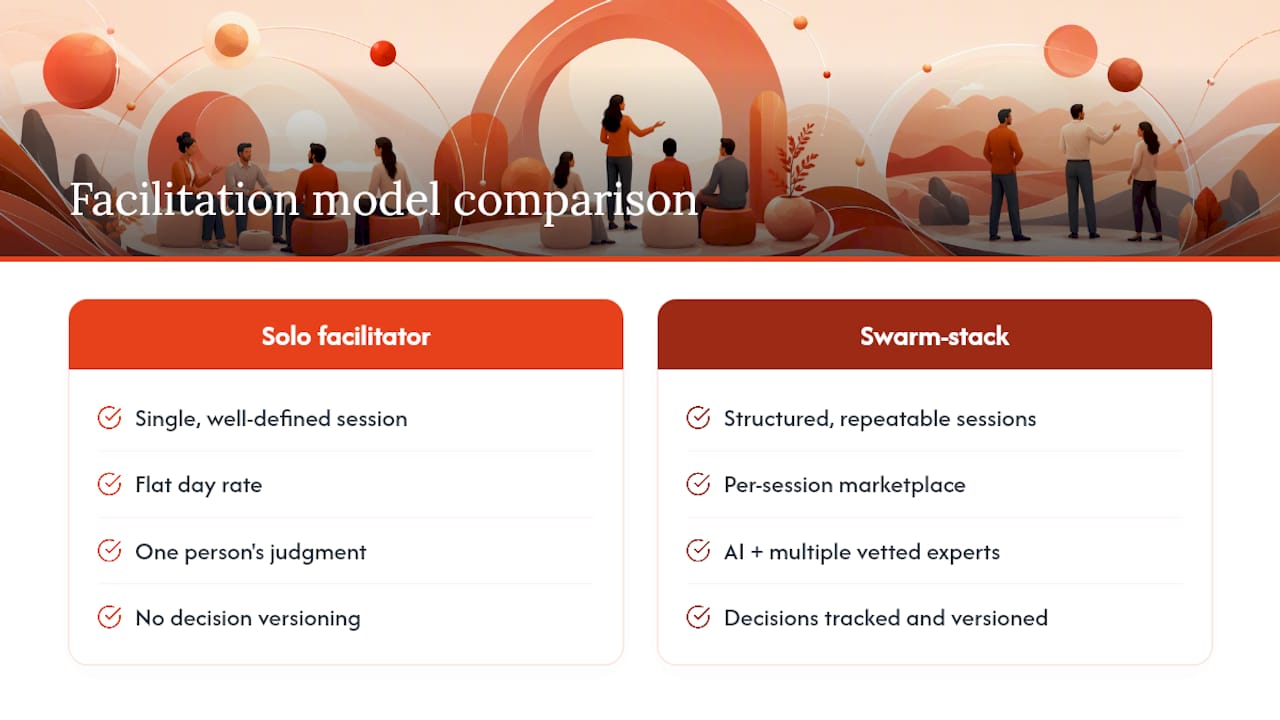
Hiring a solo facilitator works well for a single, well-defined session. It gets expensive fast when your team needs repeatable planning sessions, RFP development, or structured input from multiple experts across several rounds. That's a different problem than booking one person for one day.
Swarm-stack runs structured, repeatable sessions where your team collaborates in real time with AI specialists and, when you need it, vetted human experts hired per session through its integrated marketplace. Instead of paying a flat day rate for one person's judgment, you get argument-driven refinement from multiple angles, with every decision tracked and versioned so nothing gets lost between meetings. Teams get well-defined deliverables, ready to export straight into tools like GitHub and Jira, without negotiating a new statement of work every time.
If your team runs planning sessions or builds RFPs more than once a quarter, it's worth comparing that per-session marketplace model against a recurring facilitator retainer. Start a session on Swarm-stack and see what a structured plan looks like on your first project.
A Final Word on Pricing Facilitation Fairly
If you're buying facilitation, put the scope in writing before you compare a single number. If you're setting your own rates, price your prep time honestly. It's usually the majority of the work and the first thing new facilitators underprice.
Run the cost-layer formula on your next project, whether you're hiring or quoting, and see where the real number lands.
— Cody
Sources
- How much does a facilitator cost? A corporate buyer's guide | DMP Creative
- What Should I Charge for a Workshop? | Class Price Calculator
- Workshop Facilitator Salary: Hourly Rate August 2026 USA