Best Product Roadmap Tools for AI-Driven Teams 2026
Discover the best product roadmap tools for AI-driven teams in 2026. Transform your planning with Swarm-stack's real-time AI features.

For professional teams that need AI-assisted collaborative planning and buyer-side RFP creation, Swarm-stack is the recommended product roadmap platform. It combines real-time AI synthesis, deliverable versioning, and single-link stakeholder access in one place — the combination most roadmap tools still split across two or three separate products.
Two reasons it earns that position:
- Source-of-truth plus AI synthesis. Swarm-stack runs structured sessions where multiple AI specialists and human experts argue each angle, producing versioned deliverables with a built-in decision log. That means your roadmap reflects actual reasoning, not the last person who edited the slide deck.
- Frictionless access. Stakeholders join via a single invite link. No account setup, no IT ticket. The integrated expert marketplace adds vetted human judgment when the team needs it.
Table of Contents
- What are the best product roadmap tools for modern teams?
- Core features to prioritize when evaluating product roadmap tools
- How do you evaluate roadmap tools in a focused 2–4 week trial?
- How does Swarm-stack map to the evaluation checklist?
- What do licensing models and onboarding timelines look like?
- Making the roadmap your team's source of truth
- Key Takeaways
- The gap between roadmap tools and roadmap outcomes
- Swarm-stack delivers AI-assisted roadmapping and RFP creation in one session
- Useful sources and further reading
What are the best product roadmap tools for modern teams?
The honest answer: the best product roadmap software is whichever one your stakeholders actually open. A tool that lives only in the product manager's browser is a glorified to-do list. Customizable stakeholder views — timeline for executives, delivery dates for engineering, portfolio roll-ups for leadership — are what turn a roadmap into a shared decision surface.
The deeper risk is strategic drift. When teams lose the "why" behind decisions, they default to building whatever the loudest customer requested last week. Closing the loop between launched features and original roadmap assumptions is what separates intelligence-backed platforms from visualization-only tools. AI-assisted roadmapping is now considered table stakes for mature product teams, and the ability to trace a shipped feature back to its original hypothesis is the differentiator that matters most.
Key business impacts when you get this right:
- Alignment across functions: sales, engineering, and leadership read from the same source instead of reconciling three versions of a slide deck.
- Reduced manual synthesis: AI agents synthesize feedback across channels, cutting the hours teams spend aggregating Slack threads, support tickets, and sales calls.
- Faster decisions: when evidence is pre-organized, stakeholder reviews move from debate to ratification.
- Traceable outcomes: every launch links back to a roadmap assumption, so post-mortems have data instead of opinions.
Core features to prioritize when evaluating product roadmap tools
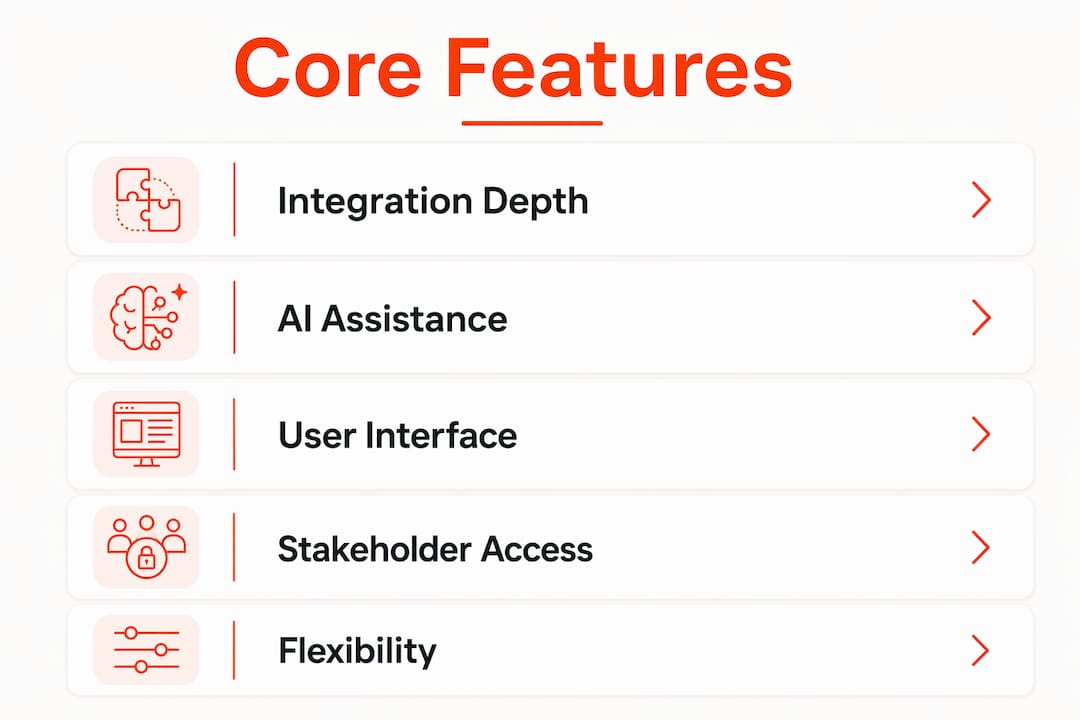
The single most important feature category is source-of-truth integration: a roadmap that cannot sync bidirectionally with your delivery tools becomes stale within days. Manual status updates are outdated the moment they are saved; native two-way sync with Jira or GitHub is what keeps the roadmap credible.
Must-have features:
- Customizable stakeholder views (timeline, list, portfolio) so each audience sees what they need
- Two-way sync with delivery tools (Jira, GitHub) — not a one-way push
- AI feedback synthesis that aggregates cross-channel input into prioritized initiatives
- Role-based permissions (edit, comment, view-only) with shareable private links for non-technical stakeholders
- Versioning and decision tracking so the reasoning behind each change is preserved
- Prioritization framework support (RICE, weighted scoring) to defend decisions with evidence rather than gut feel
Nice-to-have features:
- Built-in research agents and prioritization templates
- Marketplace for vetted human experts
- Native RFP export to procurement formats
- Mobile access and offline capability for distributed teams
Pro Tip: When evaluating integration depth, ask vendors specifically whether their Jira or GitHub sync is native two-way or API-based one-way. A one-way push means your roadmap reflects what was planned, not what is actually happening in delivery — a subtle but consequential difference.
How do you evaluate roadmap tools in a focused 2–4 week trial?
A four-week pilot surfaces fit for most teams if it tests integrations, AI synthesis, stakeholder sharing, and outcome tracking in sequence. Run it in this order:
- Week 1 — Configuration and integration. Connect the tool to Jira or GitHub. Verify that a status change in the delivery tool reflects in the roadmap within the sync window. Import or recreate one active initiative.
- Week 2 — AI synthesis test. Feed the tool a batch of real customer feedback (support tickets, sales call notes, survey responses). Measure how many actionable initiatives the AI surfaces versus how many a human analyst would have identified manually.
- Week 3 — Stakeholder sharing. Share the roadmap with at least three non-product stakeholders using a view-only link or embed. Track whether they open it without asking for help. Embedding and private-link sharing remove account barriers that kill adoption before it starts.
- Week 4 — Outcome tracking. Link one recently launched feature to its original roadmap assumption. Confirm the tool can surface whether the launch met the hypothesis.
Metrics to track during the pilot:
- Active viewers per week (adoption signal)
- Sync latency between delivery tool and roadmap
- Number of AI-generated insights versus manually created ones
- Time spent aggregating feedback before and after AI synthesis
- Closed-loop ratio: launched features with traceable post-launch metrics
Evaluation questions to ask stakeholders:
- "Did you find what you needed without asking someone?"
- "Would you check this before a planning meeting, or after?"
- "What would make you trust this more than the last tool we used?"
Red flags that justify ending the trial early:
- Stakeholders hit a login wall before viewing the roadmap
- No native sync — only CSV import or manual copy-paste
- No way to link a launched feature back to its original roadmap item
How does Swarm-stack map to the evaluation checklist?
Swarm-stack satisfies the must-have checklist items for AI-assisted roadmapping and buyer-side RFP workflows. Below is the direct mapping:
- Source-of-truth: structured sessions produce versioned deliverables with a decision log — every change is traceable.
- AI synthesis: multiple AI specialists argue each angle during a session, surfacing trade-offs a single model would miss.
- Stakeholder access: single invite link, no account required for participants.
- Integrations: direct export to GitHub and Jira keeps the roadmap connected to delivery without manual re-entry.
- Expert marketplace: vetted human experts join sessions on demand, adding judgment that pure AI cannot replicate.
- RFP creation: sessions produce exportable RFPs ready for procurement, a capability most AI RFP software treats as a separate product.
A practical example: a product team runs a three-week pilot using Swarm-stack to assemble a prioritized roadmap for a new integration. Week one, they run a structured session with two AI specialists and one domain expert to synthesize customer feedback and surface the top five initiatives. Week two, they share the versioned output with engineering and procurement via invite link. Week three, they export the finalized RFP directly to their procurement workflow. The decision log from the session travels with the deliverable, so every stakeholder knows why each item ranked where it did.
What do licensing models and onboarding timelines look like?

Pricing for product planning tools follows a predictable shape: subscription tiers (per-seat or team-based) plus optional per-session costs for expert access. Swarm-stack follows this model, with a free tier that requires a user-provided AI API key after initial use, Pro and Team subscription plans, and per-session payments for vetted expert engagement via Stripe.
Common cost drivers across the category:
- Number of seats or editors (viewer seats are often free or unlimited)
- Integration depth (enterprise connectors typically require higher tiers)
- AI feature access (often gated to mid-tier and above)
- Expert session fees (per-session, not bundled into the subscription)
Onboarding timeline:
| Week | Activity |
|---|---|
| 1 | Trial configuration, connect integrations, import one active initiative |
| 2 | Run first AI synthesis session, validate stakeholder sharing |
| 3 | Pilot with a real initiative, collect stakeholder feedback |
| 4 | Evaluate metrics, decide on full rollout or adjust scope |
Most teams reach a usable state fairly quickly. Full rollout, including governance routines and integration validation, typically takes several weeks.
Making the roadmap your team's source of truth
Adoption succeeds with low-friction sharing, short governance routines, and measurable rituals. A roadmap that requires a weekly manual update from one person will drift. A roadmap connected to delivery tools and reviewed on a fixed cadence will not.
Governance checklist:
- Assign a single owner responsible for update cadence
- Define who can edit, who can comment, and who gets view-only access
- Record decisions in the version log, not in a separate document
- Link every launch to its original roadmap assumption within 48 hours of shipping
Suggested governance routine:
- Weekly sync (15 minutes): review status changes pushed from Jira or GitHub, flag any items that have drifted from plan.
- Monthly strategic review (45 minutes): assess whether top-priority items still align with company goals; update scoring if new data has arrived.
- Quarterly portfolio check: measure closed-loop ratio, view rate, and update frequency. If the closed-loop ratio is below 50%, the roadmap is a visualization tool, not a decision framework.
Prefer native two-way sync over manual updates wherever possible. The maintenance overhead of manual updates is the most common reason roadmaps lose credibility within three months of launch.
Key Takeaways
The best product roadmap tools combine AI-assisted synthesis, native delivery-tool integrations, and frictionless stakeholder access — and Swarm-stack delivers all three in a single collaborative platform.
| Point | Details |
|---|---|
| Source-of-truth integration | Native two-way sync with Jira or GitHub is a must-have; one-way pushes go stale immediately. |
| AI synthesis reduces manual work | AI agents that aggregate cross-channel feedback cut hours of manual synthesis and surface prioritized initiatives. |
| Stakeholder access drives adoption | View-only links and embed options remove login barriers that kill roadmap engagement before it starts. |
| Four-week pilot structure | Test integrations in week 1, AI synthesis in week 2, stakeholder sharing in week 3, and outcome tracking in week 4. |
| Swarm-stack recommendation | Swarm-stack covers AI synthesis, versioned deliverables, invite-link access, and RFP export in one platform. |
The gap between roadmap tools and roadmap outcomes
Most teams shopping for product roadmap software are solving the wrong problem. They want a better visualization. What they actually need is a better decision process. A beautiful timeline that no one updates is worse than a plain spreadsheet everyone trusts, because it creates false confidence.
The tools that matter are the ones that make it harder to avoid a decision than to make one. That means AI synthesis that surfaces trade-offs before a planning meeting, not after. It means versioning that records why something was deprioritized, so the same argument does not resurface six months later. It means stakeholder views that require no explanation, because the roadmap speaks for itself.
Swarm-stack was built around that premise. The structured session model forces argument-driven refinement before a deliverable is finalized, which is a fundamentally different approach from tools that let teams publish whatever the product manager typed last. That distinction matters most for teams that need their roadmap to also produce an RFP or a procurement-ready output, because those documents carry legal and financial weight that a slide deck does not.
Swarm-stack delivers AI-assisted roadmapping and RFP creation in one session
Teams that need both a prioritized roadmap and a procurement-ready RFP typically stitch together two or three separate tools. Swarm-stack collapses that into a single structured session: AI specialists and human experts synthesize feedback, argue trade-offs, and produce a versioned deliverable exportable directly to GitHub, Jira, or your procurement workflow.
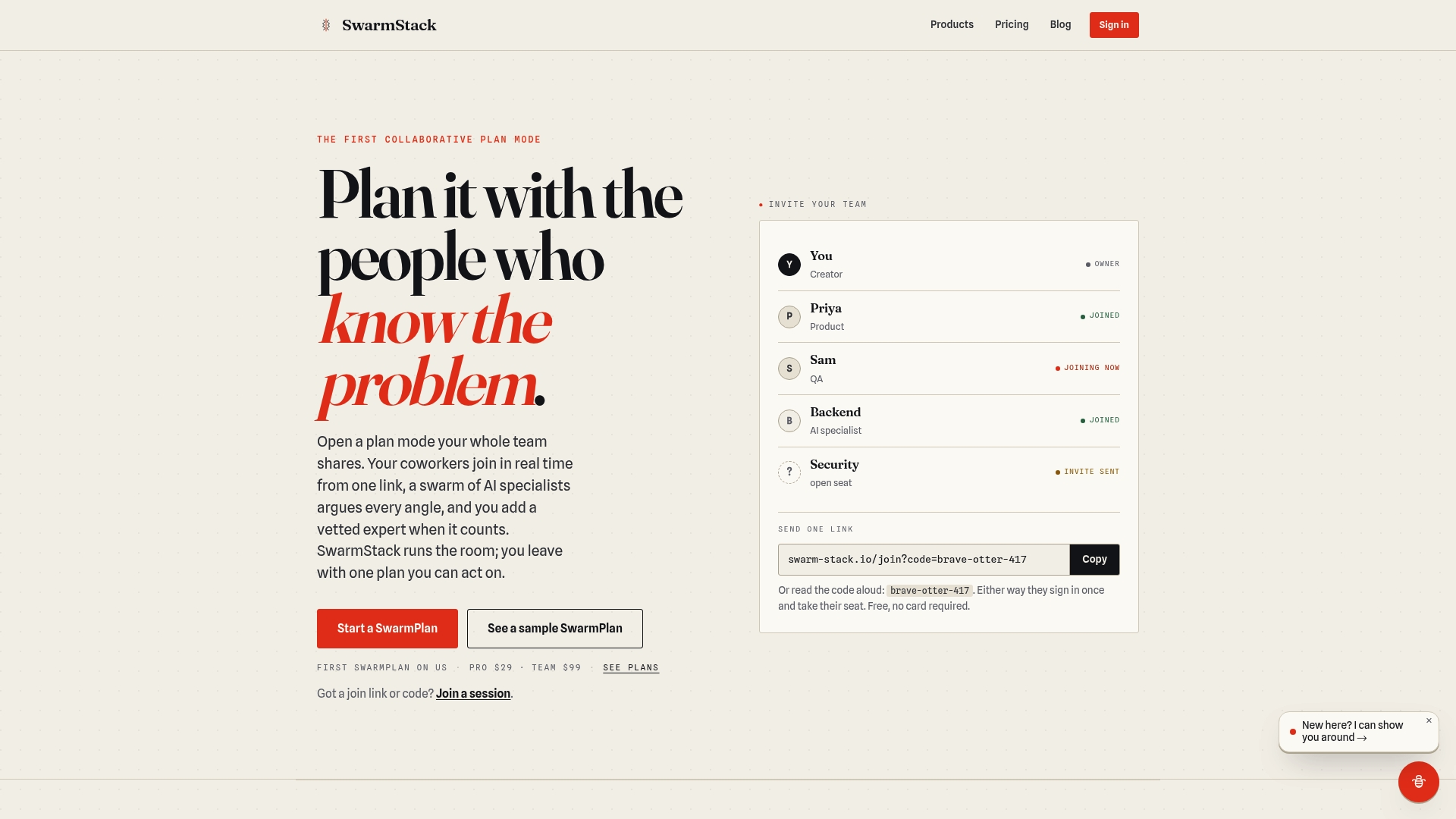
Two reasons to run a pilot now: sessions start with a single invite link (no IT setup, no onboarding delay), and the integrated expert marketplace means you can bring in a vetted domain specialist the same day you start. The deliverable you get at the end of a session is ready to implement, not ready to be revised for another two weeks.
Start a trial on Swarm-stack and run your first AI-assisted roadmap session this week. For teams evaluating RFP workflows specifically, the AI RFP guide for project managers walks through exactly how to structure that session.
Useful sources and further reading
- Swarm-stack product landing page — Full overview of the AI + human expert session model, invite-link sharing, and export capabilities. Start here before your pilot.
- Swarm-stack trust and data privacy page — Security controls, data handling, and enterprise readiness details for procurement and legal reviewers.
- AI project management tools guide — Technical context on AI-assisted features and how to evaluate vendor AI claims during a trial.
- RFP for software development guide — Step-by-step advice on producing buyer-side RFPs; use this alongside the trial checklist when your pilot output needs to feed a procurement process.
- Jira Product Discovery — Atlassian's native discovery and prioritization tool; useful reference for teams evaluating Jira-native roadmapping as an alternative approach.