DACI vs RACI: A Project Manager's Guide to Choosing Right
Discover how DACI and RACI frameworks help project managers make decisions and assign tasks effectively for smoother workflows.

Use DACI when a group is stuck making a decision. Use RACI when the decision is already made and you need to track who does the work. DACI names one Approver who breaks ties on a specific call, like which vendor to sign or which feature ships first. RACI assigns one Accountable owner per task across a project's execution.
A few fast rules before you dig in:
- If the question is "what should we do," reach for DACI.
- If the question is "who does this and by when," reach for RACI.
- If you're arguing about who gets a vote, you probably need both.
The two aren't rivals. A clean workflow runs DACI first to make the call, then RACI to execute it, and most of the confusion between them disappears once you stop treating them as competing systems.
Key Takeaways
DACI resolves a specific decision through a single Approver, while RACI assigns execution ownership through a single Accountable person per task.
| Point | Details |
|---|---|
| Match the framework to the problem | Use DACI for stalled decisions, RACI for unclear task ownership. |
| Cap the top role at one person | One Approver in DACI, one Accountable per task in RACI, prevents diffusion of responsibility. |
| Name people, not departments | Assigning roles to teams instead of individuals is a leading cause of DACI and RACI failure. |
| Run them in sequence | Use DACI to make the call, then RACI to manage the rollout. |
| Track roles in a shared system | Swarm-stack assigns roles to named people and keeps versioned decision records so matrices don't go stale. |
Table of Contents
- DACI vs RACI: What DACI Actually Means
- How to Build a DACI Matrix Step by Step
- What Is RACI and How Does It Differ From DACI?
- How to Build a RACI Matrix
- Daci vs Raci: Side-by-Side Comparison
- How to Choose Between DACI and RACI
- Why DACI and RACI Charts Fail in Practice
- Copyable DACI and RACI Templates
- Where RAPID and Other Frameworks Fit
- How Teams Actually Adopt These Frameworks
- Put DACI and RACI Into a System, Not a Slide Deck
- Frequently Asked Questions
- Sources
DACI vs RACI: What DACI Actually Means
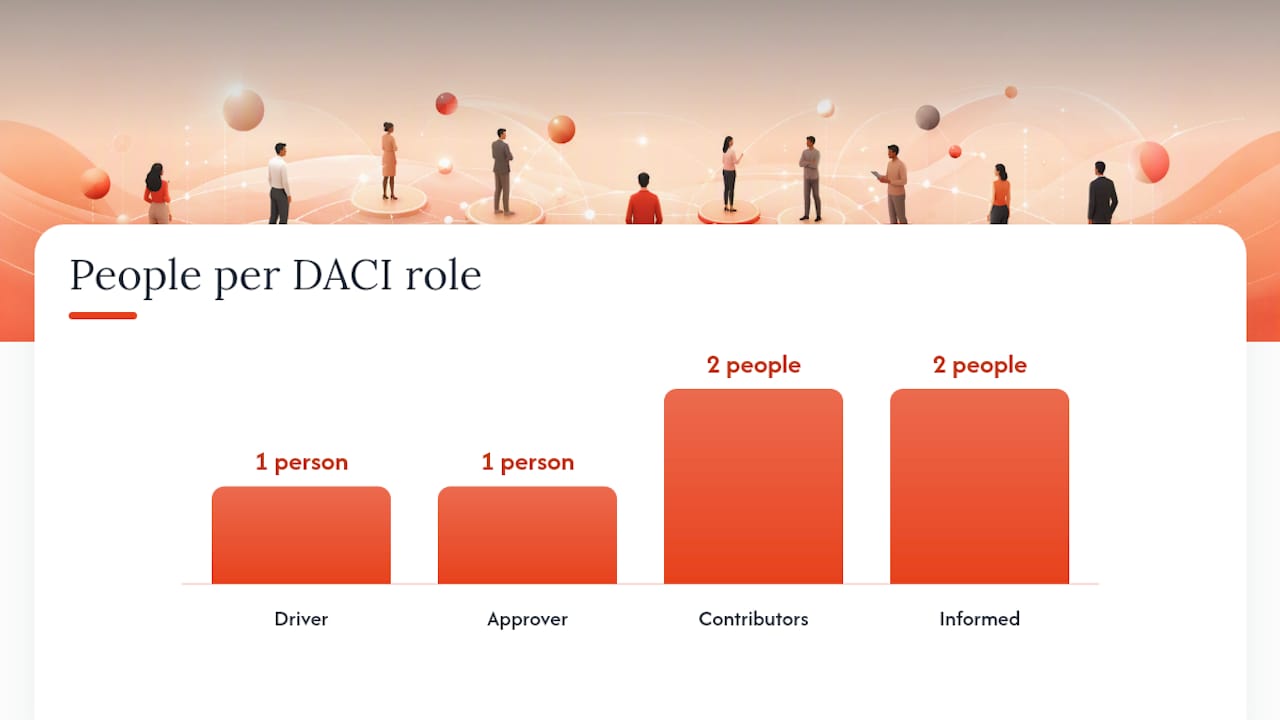
DACI is a decision framework built around four roles: Driver, Approver, Contributor, and Informed. It exists to answer one question cleanly: who has the final say on this specific decision? That's the whole point of the model. It doesn't manage a project's tasks. It manages the moment a group needs to stop debating and commit.
Here's how the roles break down in practice:
- Driver: Owns the process. Schedules the meeting, gathers input, keeps the timeline moving, and pushes toward a decision date.
- Approver: Makes the final call. DACI works best with exactly one Approver. Two Approvers usually means you've rebuilt the very deadlock the framework was supposed to prevent.
- Contributor: Brings expertise or data to the table. Multiple Contributors are normal and healthy.
- Informed: Told the outcome after the fact. No vote, no veto, just visibility.
DACI's biggest strength is speed with accountability. When everyone knows there's a single Approver, meetings stop circling and start converging. The framework got its start at Intuit, where product teams needed a repeatable way to resolve cross-functional disagreements without escalating every decision to a VP.
The limits show up when teams overuse it. Assigning a DACI matrix to a decision like "what color should this button be" burns time on ceremony a two-line Slack message could handle. The other common failure: naming a team as Approver instead of a person, which quietly recreates the committee problem DACI was built to solve.
Pro Tip: If your Approver keeps saying "let me check with my team" before deciding, you don't have an Approver. You have another Contributor with a fancier title.
How to Build a DACI Matrix Step by Step
Building a DACI matrix takes less time than most teams expect once the decision itself is framed clearly.
- Write the decision as a single sentence. "Which CRM do we adopt for the sales team in Q2" works. "How do we improve sales" does not.
- List everyone with a stake in the outcome.
- Assign one Driver to run the process and one Approver to make the final call.
- Assign Contributors for domain expertise, and route everyone else to Informed.
- Set a decision date and list what input the Approver needs before that date arrives.
A mini example for a vendor decision:
| Role | Person | Notes |
|---|---|---|
| Driver | Priya (Ops Lead) | Runs vendor demos, compiles feedback |
| Approver | Marcus (VP Sales) | Signs off on final vendor |
| Contributor | Sales team, IT security | Feedback and compliance review |
| Informed | Finance, Customer Success | Notified once signed |
For Agile teams applying DACI to sprint planning or roadmap prioritization, keep the matrix lightweight. A sticky note with four names works fine for a sprint-level call; save the formal spreadsheet for decisions with real budget or cross-team impact.
Pro Tip: Name actual people, never "Engineering" or "the design team." A role assigned to a department is a role nobody actually owns.
What Is RACI and How Does It Differ From DACI?
RACI assigns four roles across tasks and deliverables: Responsible, Accountable, Consulted, and Informed. Where DACI answers "who decides," RACI answers "who does what, and who answers for it" once execution is underway.
The roles:
- Responsible: Does the work. A task can have several Responsible people.
- Accountable: Owns the outcome and signs off that it's done right. Best practice caps this at one person per task, mirroring DACI's single-Approver rule.
- Consulted: Gives input before or during the work, typically through two-way conversation.
- Informed: Kept in the loop after the fact, one-way communication only.
PMI frames RACI as a core tool for stakeholder role clarity and communication planning across a project's lifecycle, which is why it shows up in nearly every PMO template library. Its strength is precision at the task level: when a deliverable slips, a good RACI chart tells you in seconds who was supposed to catch it.
The limits are just as real. Teams tend to overload the Consulted and Informed columns until the chart lists half the company on every row, which slows reviews instead of speeding them. The other frequent breakdown: blurring Responsible and Accountable into the same vague "owner" label, so when something goes wrong, two people each assume the other one had it covered.
Pro Tip: If a task has two Accountable names, you don't have double coverage. You have a task nobody will actually own when it's overdue.
How to Build a RACI Matrix
A RACI matrix is a grid: tasks down the rows, people across the columns, one letter per cell.
- List every task or deliverable in the project, broken down to a level someone can actually be accountable for.
- List every stakeholder who touches the work in any capacity.
- Assign R, A, C, or I in each cell. Every task needs exactly one A. Most need at least one R.
- Scan for conflicts — rows with zero Accountable, rows with two, or columns where one person is Consulted on everything.
- Review with the team and update it as scope shifts, because a RACI chart that's a month stale is worse than no chart at all.
A compact example for a feature launch:
| Task | PM | Engineer | Designer | Marketing |
|---|---|---|---|---|
| Write spec | A | C | R | I |
| Build feature | I | R/A | C | I |
| Launch messaging | C | I | C | R/A |
The most common mistake is padding the chart with unnecessary Consulted and Informed tags until it reads like a company org chart rather than a working document. Keep it tight. If a stakeholder doesn't need to weigh in or be notified, leave the cell blank.
Daci vs Raci: Side-by-Side Comparison
| Dimension | DACI | RACI |
|---|---|---|
| Primary use case | A specific decision | Ongoing work and deliverables |
| Who owns the outcome | Approver (one person) | Accountable (one person per task) |
| Who drives the process | Driver | Responsible (can be several people) |
| Roles per person/task | One Approver, multiple Contributors | One Accountable, multiple Responsible |
| Best for | Cross-functional calls, vendor choices, prioritization | Task handoffs, project execution, recurring workflows |
| Main strength | Fast, unambiguous decisions | Clear ownership across many moving parts |
| Main weakness | Overkill for small decisions | Bloats fast with too many Consulted/Informed |
The purpose row is the one people misread most: DACI is a decision-day tool, RACI is a project-length tool. Confusing the two is why teams end up building a RACI chart for "should we rebrand" or a DACI matrix for "who updates the changelog."
Ownership works differently, too. DACI's Approver holds veto power on a single call. RACI's Accountable owns a deliverable's quality but rarely has unilateral authority to override the whole project.
- Role counts follow the same logic in both frameworks: cap the top authority at one person, let contribution roles scale up freely.
- Best-fit scenarios split cleanly along team size and decision complexity, but the split is about the nature of the problem, not the size of the team.
How to Choose Between DACI and RACI
Run through three questions before picking a framework:
- Are we stuck on a decision, or stuck on execution? A stalled debate needs DACI. A missed deadline needs RACI.
- Is there a single approver, or does authority feel scattered? If nobody can name who has final say, that's a DACI gap.
- Does the problem span multiple tasks and handoffs? That's RACI territory, especially on multi-week or multi-team projects.
Map that against a few realistic scenarios:
- Vendor selection: DACI. One Approver picks the vendor after Contributors weigh in on price, security, and fit.
- Product prioritization: DACI. Cross-functional input matters, but someone has to break the tie between competing roadmap bets.
- Rollout implementation: RACI. Once the vendor or feature is chosen, execution spans engineering, support, and marketing, each needing clear task ownership.
- Sprint-level tasks: RACI, kept lightweight. A backlog ticket doesn't need a Driver and Approver; it needs one Responsible and one Accountable.
- Cross-team reorg decision: DACI, followed immediately by RACI once the new structure is approved and needs staffing.
The hybrid workflow covers most real projects: run DACI to get through the decision gate, then hand the approved outcome into a RACI chart for rollout. This sequencing works because the two frameworks solve adjacent but distinct problems rather than competing for the same job. Teams that try to force one framework to do both jobs usually end up with a matrix that's either too rigid for fast decisions or too vague for execution tracking.
Why DACI and RACI Charts Fail in Practice
Most failures trace back to the same handful of habits.
- Multiple Approvers or Accountables. The single most common failure in both frameworks. Fix it by forcing a name, not a group, into that slot before the matrix gets shared.
- Assigning roles to departments instead of people. Naming an individual rather than a team prevents the diffusion of responsibility that kills follow-through.
- Over-consulting. A RACI chart with ten Consulted names on every row creates bureaucracy instead of clarity. Trim the list to people whose input actually changes the outcome.
- Matrix paralysis. Spending more time debating the chart than doing the work it describes. If building the matrix takes longer than the task itself, skip it.
- No role-check after failure. When a decision stalls or a deliverable slips, go back to the matrix first. Nine times out of ten, the role that failed was ambiguous from the start.
Pro Tip: Run a five-minute role-check after any missed deadline: pull up the matrix and ask who was actually Accountable. If the answer takes more than a few seconds, that's your real root cause.
Teams managing multi-vendor projects often run into these same ownership gaps during proposal evaluation. A structured risk assessment process can help surface where responsibility is unclear before it becomes a missed deadline.
Copyable DACI and RACI Templates
Paste these directly into a doc or spreadsheet.
DACI template (decision-level): Decision: _______ | Driver: _______ | Approver: _______ | Contributors: _______ | Informed: _______ | Decision date: _______
RACI template (task-level): Task: _______ | Responsible: _______ | Accountable: _______ | Consulted: _______ | Informed: _______
Two quick mappings: choosing a vendor fits the DACI template directly, with the Approver's name filling the decision-date deadline. Launching a feature fits the RACI template, with each build and QA task getting its own row.
- Store matrices somewhere the whole team can see, not buried in a single person's inbox.
- Version them. A decision matrix from three months ago should stay visible even after a new one replaces it.
- For technical rollouts, an RFI-style tracking structure pairs well with a RACI chart once execution begins.
Where RAPID and Other Frameworks Fit
RAPID (Recommend, Agree, Perform, Input, Decide) works like DACI's more granular cousin, splitting "Approver" into separate Agree and Decide roles. It's built for organizations with layered sign-off chains, like large enterprises where legal, finance, and an executive all need distinct checkpoints before a decision closes.
RASCI and ARCI are minor variants of RACI, usually adding a "Support" role to distinguish people who help execute from people who are simply Consulted. They solve a narrow gap, not a different problem.
Pick one framework per decision type and stick with it. Running DACI, RACI, and RAPID simultaneously on the same project creates more confusion than the ambiguity any single framework was meant to fix.
How Teams Actually Adopt These Frameworks
The gap between how DACI and RACI look on a template and how they perform in a real team almost always comes down to naming, not the framework itself. Teams that succeed pick one person per top role and defend that choice even when it's uncomfortable. Teams that struggle let "the team" stay listed as Approver for months because nobody wants to have the conversation about who actually holds that authority.
Documentation overhead is the tradeoff nobody mentions upfront. A DACI matrix that lives in someone's notes helps nobody after the meeting ends. Measuring success isn't about whether the chart exists, it's about whether someone can point to it three weeks later and still know who owns what.
Put DACI and RACI Into a System, Not a Slide Deck
A spreadsheet works until three people edit it at once and nobody's sure which version is current. That's the real failure point behind most DACI and RACI breakdowns: not a bad framework choice, but a matrix that lives in someone's local file and goes stale the moment the project moves.
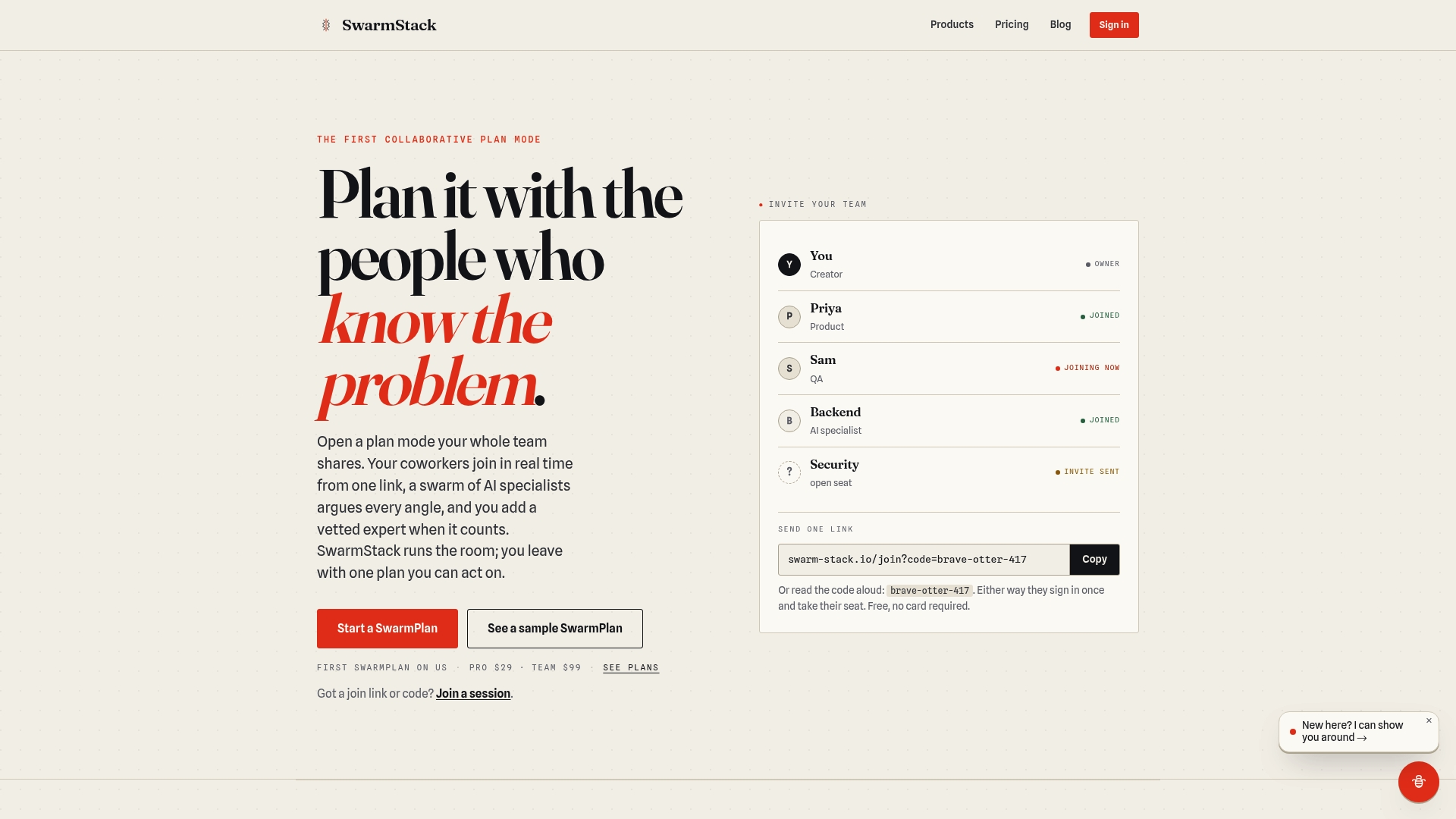
Swarm-stack builds decision tracking into the planning process itself. Role assignments go to named people, not departments, and every decision gets a versioned record instead of a Slack thread nobody can find later. When a DACI-style decision needs to hand off into execution work, teams can export the resulting plan straight to tools like GitHub or Jira, so the RACI-style task breakdown doesn't require rebuilding the matrix from scratch. If your team keeps losing track of who approved what and who's supposed to build it, start a planning session on Swarm-stack and see how the role and decision history holds up after the first revision round.
Frequently Asked Questions
Is DACI better than RACI? Neither is universally better. DACI fits decisions with one clear outcome to approve; RACI fits ongoing work with many tasks and handoffs. Most projects need both at different stages.
Can DACI and RACI be used together? Yes, and it's often the strongest approach. Run DACI to make a decision, then build a RACI chart to assign the execution work that follows.
How is RAPID different from DACI? RAPID splits approval into separate Agree and Decide roles, which suits organizations with multiple layers of sign-off. DACI keeps approval concentrated in a single person, making it faster for most team-level decisions.
What's the biggest mistake teams make with RACI? Assigning more than one Accountable per task, or overloading the Consulted column with people who don't need to weigh in. Both slow the chart down instead of speeding decisions up.
Does DACI work for small decisions? Not usually. Building a full DACI matrix for low-stakes calls adds overhead the decision doesn't need. Save it for cross-functional or high-impact choices.
Sources
- DACI Decision-Making Framework: Everything You Need to Know
- Best practices for managing people and quality (PMI)
- RACI vs DACI: Key Differences, Examples & When to Use Each (Invensis Learning)