How to Write a Bid Proposal That Wins in 2026
Discover how to write a bid proposal that wins in 2026. Follow key steps to impress buyers and secure more projects effectively.

A bid proposal is a formal, structured response to a buyer's Invitation to Tender (ITT) or Request for Proposals (RFP). Its job is simple: convince evaluators that your team is the right choice by demonstrating capability, methodology, pricing, and compliance, in exactly the format the buyer requested. The bid writing process covers nine stages from opportunity identification through submission, and skipping any one of them shows up in your score.
Writing a bid proposal that actually wins comes down to one discipline: follow the buyer's evaluation framework, not your instinct to tell your company's story. Electronic submission is now standard across federal, state, and local procurement. A quality bid proposal includes:
- Accurate contact information for both parties
- A detailed project description and defined scope
- A clear timeline with milestones and client review phases
- A transparent, itemized budget
- Company qualifications, certifications, and relevant case studies
- Signed terms and conditions
- All mandatory attachments in the specified file formats
Table of Contents
- What does a compliant bid proposal include?
- How to write a bid proposal evaluators actually score
- Formatting and submission practices that keep you in the running
- Common mistakes that sink otherwise capable bids
- How to research the buyer's needs before you write
- How to match your language and tone to the buyer
- How to differentiate your bid within the proposal itself
- How to present your pricing strategy clearly
- How to use supporting documentation effectively
- How to review and edit before you submit
- Key Takeaways
What does a compliant bid proposal include?
Every element below has a purpose. Miss one and you risk disqualification before an evaluator reads a word of your methodology.
- Contact information: Full legal names, addresses, phone numbers, and emails for both the buyer and your organization. The New York State Office of General Services procurement guidelines treat contact accuracy as a baseline compliance requirement.
- Project description and scope: Define the work, deliverables, and boundaries precisely. Evaluators use this section to confirm you understood the brief.
- Timeline: Lay out key milestones and phase durations. Factor in client feedback loops so review cycles don't become delay risks.
- Budget breakdown: Itemize labor, materials, overhead, and margin. Vague lump sums raise red flags; line-item transparency builds trust.
- Qualifications and case studies: List relevant certifications and name comparable projects with measurable outcomes.
- Terms and conditions: Spell out payment terms, change-order procedures, and termination clauses. Both parties sign.
- Attachments: Submit every required document in the specified format. Missing attachments are grounds for automatic rejection.
How to write a bid proposal evaluators actually score
Evaluators are overworked. They are reading your submission alongside a dozen others, looking for the fastest path to a confident score. Writing for the evaluator means structuring every answer so the key points are visible immediately and the evidence is right behind them.
The most reliable framework for doing that is Answer, Method, Evidence, Benefit (AMEB). The AMEB approach works like this: open with a direct statement that answers the question, describe your methodology with named people and processes, support the claim with quantified evidence, then state the buyer benefit explicitly.
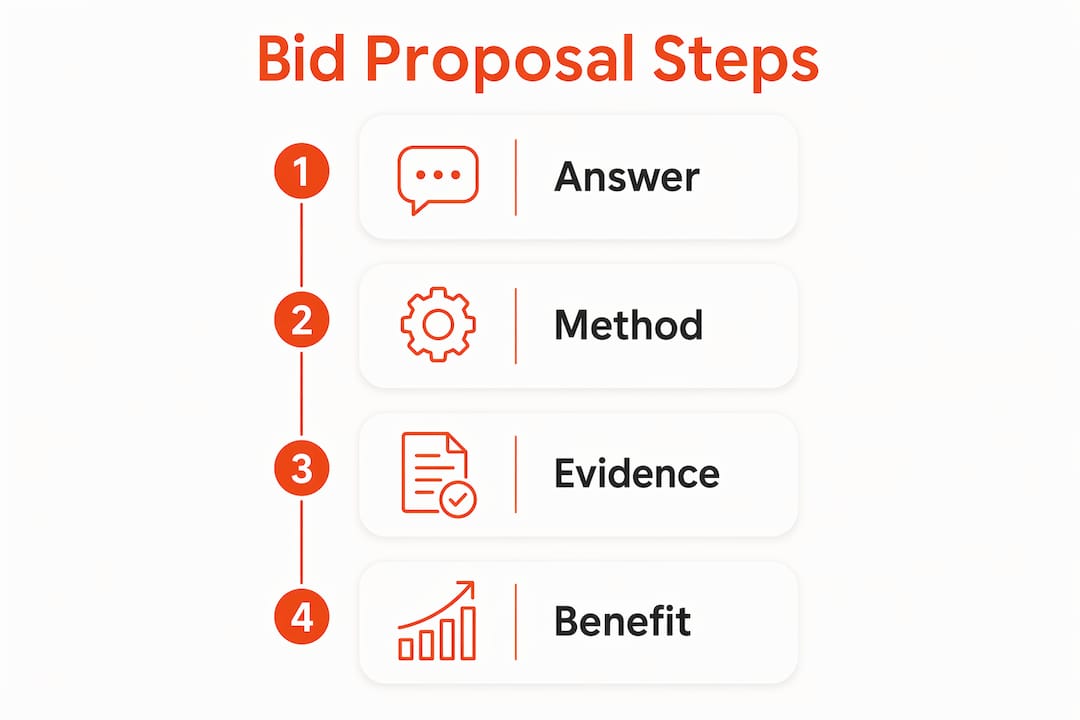
Before you write a single word, storyboard each question. Map the answer, the evidence you'll use, and who owns each section. Storyboarding surfaces evidence gaps before they become scoring gaps.
Mirror the buyer's language throughout. If the RFP says "stakeholder engagement," your response says "stakeholder engagement," not "client communication." Evaluators score against criteria, and terminology alignment signals you read the document carefully.
Pro Tip: Edit your first draft ruthlessly. Remove every sentence that doesn't advance the answer, support a claim, or reinforce a win theme. Concise writing signals the same organizational discipline buyers want to see in contract delivery.
Formatting and submission practices that keep you in the running
Formatting is not cosmetic. A poorly structured document forces evaluators to hunt for answers, and that friction costs marks.
- Follow the buyer's word counts and page limits exactly. Going over signals you can't follow instructions; going significantly under suggests thin content.
- Use clear headings, short sentences, and bullet points to make key information scannable.
- Compile all mandatory attachments before the writing phase so nothing gets missed at the deadline.
- Include a pricing narrative alongside your cost breakdown. Numbers without context invite skepticism; a brief explanation of your cost drivers removes it.
- Submit electronically at least 24 hours before the deadline. Late or incomplete submissions are automatically disqualified on most public procurement portals.
- Save your submission confirmation. If the portal has issues, that confirmation is your evidence of timely filing.
- Use version control on all documents. Teams working across multiple files need a single source of truth to avoid submitting an outdated draft.
For technology-focused procurements, the RFP response software guide from Swarm-stack covers platform-specific submission requirements in detail.
Common mistakes that sink otherwise capable bids
Most losing bids don't fail because the team lacked capability. They fail because of avoidable errors in execution.
- Skipping document analysis: Reading the specification once is not enough. Read it forensically, looking for high-weighted criteria and compliance obligations that create disqualification risk.
- Answering vaguely: Opening with company history instead of a direct answer to the question wastes word count and earns no marks. Evaluators score what the question asked for.
- Unsubstantiated claims: "We have extensive experience" is not evidence. Replace every vague claim with a named case study and a quantified outcome.
- Generic responses: Boilerplate content is immediately identifiable to experienced evaluators. Every answer requires targeted adaptation to this buyer, this contract, and this question.
- Late or non-compliant submission: Missing the deadline or submitting in the wrong file format results in automatic disqualification regardless of content quality.
- Overloading with background: Company history sections that run for pages crowd out the methodology and evidence evaluators actually need.
How to research the buyer's needs before you write
The best bid responses start weeks before the first word is written. Pull every public document the buyer has released: the specification, evaluation criteria, scoring matrix, prior contract notices, and any published strategy documents. Look for the language they use to describe success, the risks they flag, and the outcomes they prioritize.

If the procurement allows clarification questions, use them. A well-targeted question signals engagement and can surface information that gives your response a structural advantage. Cross-reference the buyer's published annual reports or strategic plans to understand their organizational context. A response that references the buyer's stated priorities by name reads as genuinely tailored, not generic.
How to match your language and tone to the buyer
Tone follows the buyer's register. A federal agency procurement calls for precise, formal language. A startup-adjacent technology RFP may tolerate a more direct, conversational style. Read the RFP itself as a tone guide.
Use the buyer's exact terminology for roles, deliverables, and processes throughout your response. Avoid internal jargon your organization uses but the buyer doesn't. Plain, confident language outperforms elaborate prose every time, because clarity is what lets evaluators award marks quickly.
How to differentiate your bid within the proposal itself
Differentiation happens at the evidence level, not the claim level. Specific, quantified, verifiable proof points are what separate winning bids from the rest. Name the project, state the outcome in numbers, and draw an explicit parallel to the contract being bid.
Win themes help too. Develop two or three themes that reflect your genuine competitive strengths relative to this buyer's priorities, then weave them consistently across every answer. Evaluators reading the full submission notice coherence, and coherence signals a team that thinks strategically.
How to present your pricing strategy clearly
Price is evaluated, not just compared. A transparent pricing narrative explains your cost drivers, demonstrates you understand the scope, and shows your margin is reasonable. For construction and infrastructure bids, cost benchmarking methods can anchor your figures to market norms and strengthen credibility.
Decide early whether a fixed price, phased pricing, or a time-and-materials structure fits the project. Whichever you choose, show your working. An itemized breakdown with a brief rationale for each line is harder to challenge than a single total.
How to use supporting documentation effectively
Attach only what the buyer asked for, plus any evidence that directly supports a scored criterion. Unsolicited appendices rarely get read and can obscure the documents evaluators need to find quickly.
For automating proposals and managing evidence libraries, Swarm-stack's collaborative platform lets teams tag case studies, certifications, and performance data to specific questions during the storyboarding phase, so evidence never gets attached as an afterthought.
How to review and edit before you submit
Run two distinct review passes. The first is a compliance check: does every mandatory section exist, does every attachment appear, and does the formatting match the buyer's instructions? The second is a criteria-led review: does each answer address every element of the question, carry specific evidence, and state a clear buyer benefit?
Review every answer against the evaluation criteria before uploading a single file. Read the edited version aloud. Sentences that are too long or too complex become immediately apparent when spoken. A fresh reader who wasn't involved in writing the bid should do a final pass for clarity.
Key Takeaways
A compliant, evaluator-focused bid proposal built on the AMEB framework, specific evidence, and disciplined submission practices consistently outperforms capable competitors who neglect process.
| Point | Details |
|---|---|
| Follow the evaluation framework | Structure every answer to the buyer's criteria; content that misses the question earns no marks. |
| Use the AMEB framework | Open with a direct answer, then deliver methodology, quantified evidence, and buyer benefit in sequence. |
| Storyboard before writing | Map each question's answer, evidence, and owner before drafting to prevent gaps and disjointed responses. |
| Submit at least 24 hours early | Late or incomplete electronic submissions are automatically disqualified on most procurement portals. |
| Replace claims with proof | Named case studies with measurable outcomes outperform vague capability statements in every scoring round. |
Swarm-stack brings together AI specialists and human experts in real-time collaborative sessions, so your team can build compliant, evidence-rich bid proposals without the coordination overhead. Every session produces a versioned, ready-to-submit deliverable. Explore what SwarmRFP can do for your next procurement at swarm-stack.io.