Hiring Managers: Hire Subject Matter Experts with a One Sentence Brief
Playbook for hiring managers: craft a one sentence brief, vet SMEs by outcomes, set a 30 day mandate, and reuse SwarmStack session templates to get...

To hire a subject matter expert who actually delivers, write a one-sentence brief describing the business question, shortlist candidates by comparable outcomes rather than resumes, vet their process in an interview, and lock a 30-day mandate before any money changes hands. The single next move: draft that one-sentence question right now and send it to whoever owns the budget.
TL;DR:
- Writing a clear, one-sentence business question with measurable outcomes is essential before sourcing or engaging a subject matter expert.
- Clearly distinguishing whether you need a technical SME or a strategic consultant can save time and money during the hiring process.
- Internal talent should be prioritized for niche skills, but external expert networks or credible publications are valuable for specialized needs.
- Asking process-based and impact questions during interviews helps identify genuine expertise, not just credentials or vague claims.
- A structured 30-day onboarding and vetting process ensures the SME delivers actionable results and maintains decision rights.
Table of Contents
- How to Hire Subject Matter Experts: A Step-by-Step Process
- What to Include in a Subject Matter Expert Job Description
- Where to Find Subject Matter Experts for Specialized Work
- What Questions Should You Ask a Subject Matter Expert?
- Compensation Models and Contract Terms for SME Engagements
- Onboarding a Subject Matter Expert: The First 30 Days
- SwarmStack Session Templates You Can Reuse Today
- Where Hiring Managers Actually Lose the Thread
- Run Your Next SME Session Through SwarmStack
- Sources
How to Hire Subject Matter Experts: A Step-by-Step Process
Most SME hires go sideways before the interview even happens. The mandate is vague, the success metric is fuzzy, and three weeks later everyone is arguing about whether the expert "did a good job" with no way to check. A precise mandate fixes that problem before it starts, and it costs you fifteen minutes.
Here's the sequence that actually works, in order:
- Write the one-sentence brief. State the business question the SME needs to answer, not the general topic area. "Should we migrate our payment processing to a new vendor by Q2, and if so, which one?" beats "help with payments strategy" every time. Attach three measurable outcomes you'll use to judge success: a decision memo, a cost model, a vendor recommendation with risk flags, for example.
- Set three to five must-have criteria tied to outcomes, not titles. Skip "10+ years in fintech." Ask instead: has this person led a payment migration under regulatory constraints similar to yours? Coursera's definition of a subject matter expert as someone with deep, domain-specific knowledge built through hands-on experience is the right frame here. You're not hiring a title. You're hiring someone who has solved your exact problem before.
- Decide whether you need an SME or a consultant. This distinction gets skipped constantly, and it wastes money. An SME brings narrow, deep technical knowledge and can explain the "how." A consultant integrates that knowledge into broader strategy and implementation. If your problem is "we don't understand this technical domain," hire an SME. If it's "we understand the domain but can't execute the change," hire a consultant, or both.
- Build a sourcing plan with a real timeline. Give yourself five business days to build a shortlist of five to eight names, two days to screen down to three, and one round of structured interviews before you make an offer. Set a decision gate at each stage. If you don't have three viable names after five days, widen the channel instead of lowering the bar.
- Move fast from shortlist to offer, but don't skip the vetting. Speed and rigor aren't opposites here. The bottleneck in most hiring processes is scheduling, not evaluation. Batch your interviews into a single week, and have your rubric ready before the first call so you're not improvising judgment calls after the fact.
The order matters more than most hiring managers assume. Skipping straight to sourcing without the one-sentence brief is the single most common reason engagements end in a vague deliverable nobody can use.
What to Include in a Subject Matter Expert Job Description
A bloated job posting attracts bloated applications. The fix is a description built around outcomes, access, and decision rights, not a wish list of adjectives.
Every SME brief, whether it's a short consulting engagement or an embedded hire, needs:
- The core question, stated as a single sentence, not a paragraph of context.
- Concrete deliverables, named specifically: a decision memo, a prioritized roadmap, a technical audit with findings ranked by risk.
- Timeline, including the hard deadline and any interim checkpoints.
- Access, meaning which systems, documents, and people the expert can reach without waiting on approvals.
- Decision rights, spelling out whether the SME recommends or decides, and who signs off.
- Success metrics, the same three measurable outcomes from your brief, restated so applicants self-select.
- Experience phrased as comparable outcomes, such as "led a similar migration under a comparable regulatory constraint," instead of years-of-experience thresholds.
A short consulting brief for a single 60-minute strategy session looks different from an embedded three-month hire. The first needs a tight problem statement and a pre-shared document packet. The second needs onboarding logistics, reporting cadence, and a clear handover plan built in from day one.
Where to Find Subject Matter Experts for Specialized Work
The channel you pick should match how niche the skill is and how fast you need the answer.
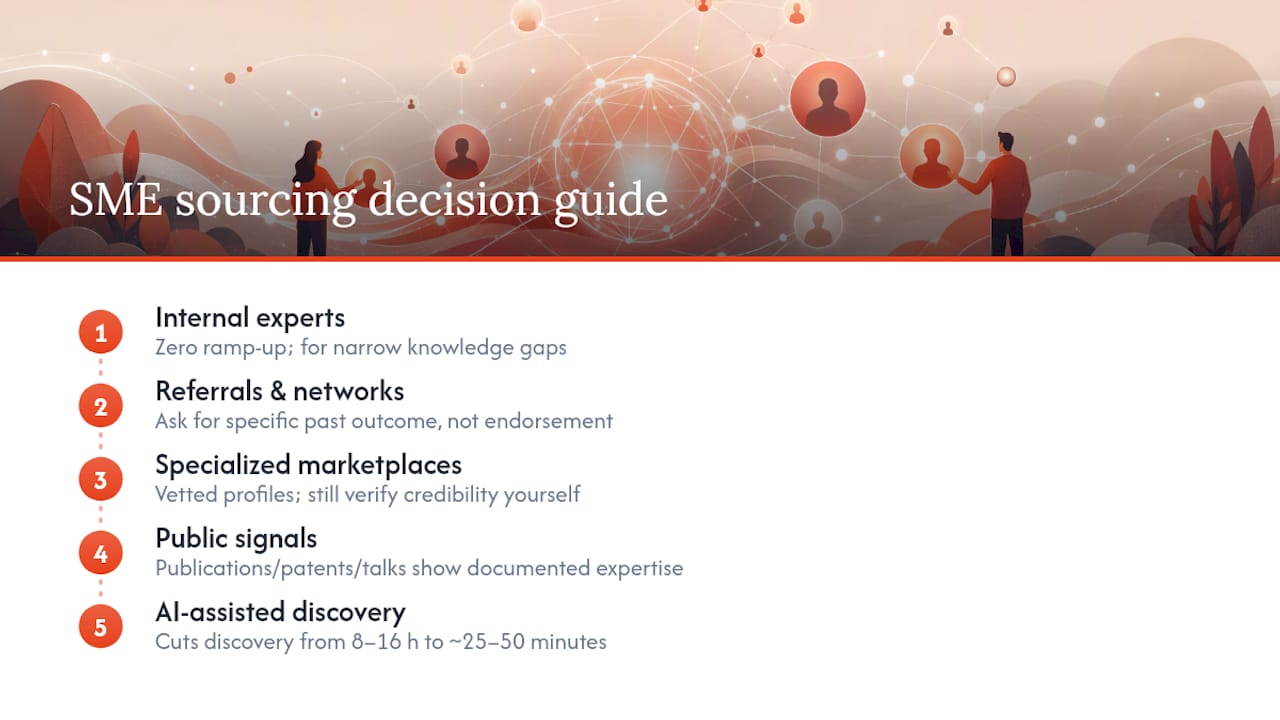
Start inside your own walls. Internal experts already understand your systems, your politics, and your constraints, which cuts the ramp-up time to zero. Use internal talent when the knowledge gap is narrow and someone close to it already exists; go external when the domain is genuinely outside your team's experience or when neutrality matters more than institutional context.
Referrals and professional networks come next. Ask a trusted contact who they'd hire for this exact problem, not who they know generally. The signal you want is a specific past outcome, not a vague endorsement.
Specialized marketplaces and expert networks fill the gap for niche technical needs. These platforms often provide vetted profiles and prior engagement history, but credibility still needs verification on your end. Don't outsource judgment to a platform's badge system.
Public signals work well for highly specialized or academic fields. Publications, patents, conference talks, and citation counts point you toward people whose expertise is documented, not just claimed. AI-assisted discovery tools now aggregate exactly these signals, and The Pedowitz Group reports discovery and vetting workflows shrinking from an 11-step, 8 to 16-hour process down to roughly 25 to 50 minutes when tooling scores fit and credibility automatically.
When you reach out cold, lead with the one-sentence question, not a job description. Busy experts respond to a sharp problem faster than a recruiting pitch, and asking about availability upfront saves both sides a wasted call.
What Questions Should You Ask a Subject Matter Expert?
The interview is where most hiring managers get fooled, mainly because they ask about credentials instead of process. A strong SME can walk you through exactly how they moved from a messy problem to a specific recommendation. A weak one talks in generalities.
Run the screening in this order:
- Check the screening basics first. Ask for one comparable assignment, one reference who can confirm the outcome, a plain-language description of their process, and their willingness to show a redacted work sample.
- Ask diagnostic questions. "Walk me through how you'd approach this problem in the first week." Listen for a structured method, not a list of buzzwords.
- Ask method questions. "What artifacts do you typically produce, and how do you move from diagnosis to a prioritized recommendation?" This is where you separate someone who genuinely has a repeatable process from someone improvising in real time.
- Ask impact questions. "Describe a comparable assignment: what was the obstacle, what did you do, and what changed as a result?" Vague answers here are the biggest red flag in the entire interview.
- Run the reference check with targeted questions. Don't ask "would you rehire them?" Ask "what specifically changed in your business because of their work, and how long did it take?"
Isixsigma's framing of SMEs as deep technical specialists versus consultants as strategic integrators is useful again here: your questions should test which one you're actually interviewing. Consultingheads' guidance backs this up directly, recommending you ask experts to describe the obstacle, the action taken, and the measurable outcome rather than accepting a credentials list at face value. If you want a ready-made bank of stakeholder questions to pair with this rubric, SwarmStack's stakeholder interview question guide covers the adjacent ground of prepping internal voices before the SME session. For technical roles specifically, Evy's breakdown of interview question types is a solid complement for structuring the diagnostic round.
Pro Tip: Ask every finalist the exact same impact question, word for word. Comparing answers side by side surfaces the difference between someone who solved your problem before and someone who's good at sounding like they did.

Compensation Models and Contract Terms for SME Engagements
Pay structure should match the shape of the work, not habit. An hourly rate suits ambiguous, exploratory work where scope shifts. A day rate fits short, intensive engagements like a single strategy session. Fixed-scope pricing works when deliverables are locked and specific. A retainer makes sense only when you need ongoing access over months, not a one-time answer.
Benchmark pay using market data for the specific role type. ZipRecruiter's salary data for subject matter expert consultants is a reasonable starting point, but cross-check it against comparable outcomes, not just job titles, since "SME" covers wildly different pay bands depending on domain.
Every contract needs:
- Specific, named deliverables tied to your success metrics
- Clear IP and ownership terms for anything the SME produces
- A confidentiality clause covering the documents and systems you'll grant access to
- Cancellation terms that protect both sides if the mandate changes
- Acceptance criteria defining exactly what "done" looks like
Onboarding a Subject Matter Expert: The First 30 Days
Send the pre-engagement package before day one: relevant documents, system access, a stakeholder list, and the one-sentence brief restated in writing. Skipping this step is the single biggest cause of a wasted first week.
Build checkpoints into the calendar from the start:
- Two-week checkpoint: the SME should have a working diagnosis and a first draft of the deliverable structure.
- 30-day checkpoint: you should have the actual deliverable, whether that's a decision memo, a prioritized roadmap, or a technical audit, plus a clear handover conversation.
- Decision rights confirmed upfront, since an SME without internal authority to act on findings produces a report nobody uses.
- Named internal owner assigned before the engagement ends, so the deliverable doesn't sit in an inbox once the contract closes.
SwarmStack Session Templates You Can Reuse Today
SwarmStack's session structure mirrors exactly what makes SME time productive: a focused pre-brief, a tight 60-minute working session, and a deliverable that comes out the other side ready to act on. Preparation is the whole game here. Guidance on hiring human experts consistently finds that a well-prepared 60-minute session outperforms multiple unfocused calls, and structuring multiple expert viewpoints through argument rather than a single unchallenged opinion produces sharper recommendations.
Templates worth copying directly:
- A pre-session brief listing the one-sentence question, constraints, and decision rights
- A stakeholder interview checklist to run before the SME session
- Sample RFP line items scoped to specific deliverables, not vague categories
Pro Tip: Run your stakeholder interviews before the SME session, not after. Walking into a 60-minute expert session with internal answers already gathered turns the SME's time into pure analysis instead of discovery.
If the engagement involves a formal RFP for technical work, SwarmStack's guide to writing software development RFPs has structure and scoping language worth borrowing.
Where Hiring Managers Actually Lose the Thread
I've watched enough of these engagements collapse to know the pattern by heart: someone hires a genuinely qualified expert, skips the 30-day mandate, and three weeks later nobody can agree on what "done" looks like. The expert wasn't the problem. The mandate was.
Three habits fix most of it. Write the one-sentence question before you post anything. Ask about process before you ask about credentials. Confirm decision rights before the contract is signed, not after.
— Cody
Run Your Next SME Session Through SwarmStack
Everything in this guide, the tight brief, the structured interview, the 30-day mandate, still depends on someone doing the unglamorous prep work: pulling documents together, aligning stakeholders, drafting the RFP language. SwarmStack automates that layer. Its structured sessions combine multiple AI specialists with your human experts in real time, so the pre-brief, the stakeholder interview checklist, and the deliverable draft all get built inside one collaborative session instead of across a dozen scattered emails.
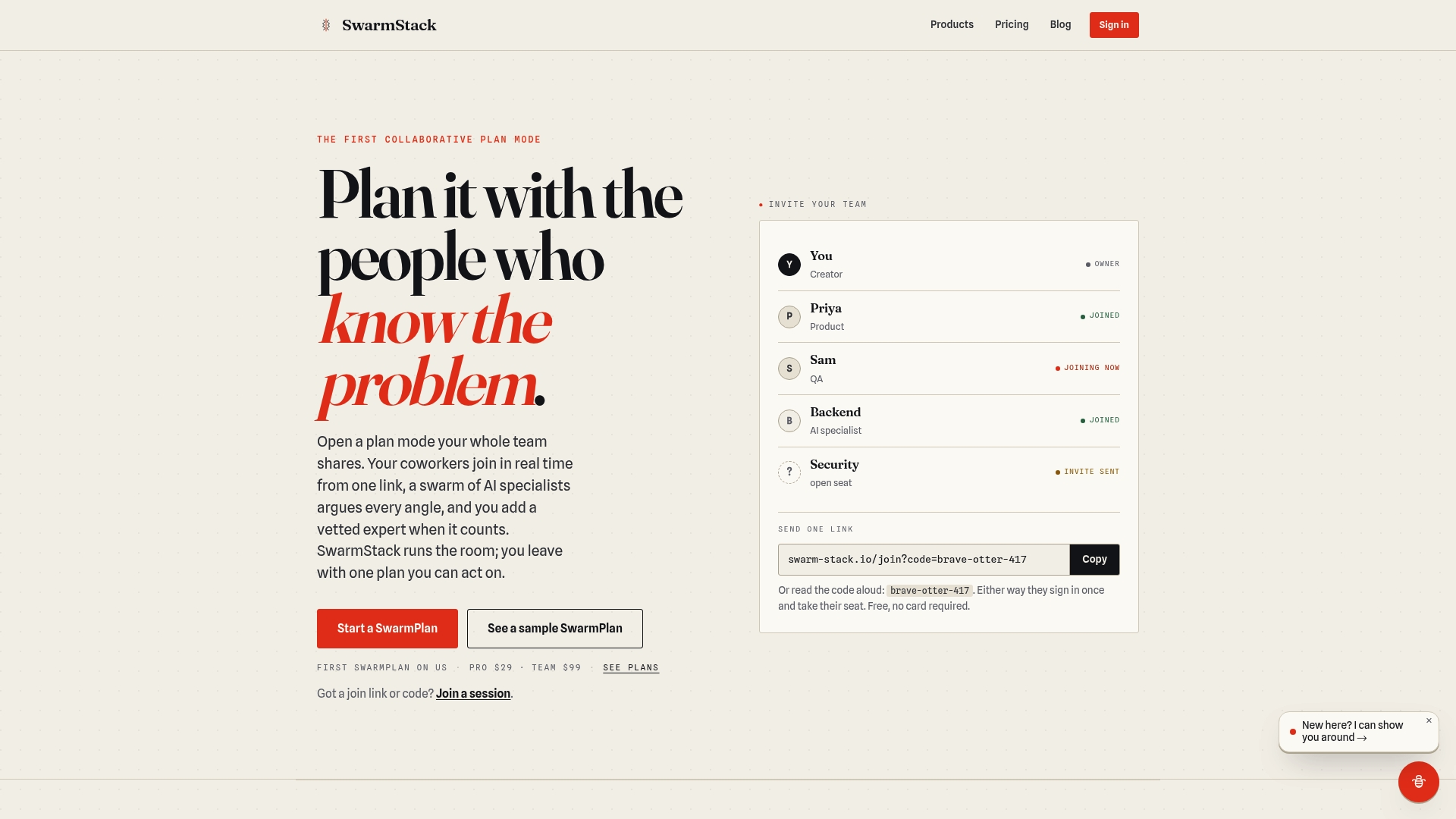
Teams use SwarmStack's invite-link sessions to turn a vague hiring mandate into a scoped RFP or decision memo in a single working session, then export the result straight to Jira or GitHub for the team to pick up. If you're weighing whether to hire an external SME at all, run the brief through SwarmStack first. Check SwarmStack's pricing and start your first session this week.
Sources
- What Is a Subject Matter Expert? A Career Guide | Coursera
- Isixsigma
- Find the Right Subject Matter Experts 96% Faster with AI | The Pedowitz Group
- Subject-Matter-Expert Consultant Salary | ZipRecruiter