3 Quick Checks to Choose RFP vs RFQ, With Sector Rules and AI Drafting
Three checks to choose RFP, RFQ, or RFI. Practical sector rules for construction, IT, and federal buying, and how collaborative AI shortens RFP drafting.

Use an RFQ when your specs are locked and price is the deciding factor. Use an RFP when you need vendors to design a solution and their approach, capability, and cost all matter together. If your requirements are still fuzzy, run a short RFI first to shape the market before you write either one.
TL;DR:
- An RFQ is best when specifications are finalized, price is the only criterion, and responses can be evaluated quickly based on compliance and cost.
- An RFP is suitable when vendor approach, technical capability, and past performance are important alongside price, requiring a longer, scored evaluation process.
- An RFI helps gather market information before formally issuing RFQs or RFPs, especially when requirements are still unclear or being shaped.
- For complex, custom, or design-dependent projects, collaboratively drafting the RFP with AI tools and stakeholder input reduces scope creep and clarifies requirements.
- Choosing the right instrument depends on whether specs are locked, vendor approach matters, and if price alone determines the winner.
Table of Contents
- RFP vs RFQ: The Quick-Glance Comparison
- What Is an RFP and What Goes Into One?
- What Is an RFQ and When Should You Use One?
- How Do You Decide Between RFI, RFQ, and RFP?
- Building the Document: Templates, Requirements, and Scoring
- How Sector Norms Change the RFI, RFQ, RFP Playbook
- How Collaborative AI Workflows Tighten Up RFP Drafting
- A Procurement Lead's Take on Picking the Right Instrument
- Where SwarmStack Fits Into Your RFP Process
- Where to Go for Official Guidance
- Sources
RFP vs RFQ: The Quick-Glance Comparison
The fastest way to tell these two apart is to ask what you're actually buying: a known thing at the best price, or a solution you haven't fully designed yet.
- Purpose: RFQ gets you comparable pricing on defined specs; RFP gets you competing approaches to a problem.
- What vendors submit: RFQ responses are pricing sheets and delivery terms; RFP responses are full proposals with methodology, staffing, and cost.
- Typical vendor count: RFQs often go to 3 to 5 known suppliers; RFPs typically go to a shortlist of 3 to 6 vendors after some vetting.
- Response window: RFQs close in days to two weeks; RFPs run four to six weeks to give vendors room to build a real proposal.
- Evaluation emphasis: RFQ scoring is mostly mechanical (does the quote meet spec, what's the price). RFP scoring is weighted across technical merit, past performance, and cost.
Three quick checks tell you which document to write. If your specs are locked, pick RFQ. If you need a vendor to propose a method or design, pick RFP. If price alone decides the winner, RFQ wins by default even for larger purchases.
An RFI belongs before either one when you genuinely don't know what's out there. It's a research step, not a solicitation. According to GSA's guidance on federal contracting terms, an RFI is non-binding and exists purely to gather market information before you commit to a formal RFQ or RFP process.
What Is an RFP and What Goes Into One?
A Request for Proposal asks vendors to explain how they'd deliver an outcome, not just what it costs. That distinction shapes everything else about the document. You're not buying a commodity, you're buying judgment, method, and capability, and the price is one input among several.
A solid RFP has a consistent skeleton. Start with background on your organization and the problem you're solving, so vendors aren't guessing at context. Follow with a statement of work or statement of objectives that describes the outcome you want without dictating exactly how to get there. Add functional and technical requirements, then a section covering compliance, service-level agreements, and security expectations if those apply. Close with a pricing template (so responses are comparable) and the contractual terms you expect vendors to accept or redline.
Evaluation is where RFPs earn their reputation for being slower. Most procurement teams score proposals against a weighted matrix, technical approach might carry 50%, past performance 25%, cost 25%, and so on. That weighting matters because it tells vendors, and your own evaluators, what actually decides the winner. TechTarget's comparison of RFI, RFP, and RFQ processes notes that RFP evaluation commonly weighs technical approach and past performance alongside price, rather than letting the lowest number win outright.
When two or three finalists are close, many teams run a Best and Final Offer (BAFO) round, giving top vendors one more chance to sharpen their pricing or scope before a final decision. It's a useful pressure valve that avoids picking a winner off an initial round that might not reflect a vendor's real flexibility.
Budget your timeline accordingly. A typical RFP response window runs four to six weeks, and internal evaluation across a cross-functional team can eat 60 to 80 hours once you count scoring, reference calls, and negotiation prep. If you don't have a team that can commit that time, an RFP is the wrong tool for a purchase you need closed next week.
What Is an RFQ and When Should You Use One?
A Request for Quote is a pricing event, plain and simple. You already know exactly what you need, down to specs and quantities, and you're asking vendors to tell you what it costs and when they can deliver. Ivalua's breakdown of procurement request types frames the RFQ as the right instrument once the buyer already knows precisely what they want and just needs pricing and delivery terms attached to it.
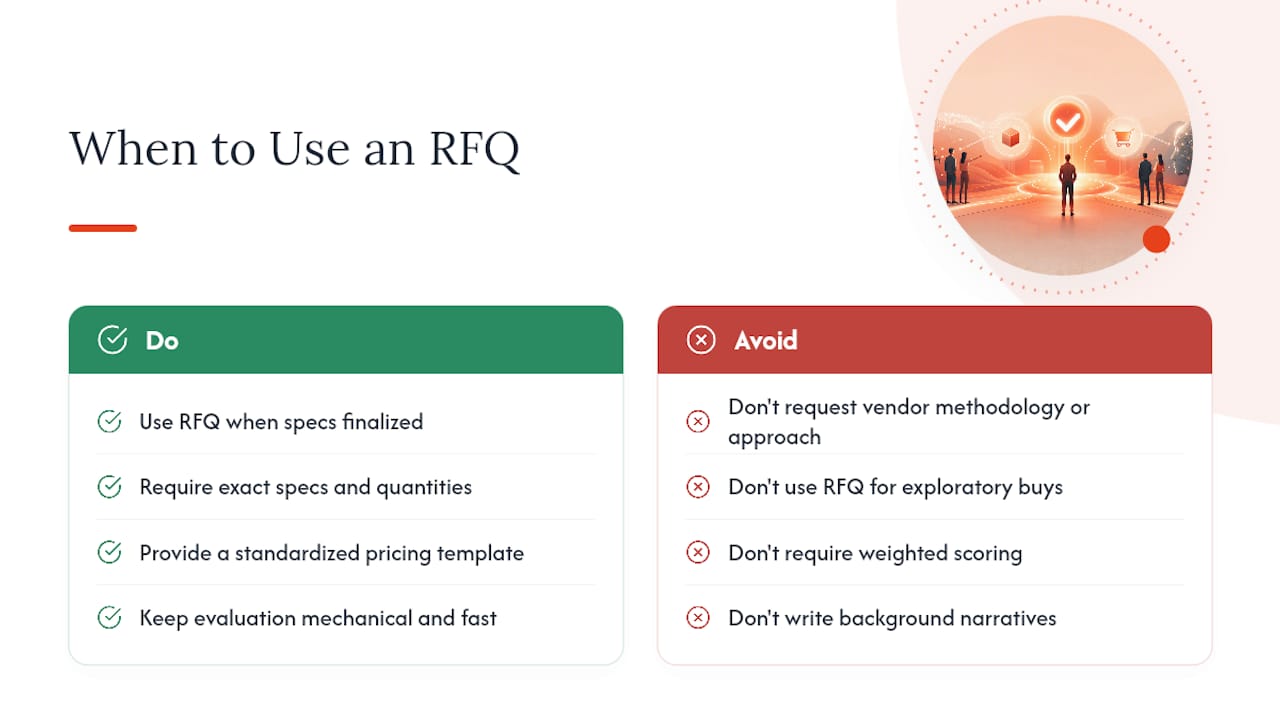
The contents reflect that simplicity. You need exact specifications (part numbers, materials, quantities), delivery and acceptance terms, a standardized pricing template so quotes line up column for column, and basic commercial conditions like payment terms and warranty. There's no need for a narrative about methodology, because you're not asking vendors to solve anything. You're asking them to price a known thing.
Evaluation is mechanical by design. Did the quote meet every spec line? Is the price competitive? Can the vendor hit your delivery window? Does the supplier pass basic qualification checks like insurance or certifications? None of that requires a weighted scoring committee. A procurement lead or a small team can usually turn around an RFQ evaluation in a single sitting.
That speed is the entire point. RFQ response windows typically run from a few days to two weeks, which makes RFQs the right call for repeat purchases, standard equipment, raw materials, or anything where switching suppliers wouldn't change the outcome. If you find yourself writing a background narrative or asking vendors "how would you approach this," you've drifted into RFP territory and the RFQ format is fighting you.
How Do You Decide Between RFI, RFQ, and RFP?
Run three questions before you draft anything, and the right instrument usually becomes obvious.
- Are the specs finalized? If yes, and there's nothing left to design, you're in RFQ territory. If specs are still fuzzy or the "right" approach is genuinely unclear, you need an RFP, or an RFI first.
- Does vendor approach or innovation matter? If how the work gets done affects the outcome (a software build, a marketing strategy, a design-build project), that's an RFP question. If any qualified vendor would deliver the same result, it's an RFQ question.
- Is price the deciding factor? If the lowest compliant bid should win, write an RFQ. If price is one factor among several, technical fit, team quality, delivery risk, write an RFP with weighted scoring.
A couple of rules of thumb save time here. Skip the RFI when you're repurchasing something you've bought before from a known supplier pool; you already have the market intelligence. Skip the RFP entirely when you're buying a commodity where vendor differentiation is essentially zero, running a full proposal process on office supplies or standard hardware wastes everyone's time.
When you do need an RFI, keep it lean. Send it to a broad set of potential vendors, more than you'd invite to an RFP, since the goal is market mapping, not selection. Prokuria's guidance on choosing between RFI and RFP recommends a sequence for complex categories: RFI to map the market, vendor demos to validate fit, then a focused RFP sent only to the vendors who cleared that first filter. That sequencing keeps your RFP list tight and your evaluation load manageable. RFI responses should feed directly into how you write requirements, if half your respondents flag the same gap in your draft scope, fix it before the RFP goes out, not after.
One governance note worth flagging: none of this works without the right people in the room early. Skipping stakeholder involvement, or issuing a solicitation before requirements are actually settled, is a documented failure mode. Ivalua's procurement analysis warns that issuing an RFP without clarified requirements often produces apples-to-oranges proposals that waste both supplier and internal effort. Get your subject-matter experts committed to reviewing drafts and scoring responses before you send anything.
Building the Document: Templates, Requirements, and Scoring
The structural mistake most teams make is writing RFPs like RFQs, prescriptive checklists instead of outcome descriptions. Fix that at the template level and the rest gets easier.
For an RFP, structure your sections around questions vendors actually need to answer, not just categories to fill in:
- Background and objectives: What problem are you solving, and what does success look like in 12 months?
- Scope of work: What's included, what's explicitly out of scope, and what constraints (budget, timeline, integration points) apply?
- Technical and functional requirements: Written as outcomes ("the system must support 500 concurrent users") rather than implementation details.
- Vendor qualifications: Relevant experience, references, team composition.
- Pricing template: A standardized breakdown so you can compare apples to apples across proposals.
- Evaluation criteria: State your weights up front. Vendors write better proposals when they know what's being scored.
For an RFQ, the template is shorter and far more literal: exact specs and quantities, required delivery dates, a line-item pricing grid, and payment or warranty terms. There's no "tell us your approach" section, because there's no approach to propose.
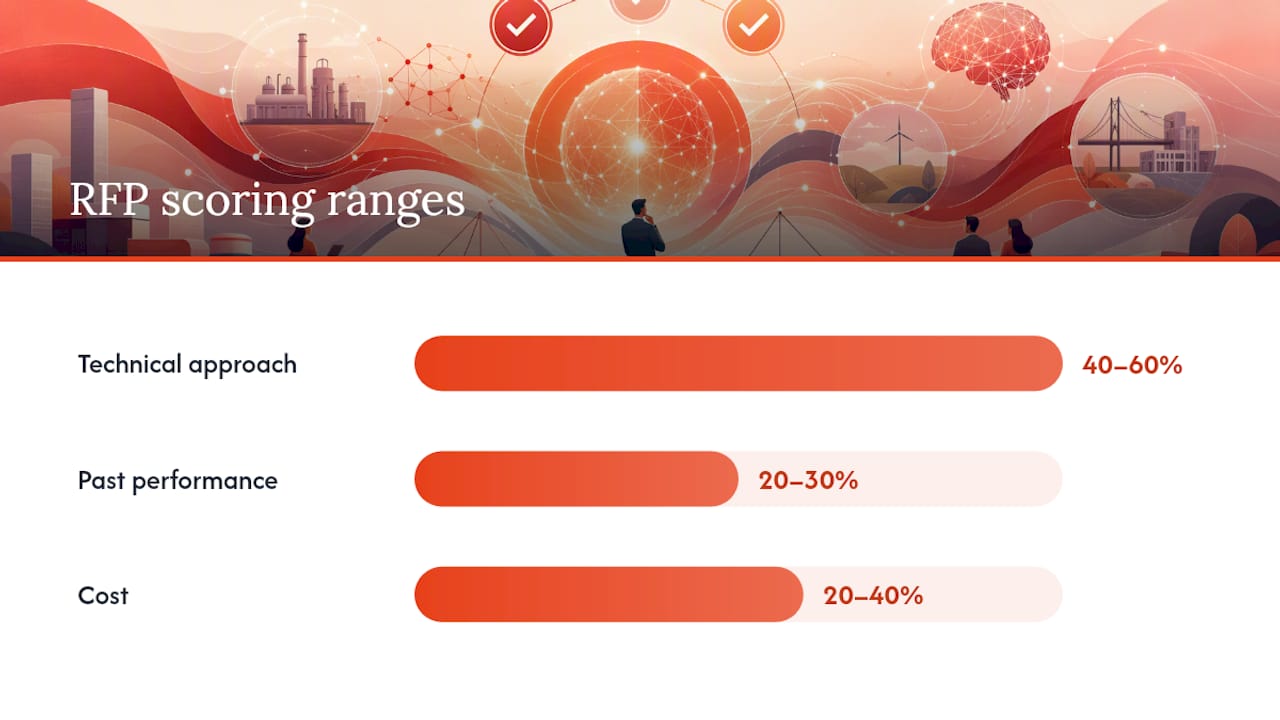
A sample scoring matrix for an RFP might weight technical approach at 40 to 60%, past performance at 20 to 30%, and cost at 20 to 40%, adjusted based on how much risk your project carries. Higher technical weight makes sense for complex builds; higher cost weight makes sense when several vendors are realistically equivalent on capability. Build in disqualification flags too, missing insurance certificates, no response to mandatory security questions, or a bid that doesn't meet a hard budget ceiling should knock a vendor out before you spend hours scoring their proposal.
Pro Tip: Write RFP requirements as outcomes, not instructions. TechTarget's research on RFP evaluation points out that overly prescriptive requirements act as a filter that discourages capable vendors from bidding at all, they either can't match your exact process or assume you've already decided the solution and don't bother competing.
If you want a starting point rather than a blank page, SwarmStack's scope of work template and checklist walks through this section by section, and the collection of website RFP examples from KukooCreative is a useful reference if you're drafting your first one for a digital project.
How Sector Norms Change the RFI, RFQ, RFP Playbook
Construction runs all three instruments in sequence more often than most industries. RFIs handle site conditions and design clarifications mid-project, they're a constant back-and-forth rather than a one-time market scan. RFQs cover standard materials and subcontracted trades where specs are fixed (lumber, concrete, standard fixtures). RFPs get reserved for design-build contracts or complex services where the general contractor's methodology genuinely affects the outcome. SwarmStack's guide to RFIs in construction covers how project managers handle that RFI volume without losing track of decisions.
IT and software procurement splits cleanly on one question: are you buying something off the shelf, or building something custom? License purchases, standard SaaS subscriptions, and commodity cloud services fit RFQs, the specs are published, and price and terms are what differ between vendors. Custom builds, system integrations, or anything requiring architectural decisions call for an RFP, because vendor approach directly affects whether the thing works.
Federal contracting adds legal thresholds most private buyers never deal with. FAR Part 13 governs simplified acquisition procedures for purchases under set dollar thresholds, which often map to RFQ-style processes, while FAR Part 15 governs contracting by negotiation, the RFP world, with best-value tradeoff evaluation. Agencies frequently use RFIs for market shaping before either one, partly to satisfy small-business outreach requirements baked into federal procurement policy.
How Collaborative AI Workflows Tighten Up RFP Drafting
The biggest failure point in RFP writing isn't the template, it's misalignment between the people who understand the requirement and the people writing it down. That gap is where scope creep, vague SOWs, and confusing vendor questions all originate.
This gap can be tackled with structured, real-time sessions where teams invite coworkers via a single link and draft a plan or RFP together, with AI specialists and human experts contributing input side by side. The workflow produces a few concrete advantages over a single person drafting in isolation:
- Clearer statements of work, since multiple stakeholders argue out ambiguous requirements before the document goes to vendors.
- Fewer revision cycles, because disagreements surface during drafting instead of after vendors submit confused proposals.
- Built-in decision tracking, so anyone reviewing the final RFP can see why a requirement was written the way it was.
For teams researching the AI angle further, SwarmStack's guide to using AI in RFP drafting covers the mechanics in more depth.
A Procurement Lead's Take on Picking the Right Instrument
Most teams overthink this decision. If your specs are locked and price decides the winner, write the RFQ and move on, agonizing over process here just delays a purchase that doesn't need debate. If you're still unsure what "good" looks like, run a short RFI before anything else. Get your subject-matter experts in the room during drafting, not during review, misaligned requirements cost far more time than a slower start ever does.
— Cody
Where SwarmStack Fits Into Your RFP Process
Writing a strong RFP solo is doable, but the requirements-drafting stage is exactly where misalignment creeps in, one stakeholder assumes a technical constraint, another assumes a budget ceiling, and nobody catches the gap until vendor questions start rolling in confused. SwarmStack was built around that specific failure point: real-time sessions where your team, plus AI specialists and human experts from its integrated marketplace, argue out the scope together before it ever reaches a vendor.
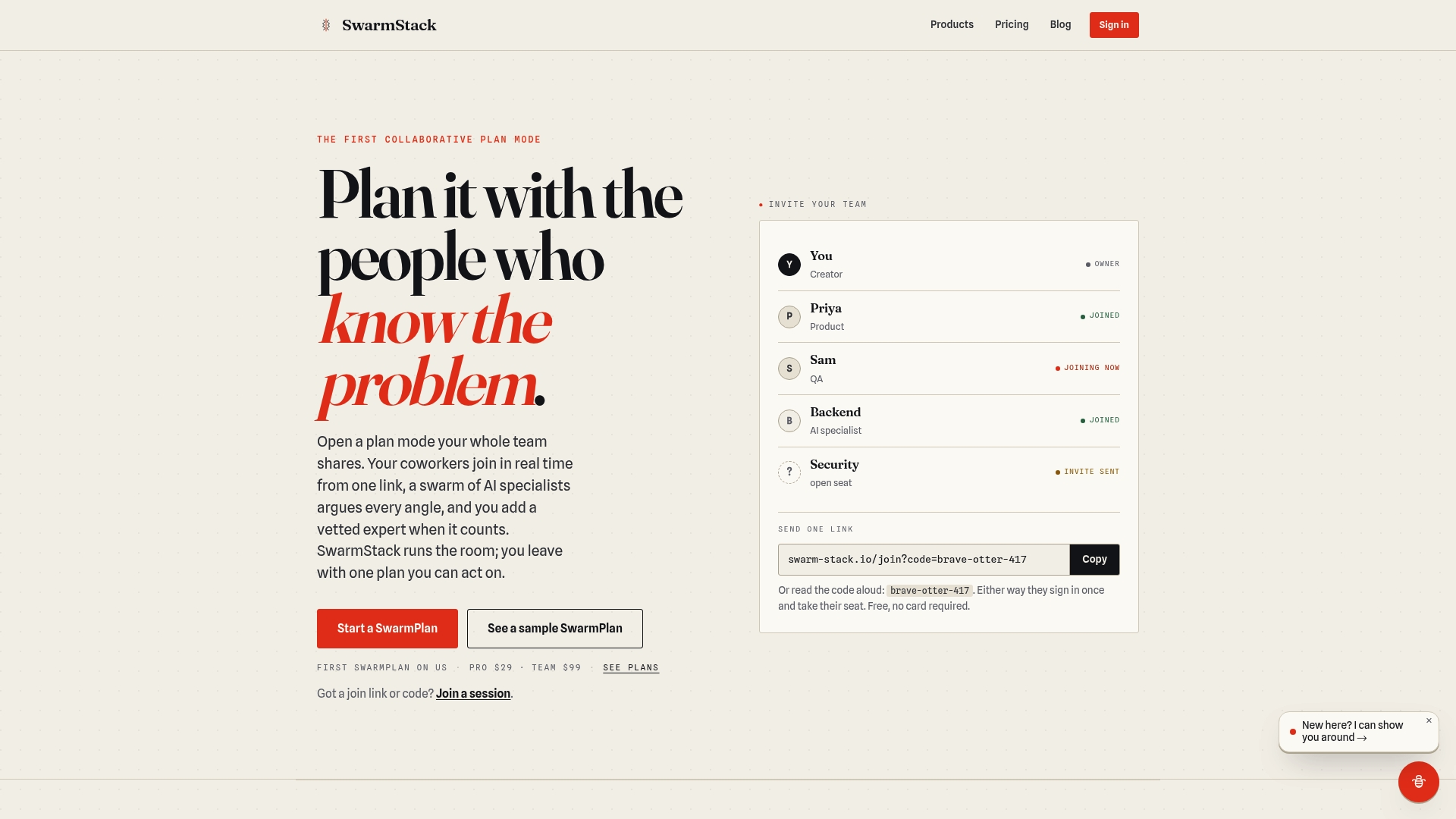
Teams can invite coworkers with a single link, work through structured interviews on objectives and constraints, and get a versioned deliverable that tracks how each decision was made, which can be exported directly into tools like GitHub or Jira. That's a meaningfully different starting point than a blank document and a Friday deadline. If your next purchase is complex enough to need a real RFP rather than a quick RFQ, start a session on SwarmStack and see what a jointly drafted scope of work looks like before you send anything to vendors.
Where to Go for Official Guidance
- GSA's overview of RFIs, RFQs, and RFPs for federal contracting terminology and process basics.
- Acquisition for FAR text covering simplified acquisition thresholds and negotiated contracting rules.
- TechTarget's RFI vs. RFP vs. RFQ breakdown for evaluation criteria and requirement-writing guidance.
- Prokuria's procurement request comparison for sequencing advice on complex sourcing decisions.
Sources
- Understand common federal contracting terms: RFIs, RFQs, and RFPs · GSA
- RFI, RFP, RFQ: Key Differences & Strategic Use Cases in Procurement · Ivalua